
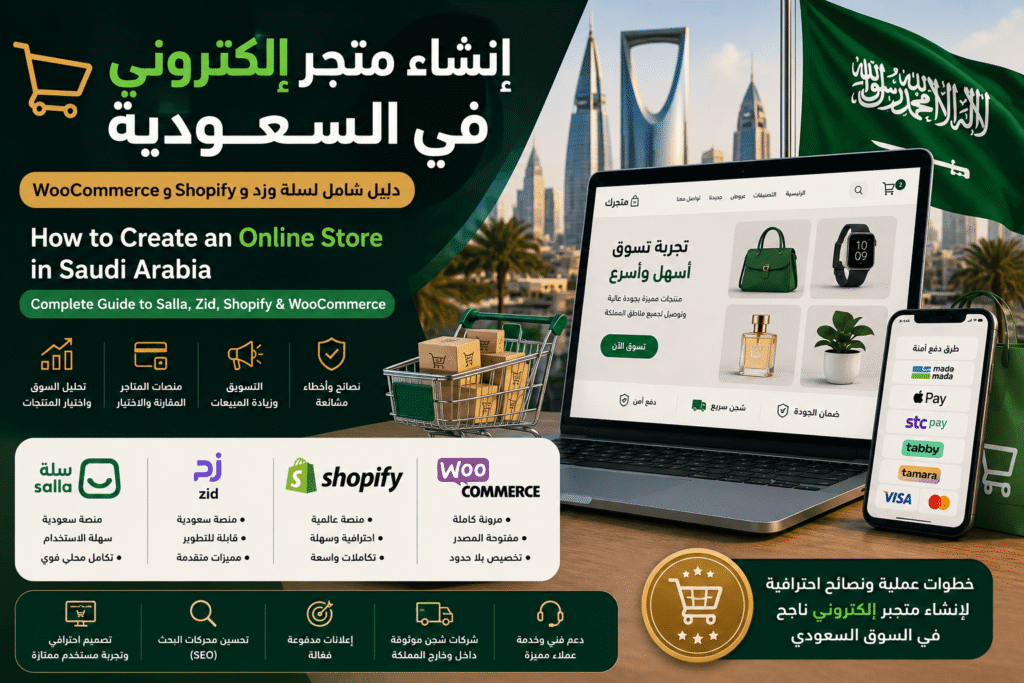
Introduction: E-Commerce in Saudi Arabia
Saudi Arabia has witnessed tremendous growth in the e-commerce sector in recent years, becoming one of the fastest-growing digital markets in the Middle East and North Africa (MENA) region. According to reports from Statista, the Saudi e-commerce market has surpassed $12 billion in value, with projections indicating it will exceed $20 billion by 2025. This accelerated growth opens vast opportunities for entrepreneurs and companies looking to create an online store and expand their business digitally.
Vision 2030, launched by His Royal Highness Prince Mohammed bin Salman, serves as the primary driver of this growth, with a strong emphasis on digital transformation and developing the Kingdom’s business environment. The widespread use of smartphones and internet penetration exceeding 95% of the population makes Saudi Arabia a fertile environment for successful online stores.
Quick Comparison Table: Best E-Commerce Platforms in Saudi Arabia
Before diving into the details, here’s a quick reference table to help you decide right away:
| Platform | Monthly Price | Ease of Use | SEO | Best For |
|---|---|---|---|---|
| Salla | From SAR 117 | ⭐⭐⭐⭐⭐ | ⭐⭐⭐⭐ | Beginners & Local Market |
| Zid | From SAR 199 | ⭐⭐⭐⭐ | ⭐⭐⭐⭐ | Medium Saudi Companies |
| Shopify | From SAR 99 | ⭐⭐⭐⭐⭐ | ⭐⭐⭐⭐ | Global Expansion |
| WooCommerce | Free + Hosting | ⭐⭐⭐ | ⭐⭐⭐⭐⭐ | Professional Sites & Advanced SEO |
Why Launch Your Online Store Now?
Before diving into the details of e-commerce platforms, let’s review the key reasons why now is the perfect time to launch your online store in Saudi Arabia:
- Strong Government Support: The Small and Medium Enterprises General Authority (Monsha’at) provides comprehensive support to digital entrepreneurs including training, financing, and regulatory facilitations.
- Advanced Infrastructure: High-speed internet networks and the widespread adoption of electronic payment services like Mada, STC Pay, and Apple Pay facilitate seamless business transactions.
- Digital Consumer Behavior: Over 70% of Saudis shop online regularly, one of the highest rates globally.
- Specialized Platforms for the Saudi Market: Platforms like Salla and Zid, specifically designed for the local market, simplify store creation and management.
- Growing Logistics Sector: Expansion of shipping and delivery companies like Aramex, SMSA, and HungerStation ensures product delivery anywhere in the Kingdom.
Salla Platform: The First Choice for Saudi Merchants
Salla is the leading and most popular e-commerce platform in Saudi Arabia and the Arab region. Founded in 2016, it has grown to be trusted by over 50,000 merchants for managing their online stores. Salla’s strength lies in being specifically designed for the Saudi and Arab market, making it the optimal choice for small and medium-sized business owners looking to establish their digital presence quickly.
Salla Platform Advantages
- Full Arabic Interface: Complete Arabic language support across all aspects of the store, from product management and orders to customer interactions.
- Saudi Payment Gateways: Full integration with all local payment gateways including Mada, STC Pay, Tamara, Zain Cash, and Ajzaa.
- WhatsApp Commerce Support: A unique feature that allows completing purchases directly through WhatsApp.
- Mobile Application: Salla’s store app allows customers to browse and purchase easily from their smartphones.
- Integrated Shipping System: Integration with local and international shipping companies with order tracking capabilities.
- Reasonable Pricing Plans: Plans starting from SAR 117/month with a free trial available.
Zid Platform: E-Commerce for Enterprises and Companies
Zid is a comprehensive Saudi e-commerce platform founded in 2017, primarily targeting medium and large companies seeking to build a distinguished shopping experience. Zid is characterized by its high flexibility and ability to adapt to the diverse needs of various stores, whether selling physical products, digital goods, or services.
What Sets Zid Apart
- Smart Pricing Rules: Ability to create complex offers and discounts and manage prices in an advanced manner.
- Inventory Management: Sophisticated inventory management system supporting multiple warehouses and quantity tracking.
- International Expansion: Support for multiple currencies and languages to facilitate expansion beyond the Saudi market.
- Advanced Analytics: Comprehensive analytical dashboard that enables understanding customer behavior and improving store performance.
- Advanced APIs: Ability to integrate with ERP, CRM, and various accounting systems.
- Mobile Apps for Merchants and Customers: Complete mobile shopping experience for both parties.
Shopify: The Global E-Commerce Platform
Shopify is the world’s leading e-commerce platform, founded in 2006 in Canada and now serving over 2 million merchants worldwide. Although not of Arab origin, it fully supports Arabic language and Saudi Riyal, and provides integrations with local payment gateways, making it an excellent choice for Saudi companies targeting both local and global markets simultaneously.
Why Choose Shopify for Your Saudi Store?
- Massive Ecosystem: Over 8,000 apps and plugins in the Shopify App Store to enhance your store’s functionality.
- Shopify Payments: A built-in payment gateway that reduces transaction costs and simplifies the payment process.
- Professional Themes: Hundreds of free and paid themes designed to achieve the highest conversion rates.
- Multi-Channel Selling: Sell your products through your website, Instagram, Facebook, TikTok, and Google Shopping from a single dashboard.
- Shopify Plus for Enterprises: A dedicated solution for large companies with premium support and unlimited customization capabilities.
- Amazon Integration: Directly connect your store to Amazon Saudi Arabia to reach millions of additional shoppers.
WooCommerce: Complete Freedom with WordPress
WooCommerce is the most popular plugin for transforming WordPress websites into comprehensive online stores. It is estimated that WooCommerce powers over 28% of all online stores worldwide, making it by far the most used option globally. For Saudi businesses, WooCommerce provides exceptional flexibility and complete control over every aspect of the online store, making it an ideal choice for technically capable teams.
WooCommerce Advantages for the Saudi Market
- Free and Open Source: You can start for free, with complete control over your store’s data and hosting platform.
- Unlimited Customization: Thousands of themes and plugins allow you to customize your store exactly to your needs.
- Excellent Arabic Support: Plugins like PayTabs, HyperPay, and Myfatoorah enable acceptance of all Saudi payment methods.
- Superior SEO Optimization: Combining WooCommerce with WordPress provides the best search engine optimization capabilities compared to any other platform.
- Local Integrations: Integration with FATOORAH for e-invoicing and ZATCA systems to ensure tax compliance in Saudi Arabia.
- Massive Community: Millions of developers and experts worldwide available for consultation on store development.
Comprehensive Comparison: Which Platform Should You Choose?
There is no single correct answer to the question “Which is the best e-commerce platform?” as the answer depends heavily on your needs, budget, and business goals. Here is a concise guide to help you decide:
- Choose Salla if: You exclusively target the Saudi or Gulf market, want to launch your store quickly without technical complexities, and sell small to medium quantities of products.
- Choose Zid if: Your company is medium to large-sized, requires complex inventory management and advanced pricing systems, with expectations of growth and expansion.
- Choose Shopify if: You target international markets in addition to the local market, want a comprehensive turnkey solution with extensive flexibility and global integrations.
- Choose WooCommerce if: You already own a WordPress website, want complete control over code and data, or need very advanced customizations with a capable technical team to implement them.
Steps to Create a Successful Online Store in Saudi Arabia
Regardless of the platform you choose, there are essential steps to follow to ensure the success of your online store:
1. Business Registration
The first step is officially registering your business through the Saudi Ministry of Commerce. You can register as a sole proprietorship or a limited liability company depending on your project size. You must also register with the Zakat, Tax and Customs Authority (ZATCA) to obtain a tax number and comply with the 15% VAT requirements.
2. Product Selection and Supplier Sourcing
Before launching your store, identify the products you’ll sell and find reliable suppliers. You can use platforms like Alibaba for imports, or search for local suppliers through the Saudi Chambers of Commerce. Conducting early feasibility studies will save you significant time and money.
3. Store Design and User Experience
First impressions are critically important in e-commerce. Invest in a professional and user-friendly interface design. Ensure your store operates efficiently on smartphones, as the percentage of mobile shopping in Saudi Arabia has exceeded 70% of total e-commerce sales.
4. Setting Up Electronic Payment Gateways
A successful online store is incomplete without reliable and diverse payment gateways. The key payment methods that must be supported in the Saudi market include: Mada (local bank cards), STC Pay, Tamara for installments, Apple Pay and Google Pay, and international credit cards through PayTabs or Moyasar.
5. Digital Marketing Strategy
Success in e-commerce is incomplete without an effective digital marketing strategy. Focus on the following key areas:
- Search Engine Optimization (SEO): Improve your store’s visibility in Google search results for keywords related to your products.
- Paid Advertising: Use Google Ads and Meta advertising to target customers interested in your products.
- Influencer Marketing: Collaborate with Saudi influencers on Instagram and TikTok to raise brand awareness.
- Email Marketing: Build a mailing list and send regular offers and updates to your customers.
- Excellent Customer Service: Provide support via WhatsApp and live chat to build trust and improve conversion rates.
Legal and Regulatory Aspects of E-Commerce in Saudi Arabia
E-commerce in the Kingdom operates under a clear regulatory framework overseen by the Ministry of Commerce through the National E-Commerce Portal. Regulations require that every online store clearly display information about the seller, return and exchange policies, and contact methods. The Consumer Protection Law also obligates merchants to comply with specific standards in handling complaints and ensuring product quality.
The Future of E-Commerce in Saudi Arabia
The future of e-commerce in Saudi Arabia looks exceptionally bright. With continued development of digital infrastructure and growing trust in online shopping, we expect to see further innovations in areas such as AI-powered shopping, Social Commerce, Quick Commerce, and augmented reality experiences for trying products before purchasing them.
Saudi Arabia is also working to develop an integrated logistics infrastructure including smart warehouses and delivery drones, which will revolutionize delivery speed and costs. Within the framework of Vision 2030 initiatives, the Kingdom aims to be among the world’s largest e-commerce economies by 2030.
Best E-Commerce Platform in Saudi Arabia 2026
This is the question everyone is asking in 2026, and the honest answer is: there’s no single platform that suits everyone, but there is a perfect platform for each situation. Here’s the direct recommendation:
- 🟢 If you’re a beginner or selling local/handmade products → Choose Salla: The fastest to launch, the easiest to manage, and the most suitable for the Saudi market. You can create your store in under an hour.
- 🔵 If you’re a medium or large Saudi company → Choose Zid: The strongest for inventory management and enterprise integrations, with professional support tailored for businesses.
- 🟡 If you’re targeting global markets → Choose Shopify: The best global ecosystem with unlimited integrations and the ability to sell in any market worldwide.
- 🟣 If you want full control and advanced SEO → Choose WooCommerce: The ideal choice for professional websites that rely on search engines as the primary source of traffic.
2026 Note: In the increasingly competitive landscape, Salla has launched major updates making it more capable of competing even at the enterprise level, while Zid is expanding into Gulf markets. The deciding factor ultimately comes down to your business scale and ambitions.
Cost of Creating an Online Store in Saudi Arabia 2026
One of the most-searched questions on Google: “How much does it cost to create an online store in Saudi Arabia?” The answer depends on the platform and your needs, but here’s a comprehensive estimate to help you plan:
Fixed Costs (Common Across All Platforms)
| Element | Annual Cost (SAR) | Notes |
|---|---|---|
| Domain Name | 50 – 150 SAR | Via GoDaddy, Namecheap, or SaudiNIC |
| Hosting (for WooCommerce) | 300 – 1,500 SAR | Not required for Salla, Zid, or Shopify |
| SSL Certificate | Free – 500 SAR | Built-in on most platforms |
| Design & Themes | 0 – 5,000 SAR | Free themes available on all platforms |
| Basic Digital Marketing | 500 – 3,000 SAR/month | Depends on budget and competition |
Cost by Platform
| Platform | Monthly Cost | Estimated Annual Cost | Includes |
|---|---|---|---|
| Salla | 117 – 399 SAR | 1,400 – 5,000 SAR | Hosting + Support + Core Apps |
| Zid | 199 – 599 SAR | 2,400 – 7,200 SAR | Hosting + Support + Advanced Integrations |
| Shopify | 99 – 399 SAR | 1,200 – 5,000 SAR | Hosting + Support + Some Apps |
| WooCommerce | 25 – 150 SAR (hosting) | 300 – 5,000 SAR | Hosting only; other components are separate |
💡 Tip: Start with a basic plan and scale as your sales grow. Don’t overspend on advanced design early on — content and marketing matter more than aesthetics in the early stages. If you need to understand your tax obligations as an e-commerce merchant, check out our comprehensive guide on VAT in Saudi Arabia. You can also use our free VAT Calculator to quickly calculate your tax obligations.
Frequently Asked Questions: Online Stores in Saudi Arabia
Is Salla Better Than Shopify?
It depends on your goal. Salla is better if you exclusively target the Saudi and Gulf market, as it’s specifically designed for it with full Arabic language support and local payment gateways. Shopify is better if you plan to expand internationally or need integrations with global tools. For a Saudi beginner, Salla is the fastest and easiest starting point.
Is WooCommerce Completely Free?
The core WooCommerce plugin is free, but you’ll need: hosting (SAR 25–150/month), a domain (SAR 50–150/year), and possibly paid themes and plugins to enhance your store. Generally, WooCommerce is the most cost-effective long-term option for large sites, but it requires more time and technical expertise than ready-made platforms.
How Much Does It Cost to Create an Online Store in Saudi Arabia?
Costs range from SAR 1,400 per year for simple stores on Salla or Shopify, up to more than SAR 20,000 for advanced stores requiring custom design and complex integrations. The good news: you can start with a very limited budget and expand your investment as your sales grow.
Do I Need a Commercial Registration for an Online Store in Saudi Arabia?
Yes, a commercial registration is required to legally operate an online store in the Kingdom. You can register a sole proprietorship through the Ministry of Commerce for a nominal fee. You must also register with ZATCA for VAT purposes if your activity exceeds the minimum registration threshold. Also check out our guide on best accounting software in Saudi Arabia 2026 to manage your store finances.
What is the Best Payment Gateway for Saudi Stores?
For Saudi stores, support Mada (essential), STC Pay (most popular among youth), Tamara or Tabby (for installments to boost conversion rates), and Apple Pay (for Apple device users). For advanced API integrations, PayTabs and Moyasar are the best technically in the Saudi market.
What is the Best Shipping Company for E-Commerce in Saudi Arabia?
It depends on your volume and location. For emerging stores, Aramex and SMSA are the most reliable. L-Express and Fetchr offer competitive pricing for large volumes. Naqel stands out for its comprehensive geographic coverage within the Kingdom. Most e-commerce platforms (Salla and Zid especially) provide direct integrations with these companies to simplify shipping and order tracking.
Are Salla and Zid Compliant with ZATCA E-Invoicing Requirements?
Yes, both platforms support the e-invoicing (Fatoora) requirements imposed by ZATCA. Salla and Zid provide invoicing systems compliant with Phase 2 (integration phase) of ZATCA’s requirements. Make sure to activate this feature in your store settings to avoid any tax violations.
Conclusion
Creating an online store in Saudi Arabia today represents a golden opportunity that should not be missed. Whether you choose Salla for its simplicity and local market fit, Zid for its flexibility and enterprise capabilities, Shopify for reaching global markets, or WooCommerce for complete control and technical freedom — the important thing is to start, learn, and grow. The market is waiting, and the Saudi consumer is ready to buy. All that remains is for you to build your store and deliver what they need!
For more information about entrepreneurship and commerce in Saudi Arabia, follow our website We Are Saudi — covering the latest news in business, technology, and life in the Kingdom of Saudi Arabia.