
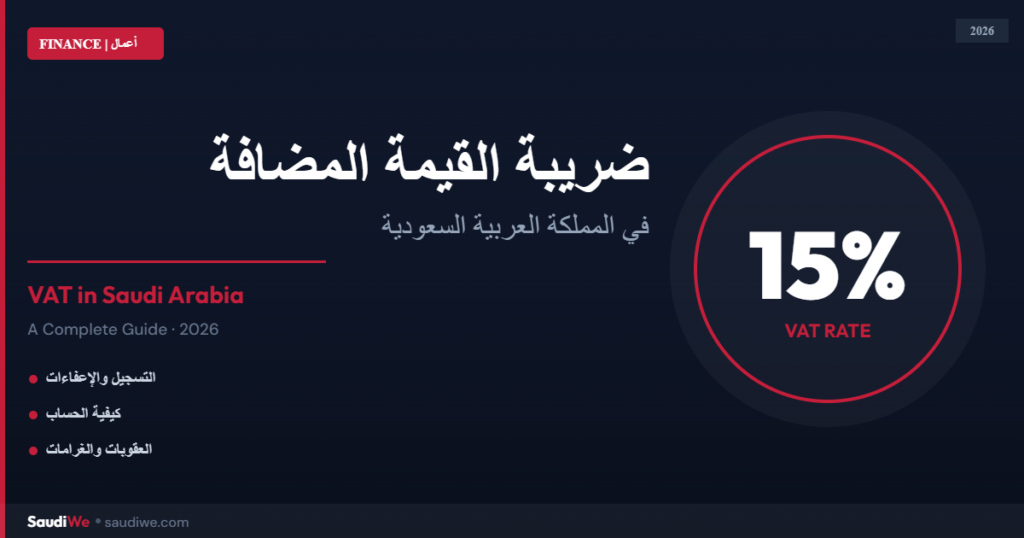
Value Added Tax (VAT) is an indirect tax applied to most goods and services consumed in Saudi Arabia. As one of the most significant economic reforms under Vision 2030, VAT was first introduced in January 2018 and is currently applied at a rate of 15% since July 2020. Understanding VAT is essential for businesses, consumers, and investors operating in the Kingdom.
What is Value Added Tax (VAT)?
VAT is a consumption tax levied at each stage of the production and distribution chain, from manufacturer to retailer to end consumer. Unlike traditional sales tax, which is charged only once at the point of sale, VAT is collected incrementally at every stage where value is added to the product or service. Ultimately, it is the final consumer who bears the full cost of the tax.
In Saudi Arabia, VAT is administered by the Zakat, Tax and Customs Authority (ZATCA), the official government body responsible for all tax and customs regulations in the Kingdom.
History of VAT Implementation in Saudi Arabia
Saudi Arabia introduced VAT on January 1, 2018, at an initial rate of 5%, alongside the other Gulf Cooperation Council (GCC) member states. In response to the economic challenges posed by the COVID-19 pandemic and declining global oil prices, the Saudi government raised the VAT rate to 15% effective July 1, 2020. This decision was part of a broader fiscal reform package aimed at diversifying government revenue and ensuring long-term economic sustainability under Vision 2030.
Who Must Register for VAT?
Both individuals and legal entities engaged in economic activities must register for VAT if their taxable revenue meets certain thresholds. Mandatory registration is required when taxable revenues exceed SAR 375,000 in the preceding 12 months or if projected revenues are expected to exceed this threshold. Voluntary registration is available for businesses whose revenues exceed SAR 187,500 but have not yet reached the mandatory threshold.
Non-resident suppliers providing taxable goods or services in Saudi Arabia are also required to register, regardless of their revenue level. For detailed registration requirements, visit the official ZATCA VAT page.
Taxable and Exempt Supplies
VAT in Saudi Arabia applies to a broad range of goods and services, categorized as follows:
- Standard-rated (15%): Most commercial goods and services, consulting services, electronics, clothing, restaurants, hotels, and entertainment.
- Zero-rated (0%): Exported goods and services, international transportation, certain medical equipment, and residential water and electricity supplies.
- VAT-exempt: Healthcare services, educational services, certain financial services, residential real estate transactions, and local passenger transportation.
The zero-rated category allows businesses to recover input tax, whereas exempt supplies do not allow for input tax recovery. This distinction is crucial for businesses making both taxable and exempt supplies.
How to Calculate VAT in Saudi Arabia
Calculating Saudi Arabian VAT is straightforward once you understand the basic formulas:
Adding VAT to a price: VAT-inclusive price = Original price × 1.15. For example, a product priced at SAR 100 would cost SAR 115 including VAT (SAR 15 in tax).
Extracting VAT from an inclusive price: VAT amount = Inclusive price ÷ 1.15 × 0.15. For example, from a SAR 115 inclusive price: SAR 115 ÷ 1.15 × 0.15 = SAR 15 in VAT.
For quick and accurate VAT calculations, use the SaudiWe VAT Calculator — our free tool helps you add or remove VAT from any amount in seconds.
Obligations of VAT-Registered Businesses
Once registered, businesses must comply with several key obligations:
- Issue tax invoices: Every taxable supply must be accompanied by a compliant tax invoice showing the VAT registration number and the tax amount.
- File periodic VAT returns: Returns are submitted monthly or quarterly, depending on the business’s annual taxable turnover.
- Maintain accounting records: All relevant documents must be retained for a minimum of six years.
- Pay VAT on time: Late payment results in financial penalties of up to 5% of the outstanding tax amount.
E-Invoicing (Fatoora) System
ZATCA launched the mandatory e-invoicing system, known as “Fatoora,” in two phases. Phase 1, implemented in December 2021, required all VAT-registered businesses to generate electronic invoices. Phase 2, which began rolling out in January 2023, introduced integration requirements whereby businesses must connect their invoicing systems directly with ZATCA’s platform in real-time. This initiative aims to combat tax evasion and enhance financial transparency. Learn more at the official Fatoora e-invoicing page.
VAT Penalties and Fines
ZATCA enforces strict penalties for non-compliance, including:
- Failure to register: Up to SAR 10,000.
- Late filing of VAT returns: 5% to 25% of the unpaid tax amount.
- Tax evasion: Up to three times the unpaid tax amount, and potentially imprisonment.
- Non-compliance with e-invoicing requirements: Starting from SAR 1,000 per violation.
Full details on applicable penalties are available in the official VAT regulations published by ZATCA.
VAT Refunds and Recovery
Registered businesses can recover input VAT (the tax they pay on their purchases) by offsetting it against the output VAT (the tax they charge customers). If input VAT exceeds output VAT in a given period, the business can claim a refund from ZATCA. Additionally, qualifying foreign tourists visiting Saudi Arabia may be eligible for VAT refunds on their purchases under the tourist refund scheme, subject to specific conditions and minimum spending thresholds.
VAT and the Saudi Economy
VAT has become a cornerstone of Saudi Arabia’s non-oil revenue strategy. According to official data from the Ministry of Finance, VAT revenues have contributed hundreds of billions of Saudi riyals annually to the national budget. These funds are channeled into major Vision 2030 infrastructure and development projects, including NEOM, the Red Sea Project, and the expansion of healthcare and education sectors. The tax has played a vital role in reducing the Kingdom’s fiscal deficit and strengthening its economic resilience.
Frequently Asked Questions (FAQs)
Are exported goods subject to VAT? No. Exported goods and services are zero-rated, meaning no VAT is charged and the exporter can still recover input tax.
What is the difference between zero-rated and exempt supplies? Zero-rated supplies allow businesses to reclaim input VAT, while exempt supplies do not. This makes zero-rating more beneficial for businesses.
How long does VAT registration take? The registration process through ZATCA’s portal typically takes a few business days once all required documents are submitted.
Do freelancers need to register for VAT? Yes, if their annual taxable income exceeds the mandatory threshold of SAR 375,000, they must register. Voluntary registration is available from SAR 187,500.
Saudi Arabia’s E-Invoicing System (Fatoora): A Complete Guide
The Saudi e-invoicing system, known as Fatoora (فاتورة), is one of the most significant digital initiatives launched by the Zakat, Tax and Customs Authority (ZATCA). Designed to modernize the business environment in Saudi Arabia, Fatoora aims to digitize financial transactions, combat tax evasion, and bring the Kingdom’s tax ecosystem in line with global best practices. It is directly tied to VAT compliance.
What is the Fatoora E-Invoicing System?
Fatoora is a mandatory e-invoicing framework that requires all VAT-registered businesses in Saudi Arabia to generate invoices electronically using ZATCA-compliant systems. Traditional paper invoices and standard PDFs are no longer acceptable as standalone documents. The system enables ZATCA to monitor commercial transactions in near real-time, significantly reducing opportunities for tax fraud and under-reporting.
Two Phases of Fatoora Implementation
Phase 1 – Generation (December 4, 2021): All VAT-registered businesses became required to issue invoices electronically. This phase mandated the use of compliant e-invoicing systems that generate invoices in XML or PDF/A-3 format with an embedded XML component. Each invoice must include a QR code and meet specific technical standards set by ZATCA. Manual, handwritten, and non-compliant point-of-sale systems were prohibited.
Phase 2 – Integration (January 2023 onward): This phase introduces real-time integration between businesses’ invoicing systems and ZATCA’s Fatoora platform. Business-to-business (B2B) tax invoices must be submitted to ZATCA for clearance approval before being sent to the buyer. Business-to-consumer (B2C) simplified invoices must be reported to ZATCA within 24 hours of issuance. Phase 2 is being rolled out in waves based on annual revenue thresholds.
Types of Invoices Under Fatoora
The system distinguishes between two main invoice types. Tax Invoices are used for B2B transactions and require real-time clearance from ZATCA before the invoice is shared with the buyer. They must include the buyer’s VAT registration number and full transaction details. Simplified Tax Invoices are used for B2C transactions with individual consumers. They are reported to ZATCA within 24 hours and do not require pre-clearance, but must still meet all technical specifications including QR codes and cryptographic stamps.
Technical Requirements
Fatoora imposes several mandatory technical requirements on invoicing systems, including: a cryptographic digital signature on every invoice, a QR code containing encoded invoice data, a unique UUID identifier for each invoice, an invoice counter number to ensure continuity, and a cryptographic stamp to prevent data tampering. Systems used must be officially certified by ZATCA. For full technical specifications, refer to the official ZATCA e-invoicing guidelines.
Benefits of Fatoora for Businesses
While transitioning to a fully digital invoicing system may initially seem burdensome, Fatoora delivers tangible operational benefits: faster invoice processing and payment cycles, significant reduction in manual data entry errors, improved auditability and financial record-keeping, lower long-term operational costs compared to paper-based systems, and a cleaner tax compliance profile that simplifies periodic VAT return filing. Businesses that embrace Fatoora early typically experience smoother ZATCA audits and fewer compliance penalties.
Penalties for Non-Compliance
ZATCA enforces strict penalties for businesses that fail to comply with Fatoora requirements. Fines start at SAR 1,000 per violation and can escalate with repeated non-compliance. It is essential to ensure your invoicing solution is ZATCA-certified and kept up to date with any regulatory changes. A list of approved e-invoicing solutions is available on the official Fatoora page.
Conclusion
Value Added Tax in Saudi Arabia is a critical component of the Kingdom’s economic transformation journey. Whether you are a business owner, professional, or consumer, understanding VAT and its implications helps you make informed financial decisions and remain compliant with the law. Always stay updated through the official ZATCA website, and take advantage of helpful digital tools like the SaudiWe VAT Calculator to quickly and accurately calculate your VAT obligations.