
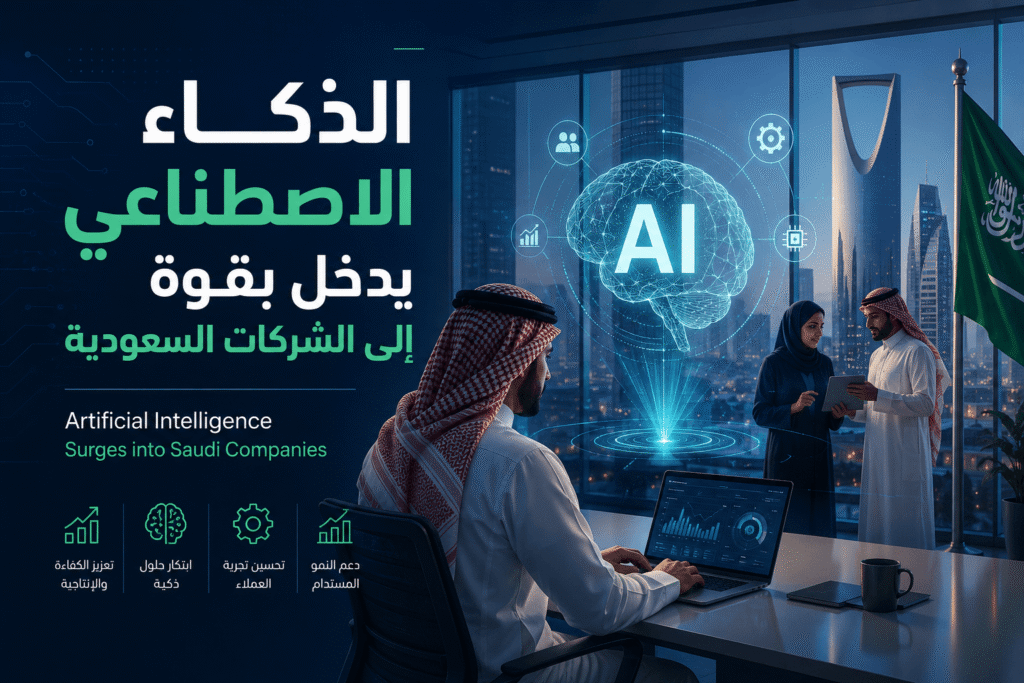
In the midst of rapid digital transformations sweeping the Middle East, the Kingdom of Saudi Arabia stands out as an exceptional model for adopting artificial intelligence technologies across companies and institutions. This is no longer just a future trend — it has become a tangible reality revealed by modern statistics and figures. According to reports from leading global institutions, the Kingdom is making confident strides toward achieving the Vision 2030 targets related to the digital economy and advanced technology.
Numbers Don’t Lie: AI in Saudi Arabia’s Business Sector
McKinsey Global Institute reports indicate that Saudi Arabia is one of the fastest countries in the Middle East to adopt generative AI technologies in the commercial sector, with AI adoption rates among large corporations exceeding 65% in 2024. The IDC Middle East report further revealed that AI spending in the Kingdom reached $2.5 billion in 2024, with projections indicating this figure will triple by 2028.
On the governmental investment front, the Kingdom established the Saudi Data and Artificial Intelligence Authority (SDAIA), which leads the national digital transformation and develops a comprehensive AI infrastructure at the national level. SDAIA is implementing ambitious initiatives including large data platforms, national training programs, and partnerships with leading global technology companies.
Sectors Leading AI Adoption in Saudi Arabia
AI adoption is not evenly distributed across sectors. The following industries are leading the charge in AI utilization across the Kingdom:
1. Financial and Banking Sector
The financial sector is one of the most heavily invested in AI in Saudi Arabia. Major banks like Al Rajhi Bank and Saudi National Bank deploy sophisticated AI systems for fraud detection, personalized banking services, and improving customer experience. The Saudi Central Bank (SAMA) reported that over 80% of banking transactions in the Kingdom utilize some form of AI in their processing or monitoring.
2. Energy and Oil Sector
Saudi Aramco, the global oil giant, is making massive investments in AI to improve oil extraction efficiency, predictive facility maintenance, and supply chain optimization. The company unveiled its digital transformation strategy that makes AI a core pillar in exploration and production operations, contributing to a reduction of operational costs by more than 15% over the past three years.
3. Retail and E-Commerce Sector
Saudi Arabia’s retail sector has experienced a qualitative leap in AI use, particularly following the COVID-19 pandemic which accelerated the shift towards e-commerce. Platforms such as Noon and eXtra, as well as chains like BinDawood, deploy smart recommendation algorithms and consumer behavior analysis to enhance the shopping experience and increase conversion rates. Statista data indicates that Saudi Arabia’s e-commerce market reached $28 billion in 2024, with expected growth of 13% annually through 2029.
4. Healthcare Sector
Healthcare is equally significant in the AI adoption journey, as major hospitals and healthcare networks embrace AI technologies in medical diagnosis, radiology image analysis, and appointment management. The Saudi Ministry of Health has launched multiple initiatives to integrate AI into the national healthcare system, including programs for early detection of chronic diseases.
Vision 2030 and AI’s Role in Economic Diversification
Understanding AI’s journey in the Kingdom cannot be done in isolation from Vision 2030, the comprehensive strategic plan aimed at diversifying national income sources and reducing dependence on oil. Artificial intelligence forms a fundamental pillar in the national digital transformation journey — not merely as a tool for improving efficiency, but as a genuine engine for creating a diverse knowledge economy.
In this context, the Kingdom launched the Cognitive Valley initiative in NEOM, which aims to build an integrated technology complex combining research, innovation, and commercial applications of AI. The Kingdom has also established specialized research centers working to develop Arabic AI models that respect the language and cultural particularities of the region.
Adoption Challenges: Obstacles to Widespread Integration
Despite the significant momentum in AI adoption in the Kingdom, real challenges face companies on this path. Chief among these is a shortage of specialized human talent, as World Economic Forum studies indicate that the Middle East region suffers from a digital skills gap that could cost its economies dearly if not addressed promptly.
On the infrastructure front, despite massive investments in data centers and digital infrastructure, some small and medium-sized enterprises face challenges accessing adequate infrastructure to run AI applications with high efficiency. Moreover, data governance and privacy remain among the most prominent concerns casting shadows over the adoption journey.
Arabic AI: Large Language Models That Speak Arabic
One of the most distinctive features of the Saudi AI landscape is the growing interest in developing large language models in Arabic. SDAIA launched the Jais model in collaboration with the Mohamed bin Zayed University of Artificial Intelligence — a large Arabic language model considered the first of its kind in the Arab world. Several Saudi companies have also announced partnerships with global AI providers to develop customized models that understand the Arab cultural and linguistic context.
Strategic International Partnerships: The Kingdom Opens Its Doors to Tech Giants
Recent years have witnessed a wave of strategic partnerships between the Kingdom and major global technology companies. Microsoft signed an agreement to invest $2.18 billion in cloud computing and AI infrastructure in the Kingdom. Amazon Web Services announced plans to launch a new cloud region in Riyadh with an investment exceeding $5.3 billion. Similarly, Google Cloud has established partnerships with government and private entities to enhance AI capabilities in the Saudi market.
Saudi Tech Startups: Pioneers of Local AI
The Saudi AI journey is not limited to large corporations — a thriving entrepreneurial ecosystem is emerging with innovative business models that place AI at their core. Specialized startups have emerged in smart education, financial technology, supply chain management, and intelligent digital marketing. The Small and Medium Enterprises General Authority (Monsha’at) hosts a large number of these startups and provides them with an enabling environment including funding, training, and mentorship.
According to indicators from the Ministry of Investment of Saudi Arabia, Saudi tech and AI startups attracted investments totaling $800 million during 2024 — a nearly 40% increase compared to 2023 — reflecting growing confidence in the Saudi tech innovation ecosystem.
The Future of AI in the Kingdom: Expert Projections
Experts paint a bright picture for the future of AI in Saudi Arabia. A PricewaterhouseCoopers (PwC) study projects that AI could add up to $135.2 billion to the Saudi economy by 2030, equivalent to 12.4% of the Kingdom’s GDP. Analysts believe this growth will reshape the labor market and create new jobs in specializations that didn’t exist just a few years ago.
In the context of education and talent development, a notable expansion is underway in AI programs at Saudi universities. King Abdulaziz University and King Fahd University of Petroleum and Minerals both offer specialized programs in artificial intelligence, machine learning, and big data, responding to increasing demand from the labor market.
Related Articles
If this topic sparked your interest, you may also find it useful to explore our coverage of the latest tech and innovation news in Saudi Arabia, as well as our Business and Economy section to stay up to date with the latest developments in the Saudi business landscape.
Frequently Asked Questions About AI in Saudi Companies
What is the AI adoption rate among large Saudi companies?
According to McKinsey Global Institute reports, the AI adoption rate among large corporations in Saudi Arabia exceeded 65% in 2024, making the Kingdom one of the fastest-adopting countries in the region.
Which government authority leads AI development in Saudi Arabia?
The Saudi Data and Artificial Intelligence Authority (SDAIA) leads national AI initiatives, including building the digital infrastructure and launching training and qualification programs.
How much does Saudi Arabia spend on artificial intelligence?
AI spending in Saudi Arabia reached $2.5 billion in 2024 according to the IDC Middle East report, with projections indicating it will triple by 2028.
What is the Arabic AI model launched by SDAIA?
SDAIA launched the Jais model in collaboration with the Mohamed bin Zayed University of Artificial Intelligence — a large Arabic language model dedicated to the Arabic language and considered the first of its kind in the Arab world.
How much could AI contribute to Saudi Arabia’s economy by 2030?
PwC projects that AI could add up to $135.2 billion to the Saudi economy by 2030, equivalent to approximately 12.4% of the Kingdom’s GDP.
Which sectors are leading AI adoption in Saudi Arabia?
The financial and banking, energy and oil, retail and e-commerce, and healthcare sectors are at the forefront of AI adoption in the Kingdom of Saudi Arabia.
Conclusion: An Unstoppable Wave
It is abundantly clear that the AI revolution in Saudi Arabia is not a passing wave but a deep civilizational transformation underpinned by firm political will, substantial investments, and a favorable legislative and regulatory environment. With the growing number of companies integrating AI into their core operations and the escalating government and private spending on these technologies, the Kingdom appears well on its way to claiming a leading position on the global AI map in the coming years.
Saudi companies are no longer asking “Should we adopt AI?” — the fundamental question has become “How do we accelerate adoption and maximize its returns?” This shift in business mindset represents in itself a historic turning point in the Saudi economy’s journey toward the future.