Quick Facts — Elon Musk at a Glance
| Full Name | Elon Reeve Musk |
| Date of Birth | June 28, 1971 |
| Age (2026) | 54 |
| Nationality | South African, Canadian, American |
| Estimated Net Worth (2026) | ~$300–400B (fluctuates with markets) |
| Number of Companies | 6 (Tesla, SpaceX, xAI, X, Neuralink, The Boring Company) |
| Children | 12 |
| Title | World’s Richest Person (as of 2026) |
| Key Achievement | First person to approach a $1 trillion net worth |
Introduction: The Man Rewriting the Rules of Wealth
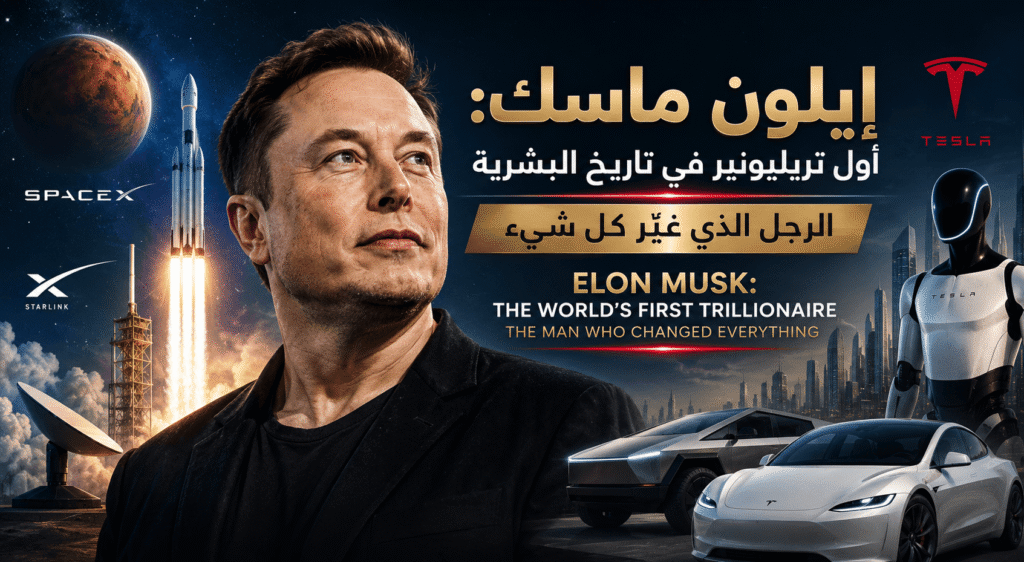
No figure in modern business history has commanded as much attention, controversy, and awe as Elon Musk — the South African-born entrepreneur who leads Tesla, SpaceX, xAI, X, Neuralink, and The Boring Company simultaneously. As of 2026, Musk holds the title of the world’s richest person, with a net worth that has at various points approached — and in some estimates briefly touched — the extraordinary milestone of one trillion US dollars.
It is important to note that whether Musk has formally crossed the trillion-dollar threshold depends on the methodology used. According to real-time tracking by Bloomberg’s Billionaires Index and Forbes Real-Time Billionaires, his wealth fluctuates significantly with stock market movements — primarily Tesla’s share price. At peak valuations, some estimates have placed him near or at the trillion-dollar mark, making him the closest any individual has ever come to that milestone. Whether he is formally declared the world’s first trillionaire will ultimately depend on sustained valuations across his portfolio companies.
Regardless of the exact figure, one thing is indisputable: Elon Musk’s wealth and influence are unprecedented in human history, and his companies are reshaping multiple industries simultaneously — from transportation and energy to space exploration, artificial intelligence, and neurotechnology.
Who Is Elon Musk? The Man Behind the Billions
Born on June 28, 1971, in Pretoria, South Africa, Elon Reeve Musk demonstrated an extraordinary aptitude for technology and entrepreneurship from an early age. At just 12 years old, he created and sold a video game called “Blastar” — a small but telling sign of the entrepreneurial path that would define his life.
After briefly attending the University of Pretoria, Musk moved to Canada and later enrolled at the University of Pennsylvania, where he earned degrees in Economics and Physics from the Wharton School. He went on to begin a PhD in energy physics at Stanford University — but left after just two days to pursue his entrepreneurial ambitions full-time, co-founding Zip2 and later X.com, which merged to become PayPal and was sold to eBay for $1.5 billion in 2002.
It was the money from that sale — roughly $180 million after taxes — that Musk used to co-found SpaceX, invest in Tesla, and ultimately build the multi-company empire that makes him the richest person on Earth today. His story is one of audacity, repeated near-failure, and a relentless refusal to accept conventional limits on what is possible.
Elon Musk’s Companies: An Overview
Understanding Musk’s wealth requires understanding the empire he has built across six major companies, each operating at the frontier of its respective industry.
| Company | Founded | Musk’s Role | Industry |
|---|---|---|---|
| Tesla | 2003 | CEO | Electric Vehicles, Energy |
| SpaceX | 2002 | Founder & CEO | Space Exploration, Satellites |
| xAI | 2023 | Founder & CEO | Artificial Intelligence |
| X (Twitter) | Acquired 2022 | Owner & Executive Chairman | Social Media |
| Neuralink | 2016 | Co-founder | Brain-Computer Interfaces |
| The Boring Company | 2016 | Founder | Underground Transportation |
Tesla: The Electric Vehicle Giant — and Its Growing Challenges
When Musk joined Tesla as chairman in 2004 and became CEO in 2008, few believed that electric cars could compete with traditional gasoline-powered vehicles. Today, Tesla is a global leader in electric vehicles (EVs), energy storage, and solar energy — a remarkable transformation of an industry that resisted change for decades.
However, Tesla’s story in 2025–2026 is increasingly one of both achievement and challenge. The company has faced declining sales in key markets including Europe and China, where rising competition from domestic Chinese manufacturers has eroded Tesla’s market share significantly. Brands such as BYD, NIO, and Li Auto now offer compelling alternatives at competitive price points, and BYD has surpassed Tesla in total EV unit sales globally.
Additionally, Musk’s highly public political activities — including his involvement in U.S. government advisory roles — have triggered consumer boycotts in several Western markets, contributing to weaker-than-expected sales figures in early 2026. Investors and analysts have raised concerns about whether Musk’s divided attention across so many ventures is affecting Tesla’s operational focus. The company’s financial data is publicly available through Tesla Investor Relations.
SpaceX: Revolutionizing Space — But Not Without Controversy
Founded in 2002, SpaceX remains arguably the most impressive company Musk has built. Its Falcon 9 rocket became the first orbital-class rocket to successfully land and reuse its first stage, dramatically reducing the cost of reaching orbit. The Crew Dragon spacecraft has transported NASA astronauts to the International Space Station, and Starlink now provides satellite internet to millions worldwide.
In May 2026, SpaceX completed Starship’s Twelfth Flight Test — a major milestone for the world’s most powerful rocket, which is intended to carry humans to the Moon and eventually to Mars. NASA has contracted SpaceX to use Starship as its Human Landing System for the Artemis lunar program. More details are available at NASA’s official website.
Nevertheless, SpaceX has faced significant regulatory friction. The U.S. Federal Aviation Administration (FAA) has repeatedly clashed with SpaceX over environmental assessments and launch licenses for Starship, and the company’s Starlink constellation has drawn criticism from astronomers and international bodies concerned about light pollution and the increasing congestion of low-Earth orbit.
X (Formerly Twitter): A Struggling Turnaround
Musk’s 2022 acquisition of Twitter for approximately $44 billion — which he subsequently rebranded as X — has been one of the most controversial business moves of the decade. The deal was financed largely through debt, and the platform has struggled financially since the takeover.
Major advertisers fled the platform in 2022–2023 following changes to content moderation policies and high-profile controversies. While Musk has introduced subscription revenue through X Premium (formerly Twitter Blue), the platform’s total revenue remains well below pre-acquisition levels. The company, which Musk initially valued at $44 billion, was written down to a fraction of that value by major investors including Fidelity within the first year of his ownership. X’s path to profitability remains a significant open question.
xAI: Promising — But Under Scrutiny
Founded in 2023, xAI is Musk’s artificial intelligence company, and its Grok chatbot has undergone multiple major updates to compete with OpenAI’s ChatGPT, Google’s Gemini, and Anthropic’s Claude. xAI has attracted significant investment, valuing the company at tens of billions of dollars.
However, critics have noted that Grok’s less restrictive content policies have raised concerns about the spread of misinformation and harmful content on the X platform, where it is primarily deployed. Some AI researchers have also questioned the pace of capability claims versus independently verified benchmarks. The AI sector as a whole faces increasing regulatory scrutiny globally, and xAI is not immune to those pressures.
Neuralink and The Boring Company
Neuralink made a historic breakthrough in January 2024 when it successfully implanted its brain-computer interface device — called “Telepathy” — in its first human patient, allowing a paralyzed individual to control a computer cursor with their thoughts. The company continues to conduct clinical trials and has begun expanding its patient cohort. While early results are promising, Neuralink faces an extensive regulatory pathway before the technology can reach broad commercial deployment.
The Boring Company continues to develop underground transportation tunnels, with its Las Vegas Loop system serving as its primary operational showcase. Progress has been slower than originally projected, and the company’s earlier ambitious plans for hyperloop-style networks have been scaled back significantly.
How Close Is Musk to a Trillion-Dollar Net Worth?
This is the central question that analysts, financial media, and investors continue to debate. Musk’s net worth is not a simple bank account — it is primarily composed of equity stakes in private and public companies, the values of which fluctuate daily with market conditions.
At its peak in late 2024, some real-time estimates from Bloomberg and Forbes placed his net worth in the range of $300–400 billion, with some brief peak estimates approaching higher figures depending on Tesla’s stock price and SpaceX’s private valuation. These figures make him by far the wealthiest individual in recorded history — but the trillion-dollar threshold, while theoretically within reach under optimistic scenarios, has not been formally confirmed or sustained by either Bloomberg or Forbes as of mid-2026.
To put one trillion dollars in context: it equals 1,000 billion dollars. According to data from the World Bank, the GDP of many individual countries is smaller than even Musk’s current, more conservative net worth estimates — illustrating just how extraordinary the concentration of wealth in a single individual has become in the modern era.
This level of wealth concentration raises profound questions about economic inequality, the influence of technology billionaires over public policy, and the governance of powerful private companies operating in domains — space, AI, critical infrastructure — that have historically been the province of governments and international bodies. Economists, sociologists, and policymakers tracked by outlets such as the Financial Times and CNBC are increasingly grappling with these implications.
Controversy, Criticism, and the Other Side of the Ledger
Any honest assessment of Elon Musk must grapple with the significant controversies that surround him. His management style is frequently described as chaotic and demanding, with former employees at Tesla, SpaceX, and X reporting extreme work expectations and, in some cases, a culture of fear and retaliation.
His social media behavior — including erratic posts, market-moving statements about cryptocurrencies like Dogecoin, and provocative political statements — has attracted regulatory scrutiny from the U.S. Securities and Exchange Commission (SEC). Labor practices at Tesla have faced scrutiny from the National Labor Relations Board (NLRB), which has ruled against the company in several cases involving workers’ rights to organize.
Tesla’s declining market share in China — the world’s largest EV market — and the fierce competition from Chinese manufacturers represent a structural challenge that analysts believe Tesla must address to sustain its premium valuation. Meanwhile, Musk’s political activities have alienated portions of Tesla’s traditionally progressive customer base in Europe and North America, raising valid questions about the relationship between a CEO’s personal brand and a publicly traded company’s performance.
The Legacy and Future of Elon Musk
Whatever one’s view of Elon Musk — transformative visionary, disruptive force, or deeply controversial figure — his impact on multiple industries is undeniable. He has fundamentally changed how the world thinks about electric vehicles, space exploration, artificial intelligence, and brain-computer interfaces. His companies employ hundreds of thousands of people globally and have produced technologies genuinely reshaping the world.
Looking ahead, his stated goals remain extraordinarily ambitious. SpaceX aims to land humans on Mars before the end of this decade. Tesla continues to push toward fully autonomous vehicles. xAI is working to develop artificial general intelligence (AGI) in a way that — in Musk’s framing — benefits humanity. Neuralink hopes to restore sensory and motor function to paralyzed individuals at scale.
Whether Musk ultimately becomes the world’s first formally confirmed trillionaire will depend on market conditions, regulatory outcomes, and the operational performance of his companies in an increasingly competitive landscape. What is already certain is that his trajectory — from a middle-class upbringing in South Africa to the pinnacle of global wealth — is one of the most extraordinary stories of the 21st century.
Latest Updates (2026)
As of mid-2026, key developments include: SpaceX’s Starship completed its Twelfth Flight Test in May 2026 — the most powerful rocket ever built continues to advance toward operational readiness. Tesla reported mixed Q1 2026 results, with strong margins in the U.S. offset by continued pressure in European and Chinese markets — detailed financials are available via Tesla Investor Relations. xAI’s Grok AI model has undergone multiple major updates, and the company raised additional capital at a valuation placing it among the most valuable AI startups globally. Neuralink continues to expand its clinical trial program, having now implanted devices in multiple patients.
Frequently Asked Questions (FAQ)
1. Is Elon Musk the world’s first trillionaire?
Not formally confirmed as of mid-2026. Musk is the world’s richest person by a wide margin, with a net worth tracked by Bloomberg and Forbes that has approached but not been officially sustained at the one-trillion-dollar mark. His wealth fluctuates significantly with Tesla’s share price and SpaceX’s private valuation. He is the first person in history to come this close to a trillion-dollar net worth.
2. What is Elon Musk’s net worth in 2026?
Estimates vary and change daily. As of mid-2026, most reputable trackers place his net worth in the range of $300–400 billion, primarily driven by his stakes in Tesla (public) and SpaceX (private). This makes him the world’s richest person — but the exact figure is highly sensitive to market conditions.
3. What companies does Elon Musk own or lead?
Musk is CEO of Tesla and SpaceX, founder and CEO of xAI, owner and Executive Chairman of X, co-founder of Neuralink, and founder of The Boring Company.
4. Why has Tesla’s stock price been volatile?
Tesla’s stock price is influenced by a complex mix of factors: its own financial performance, Musk’s personal controversies and political activities, competition from Chinese EV makers (especially BYD), interest rate environments affecting growth stock valuations, and investor sentiment about the timeline for fully autonomous driving technology. More details are available at Tesla Investor Relations.
5. What is SpaceX’s Starship, and why does it matter?
Starship is the world’s most powerful rocket — fully reusable and designed to carry humans to the Moon, Mars, and beyond. SpaceX completed Starship’s Twelfth Flight Test in May 2026. NASA has contracted SpaceX to use Starship as the Human Landing System for its Artemis crewed lunar missions.
6. Has Elon Musk faced legal or regulatory issues?
Yes. The SEC has investigated Musk over social media posts affecting stock prices. The NLRB has ruled against Tesla in labor rights cases. SpaceX has faced FAA regulatory hurdles with Starship. These challenges have not stopped his companies from growing, but they represent real risks to his operations and public standing.
7. What is Neuralink and what has it achieved?
Neuralink implanted its first brain-computer interface device in a human patient in January 2024, allowing the paralyzed individual to control a computer cursor with thought alone. Clinical trials are ongoing, with the company working toward FDA approval for broader therapeutic applications.
8. What does Musk’s wealth mean for economic inequality?
Musk’s wealth — even at its more conservative estimates — exceeds the GDP of many nations, as documented by the World Bank. This raises serious questions about wealth concentration, the influence of ultra-wealthy individuals on democracy and public policy, and the need for updated regulatory frameworks to govern companies operating in critical sectors like AI, space, and critical infrastructure.
Sources & Further Reading:
Bloomberg Billionaires Index | Forbes Real-Time Billionaires | Tesla Investor Relations | SpaceX | NASA | SEC | NLRB | World Bank | Financial Times | CNBC