Introduction: A New Era in the AI Race
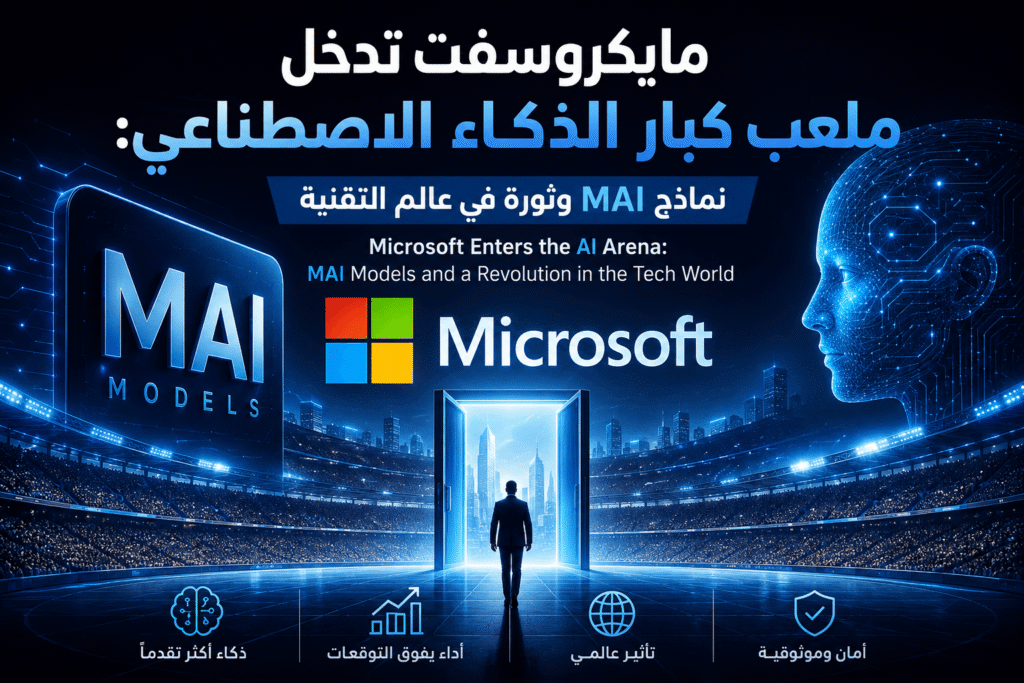
In a world where technological advancement accelerates at an unprecedented pace, Microsoft has officially stepped into the arena of AI giants — not as a supporting player, but as a primary contender with an ambitious vision and a clear roadmap. Through its dedicated platform Microsoft AI (MAI), the tech behemoth is launching a suite of advanced foundational models that directly challenge offerings from OpenAI, Google DeepMind, and Anthropic. This move is not merely a marketing announcement — it represents a genuine strategic shift in Microsoft’s technological architecture and its philosophy toward the future.
To understand the magnitude of this transformation, we need to step back briefly. Microsoft invested billions of dollars in OpenAI, gaining access to the famous GPT models and integrating them into products like Copilot, Bing, and Azure. But now, the company is taking a bolder step: building its own models from scratch under the brand MAI (Microsoft AI Models), reducing its dependence on external parties and strengthening its complete technical sovereignty.
MAI Models: Next-Generation Technical Power
The true heart of Microsoft’s ambition lies in the MAI model portfolio announced via microsoft.ai/models. These are not mere incremental improvements — they represent a qualitative leap in performance and capabilities:
1. MAI-Thinking-1: The Analytical Engine
MAI-Thinking-1 is one of Microsoft’s most powerful reasoning models, designed specifically for complex problems requiring deep logical thinking and multi-step analysis. It achieves competitive results on the SWE-Bench Pro benchmark for evaluating technical models — at a mid-weight price point that makes it highly accessible. This positions it as an ideal solution for enterprise applications demanding high analytical precision without excessive operational costs.
2. MAI-Code-1-Flash: The Intelligent Programmer
For developers and software teams, MAI-Code-1-Flash is a game-changer. This lightweight agentic model is embedded directly into GitHub Copilot and VS Code, enabling engineering teams to write better code faster. It represents a direct enhancement to developer tools relied upon by millions of programmers worldwide every single day.
3. MAI-Image-2.5: The Digital Artist
In the field of AI image generation, MAI-Image-2.5 delivers exceptional performance. It can create stunning, design-ready images from any text or photo prompt, holding top positions in Arena ELO leaderboards — at a lower cost than competitors. This makes it highly attractive for media companies, marketing agencies, and design studios seeking high quality at a reasonable price point.
4. MAI-Transcribe-1.5: The Precision Audio Converter
MAI-Transcribe-1.5 addresses a challenge that has long troubled organizations: converting noisy or background-heavy audio into precise, domain-specific transcripts. Excelling on the FLEURS benchmark and Artificial Analysis evaluations, it’s the top choice for medicine, law, business, and any field demanding high-accuracy transcription.
5. MAI-Voice-2: The Expressive AI Voice
MAI-Voice-2 delivers an exceptional text-to-speech experience with an expressive voice and extremely low latency even across long-form generations. This opens broad possibilities for virtual assistant applications, e-learning platforms, and therapeutic use cases.
The “Humanist Superintelligence” Vision: A Different Philosophy
What distinguishes Microsoft from its AI competitors is not only the power of its models, but its core philosophy. The company champions what it calls “Humanist Superintelligence” — a vision grounded in a clear principle: AI should amplify human potential, not surpass or replace it. This orientation sets it apart from the race toward full automation embraced by some rival companies.
Within this framework, all MAI models are designed to be as safe as they are capable, built for the demands of real work, and engineered not to outpace human potential. This approach redraws the line between productivity enhancement and job replacement — a line that concerns hundreds of millions of people worldwide.
Copilot: The Interface That Changes Everything
No discussion of Microsoft’s AI strategy is complete without Microsoft Copilot, which serves as the primary consumer and professional interface for MAI technologies. Copilot is no longer just a smart assistant that answers questions — it has evolved into a comprehensive work partner deeply integrated into Microsoft 365 (Word, Excel, PowerPoint, Teams), providing proactive assistance based on a deep understanding of the user’s work style and organizational context.
The latest Copilot releases have made it more personal and relevant to everyday life, featuring health companions, personal context awareness, and persistent memory. According to Microsoft’s latest usage report, millions use Copilot daily for tasks ranging from writing reports and analyzing data to managing email and summarizing meetings.
Azure AI and Foundry: The Enterprise Backbone
At the enterprise level, Microsoft offers an integrated ecosystem through Azure AI Services and the Azure AI Foundry platform. This ecosystem enables organizations to:
- Fine-tune models to fit their business: Through Microsoft Frontier Tuning, any company can train a customized MAI model that reflects its own data and business rules, with complete privacy and data control.
- Ensure security and compliance: Models are wrapped in layers of safety guarantees and compliance with international regulations like GDPR and HIPAA, making them suitable for sensitive sectors such as finance, healthcare, and government.
- Scale globally: Azure’s massive infrastructure spanning dozens of data centers worldwide guarantees high performance and continuous availability.
The Competitive Landscape: Where Does Microsoft Stand?
To appreciate the significance of what Microsoft is delivering, we need to examine the full competitive landscape. Since the launch of ChatGPT in late 2022, generative AI has transformed from an elite technology into a fierce race among tech giants: Google develops Gemini models and integrates them across Search, Android, and Gmail. Meta releases open-source Llama models embedded in WhatsApp, Instagram, and Facebook. Anthropic offers advanced Claude models with a special focus on safety. xAI by Elon Musk develops Grok with an unconventional approach.
Amid this crowded race, Microsoft positions itself cleverly: it’s not just competing on being technically best, but on being the most integrated into the modern work environment. With its massive user base across Windows, Microsoft 365, Azure, and GitHub, the company holds a competitive advantage that no one else possesses: daily access to hundreds of millions of users and businesses worldwide.
Impact on the Middle East and Saudi Arabia
In the context of Saudi Vision 2030 and its drive toward digital transformation and artificial intelligence, Microsoft’s full entry into this space carries significant implications. Saudi Arabia relies heavily on Microsoft products in both public and private sectors, and expanding AI capabilities in these products translates into real opportunities for Saudi companies and institutions to improve productivity and raise operational efficiency.
Microsoft’s investment in cloud infrastructure in the region through expanding Azure Regions further enhances the ability to leverage MAI models with low latency and full compliance with local regulations.
Challenges and Concerns
Despite this tremendous momentum, Microsoft faces real challenges that cannot be ignored. The most prominent is cost: training and operating foundational AI models consumes enormous computing resources, placing continuous pressure on profit margins. There are also pressing privacy and security concerns: as users and companies increasingly depend on AI models, risks related to data confidentiality and potential misuse escalate.
Regulatory challenges are also mounting: the European Union, the United States, and many other nations are tightening AI regulations, which could restrict certain uses or impose additional compliance costs. Additionally, labor market impact concerns remain real, as many believe accelerating automation will threaten jobs across wide sectors of the economy.
The Future of AI: Is Microsoft Leading?
The complete picture reveals that Microsoft is not just seeking to compete — it is seeking to redefine productive computing in the age of artificial intelligence. With its integrated ecosystem encompassing Windows, Microsoft 365, Azure, GitHub, and a massive developer network, the company is uniquely positioned to achieve complete vertical integration of AI. The recent announcements at Microsoft Build 2026 unveiled an ambitious roadmap extending years into the future, featuring more specialized, lower-cost, higher-performance models.
Betting on Microsoft in the AI race is now a justified bet by all measures. The company that built its empire on operating systems and productivity software is now signaling that it will build a new generation of digital human capabilities — where the machine is a partner, not a replacement.
Conclusion: The Moment That Changes Everything
Microsoft’s entry into the arena of AI giants with its own models through the MAI platform is not merely a passing technical event — it is a defining milestone in the history of technology. Whether you are a developer, a business owner, a creative professional, or simply a daily technology user, what Microsoft is building today will directly impact how you work and live in the years ahead. The race is open, the winds signal radical change — and this time, Microsoft is at the heart of the storm.