
FABEX Saudi Arabia 2026 starts today, Sunday, October 11, in Riyadh according to its announced schedule, and runs through October 14. For manufacturers, contractors and purchasing teams, the exhibition offers a reason to investigate equipment and suppliers connected with metal production. The useful outcome is a clearer next step: a test to arrange, an operating problem to investigate, or a supplier whose proposal deserves closer review.
This guide brings together the published essentials for planning a visit, followed by practical questions for evaluating what you see. The purchasing and workflow suggestions are general editorial guidance. They are not findings from tests of particular machines, endorsements of exhibitors, or promises about savings and production performance.
FABEX 2026 dates and location
The official FABEX Saudi Arabia website lists the thirteenth edition for October 11–14, 2026, covering steel fabrication, metal forming and finishing. It is held alongside Mach Saudi Arabia and Metal & Steel Saudi Arabia.
| Detail | Published information |
|---|---|
| Dates | October 11–14, 2026 |
| Venue | Riyadh International Convention and Exhibition Center |
| Address | King Abdullah bin Abdulaziz Road, Al Waha district |
Check the organizer’s official venue page before setting out. Use the full venue name when looking up directions so that you do not confuse it with another exhibition location in Riyadh. The published date range does not, by itself, establish a daily opening timetable or confirm that an opening ceremony has already taken place.
Visitor registration: use the official route
The organizer links to an official FABEX visitor registration form. When reviewed, it displayed fields including name, job title, company, country, phone and email, with Arabic and English language options. A visible form is not confirmation that an unsubmitted application has been accepted or that an entry badge has been issued.
Use an email address you check regularly and review your contact details before submitting. If a confirmation arrives, keep it accessible and read any instructions concerning identification, badges or entry. For a technical problem, use the organizer’s contact channels rather than entering information into a registration link whose source you cannot verify.
The official pages reviewed did not establish specific visitor admission fees or daily attendance hours. This guide therefore does not describe entry as free or publish an unverified timetable. Confirm those details with the organizer before travelling, particularly if you are coming from outside Riyadh or coordinating several colleagues.
Connect the exhibition to a production problem
The published scope includes cutting, forming, welding, finishing, CNC equipment, robotics and automation, along with related tools and industrial equipment. These categories provide a starting point for planning. They do not confirm that a particular model or solution will be available from a specific exhibitor.
Start with something your operation needs to understand. Repeated rework might call for better investigation of quality variation. Late orders might involve a bottleneck in one process, or delays in moving material between processes. A faster machine will not automatically remove time lost while drawings are approved or parts wait for the next operation. Ask questions that connect the demonstration to the whole workflow.
Give each member of your team a role
The organizer’s visitor profile page includes engineers, manufacturers, contractors, project professionals, purchasing teams and suppliers. Their information needs differ. An engineer may focus on process capability, a buyer on comparable quotations, and an operations manager on training and support.
If several colleagues attend, assign these responsibilities before arriving. One person can assess the product requirements, another can investigate installation and service, and a third can record the commercial scope. Briefly compare notes after each meeting. This helps catch contradictions while the discussion is fresh and prevents different departments from remembering different versions of the same proposal.
Compare equipment using the same task
A demonstration becomes more informative when you know what it is supposed to prove. Prepare a description of a material you actually use, a representative part, a typical batch and the required quality. Ask how closely the demonstration matches those conditions and what would change with a different material, geometry or method of holding the workpiece.
When discussing speed, identify where the measurement starts and ends. Does the figure include file preparation, loading, setup, machining and unloading, or only a short cutting operation? Record the definition alongside the number. Comparing a complete production cycle with a limited operating time can make one proposal look better without demonstrating a real advantage.
- Ask how the demonstrated quality was measured.
- Identify the operator experience needed to reproduce the result.
- Check which tooling and accessories are required for your part.
- Separate observed performance from written specifications and claims that still need testing.
You do not need to decide at the stand whether a machine is the right purchase. A useful meeting can simply establish that a properly defined trial is worth arranging. Bringing a consistent set of questions to several suppliers makes that later decision easier.
Investigate installation and support
A machine operates within a system of people, materials, utilities and maintenance. Ask who performs installation, what preparation is needed at your site, and which steps precede production. Delivery is not necessarily the same as readiness to manufacture. Request a clear explanation of commissioning, training and acceptance testing.
For service, seek answers that can be retained and checked: who receives a fault report, where spare parts are supplied from, how technical support is provided, and which services are included. Ask for the important points in writing and have the relevant specialist in your organization review warranty details before a commitment. An attractive stand alone does not establish long-term support capability.
| Comparison area | Question to ask |
|---|---|
| Suitability | Can the equipment meet our product and quality requirements? |
| Operation | What training, preparation and consumables are needed? |
| Support | How do we obtain service and replacement parts? |
| Quotation | What is included, and what is charged separately? |
Keep the quotation scope consistent. A headline equipment price can exclude items another supplier includes, such as tooling or training. Rather than assuming two totals describe equivalent offers, list the components and request clarification on missing entries. This is a method for gathering information, not a prediction of which proposal will be cheapest to operate.
Automation needs an understandable workflow
When considering a robot or monitoring platform, ask what task it performs and what information it needs. A repetitive, organized operation may be a suitable starting point for automation, but material movement, safety arrangements and exceptions still require attention. Request an explanation using a realistic working scenario, including what the operator does when the process stops or the task changes.
Production data is valuable when the team can act on it: investigating stoppages, tracking repeated defects or identifying an order that is falling behind. For broader technology context, see SaudiWe’s guide to the Google Cloud Saudi Arabia Summit 2026 and AI agent themes. That is a separate discussion of cloud and data topics; the link does not imply an affiliation between the events.
Build a realistic visit plan
Choose three priorities: a problem to explore, a supplier to evaluate and a missing piece of process information. Begin with meetings connected to those priorities, then allow time for discovery. Bring a concise requirements summary rather than sharing sensitive drawings or commercial data indiscriminately at every stand.
Use the same note format throughout the visit: supplier, equipment, task discussed, answer received and next action. Photographs can help where permitted, but a picture of a machine plate will not preserve the reasoning behind a conversation. Write down why the proposal matters and obtain contact details for the person responsible for the solution you discussed.
Turn conversations into follow-up work
After the visit, review the notes with your team. Separate plausible solutions from interesting ideas that require more research. Request quotations against the same requirements, and identify unanswered questions instead of relying on a general impression that a presentation was impressive. If a test is needed, agree on material, expected output and measurement before arranging it.
A successful visit may produce a supplier worth testing, a solution ruled out because it does not fit the operation, or a workflow improvement that does not require buying new equipment. With FABEX beginning today on its announced schedule, a little preparation can turn the exhibition into a useful set of informed decisions and practical next steps.
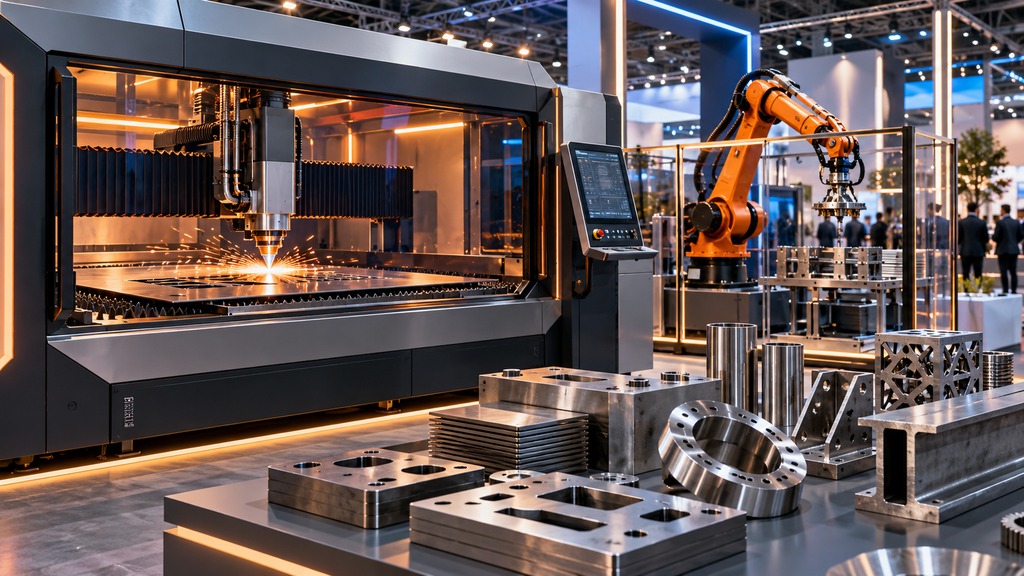
The featured image is an original conceptual illustration of metal fabrication equipment, not a documented photograph of the exhibition.