
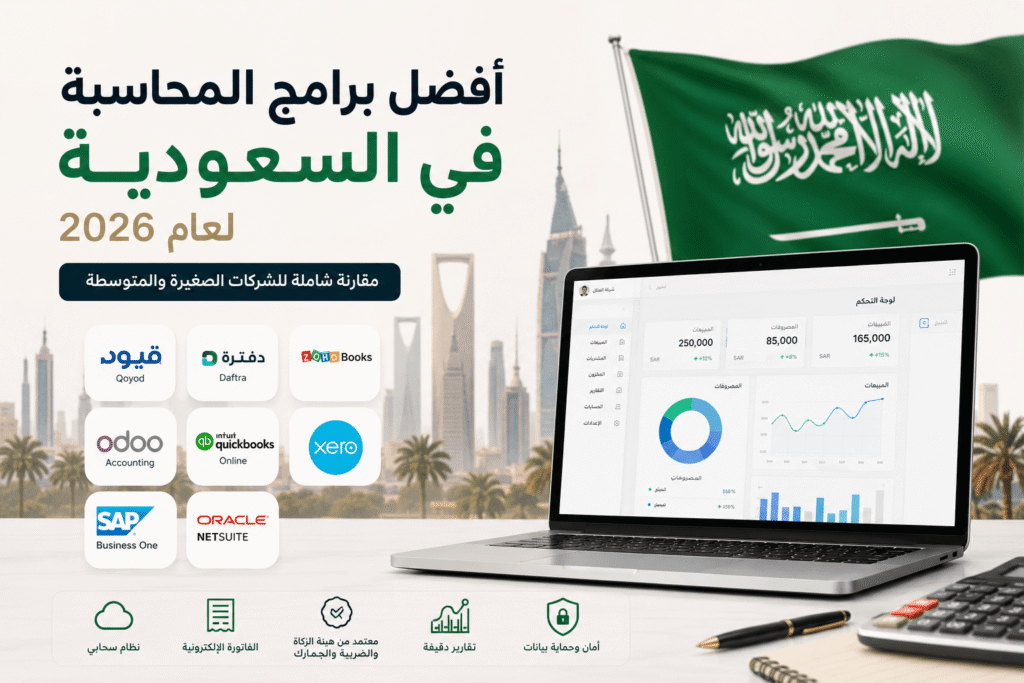
Saudi Arabia’s business landscape is undergoing a remarkable digital transformation under Vision 2030, making professional financial management more critical than ever. Whether you run a startup, a growing SME, or a large enterprise, choosing the right accounting software can be the difference between financial clarity and costly confusion. This comprehensive guide for 2026 reviews the best accounting software available in Saudi Arabia, with detailed comparisons to help you make the right choice for your business.
🔍 Quick Guide – Find Your Best Match
Before diving into the details, here’s a quick recommendation based on your business type:
| You are… | Recommended Software |
|---|---|
| 🏪 Small business or startup | Qoyod or Daftra |
| 🛒 E-commerce store | Daftra |
| 🏢 Mid-size company | Odoo or Zoho Books |
| 🌍 Enterprise / multinational | NetSuite or SAP Business One |
Table of Contents
- Why Saudi Businesses Need Accounting Software
- Key Selection Criteria for Accounting Software
- Best Accounting Software in Saudi Arabia 2026
- Detailed Software Comparison
- Best Software by Business Size
- Frequently Asked Questions
- Conclusion and Recommendations
Why Saudi Businesses Need Accounting Software
The Zakat, Tax and Customs Authority (ZATCA) mandates that all businesses operating in Saudi Arabia comply with e-invoicing (Fatoorah) regulations. This legal requirement makes adopting professional accounting software not just a convenience but a business necessity. Modern accounting platforms that support Fatoorah Phase 2 compliance help businesses generate XML-formatted invoices, submit them through the approved platform, and maintain accurate audit trails — all while reducing the burden of manual compliance work.
Beyond compliance, research consistently shows that SMEs using accounting software reduce financial errors by up to 80% and cut financial reporting time by approximately 60% compared to manual methods. In Saudi Arabia’s competitive and rapidly evolving economy, this operational efficiency directly impacts profitability, growth capacity, and investor confidence. The right accounting platform gives business owners real-time cash flow insights and the data needed to make strategic decisions.
Key Selection Criteria for Accounting Software in Saudi Arabia
Before exploring individual software options, understanding what makes an accounting solution suitable for the Saudi market is essential. These criteria should guide every purchasing decision:
1. ZATCA and Fatoorah Compliance
Compliance with Saudi Arabia’s e-invoicing system is non-negotiable. Your chosen software must support the generation and transmission of XML invoices according to ZATCA’s Fatoorah specifications, including QR code generation, cryptographic stamping, and integration with the Fatoorah platform. Both Phase 1 (generation) and Phase 2 (integration) compliance should be verified before committing to any platform.
2. Arabic Language and RTL Support
For businesses operating primarily in Arabic, full right-to-left (RTL) interface support, Arabic invoice templates, Hijri calendar compatibility, and bilingual reporting (Arabic and English) are essential features. Software built specifically for the Arab market will naturally excel in these areas, while international platforms may offer varying levels of Arabic support.
3. VAT Management
Since Saudi Arabia implemented Value Added Tax at 5% in 2018, subsequently raised to 15% in 2020, any viable accounting software must automate VAT calculations, generate periodic VAT return reports, and produce ZATCA-compliant tax invoices. Look for platforms that offer automated VAT filing preparation to streamline this recurring compliance obligation.
4. User Experience and Arabic Support
Even the most feature-rich software loses value if it’s too complex to use effectively. Evaluate the intuitiveness of the user interface, availability of Arabic-language customer support, quality of onboarding resources, and response times for technical issues. A platform offering phone, live chat, and email support in Arabic provides significant operational advantages.
5. System Integration Capabilities
Modern Saudi businesses need seamless integration with e-commerce platforms, point-of-sale systems, inventory management, HR and payroll, and local payment gateways including Mada, STC Pay, and Sadad. The depth of available integrations significantly affects workflow efficiency and data accuracy across your business operations.
Best Accounting Software in Saudi Arabia 2026
1. Qoyod (قيود) – The Comprehensive Arabic Accounting Solution
Qoyod stands as one of the most prominent cloud accounting platforms purpose-built for the Arab market. It offers a fully integrated suite covering general accounting, inventory management, invoicing, payroll, and project tracking — all with complete ZATCA Fatoorah compliance built in. The Arabic-first interface is designed to be accessible even to users without formal accounting training, making it particularly valuable for business owners managing their own finances. Qoyod offers a free plan for small businesses and paid plans starting from SAR 99/month, with advanced tiers offering multi-branch management and enhanced reporting. Its mobile application allows complete financial management on the go, which is increasingly important for Saudi entrepreneurs.
2. Daftra (دفترة) – E-Invoicing Made Simple
Daftra was designed with Saudi and Gulf entrepreneurs in mind, prioritizing simplicity without sacrificing essential functionality. Its elegant Arabic interface guides users through invoice creation, expense tracking, and payment management with minimal complexity. Full ZATCA Fatoorah compliance is integrated natively, and the platform generates compliant VAT reports with minimal user input. Pricing starts from SAR 79/month with a free trial period available. Daftra is the go-to recommendation for freelancers, sole proprietors, and small businesses that need reliable compliance and professional invoicing without the learning curve of enterprise solutions.
3. Zoho Books – Comprehensive Power at a Reasonable Cost
Zoho Books has established a strong presence in the Saudi market through its solid VAT support and partial Arabic interface. The platform offers an impressive feature set covering invoicing, project management, inventory tracking, and bank reconciliation, with seamless integration across the broader Zoho ecosystem (CRM, HR, Marketing). Advanced workflow automation reduces time spent on repetitive tasks, and the customizable reporting suite provides meaningful financial insights. Pricing begins at approximately SAR 159/month for the standard plan. Zoho Books is an excellent choice for growing SMEs that need a well-rounded platform without the complexity or cost of enterprise ERP systems.
4. Odoo Accounting – Flexibility and Customization Without Limits
Odoo Accounting distinguishes itself as part of an open-source ERP ecosystem that can be tailored to virtually any business requirement. It supports Saudi e-invoicing requirements and VAT reporting, and integrates natively with Odoo modules for sales, purchasing, inventory, manufacturing, and HR within a single platform. The Community edition is available free of charge for technically capable teams, while cloud-hosted Enterprise plans start at approximately SAR 225/user/month. Odoo is the recommended choice for businesses with complex operational requirements that demand deep customization, particularly those with developer resources available for implementation and maintenance.
5. QuickBooks Online – The Global Standard
QuickBooks Online holds the distinction of being the most widely used accounting software globally, with a Gulf-localized version that includes partial Arabic support. Its strengths lie in cash flow management, expense tracking, financial reporting, and an ecosystem of over 750 third-party integrations. The platform provides excellent value for international companies with Saudi operations that already use QuickBooks in their global workflows. It is worth noting that native ZATCA Fatoorah compliance is more limited compared to locally developed alternatives, which may require additional integration work. Pricing starts from approximately SAR 195/month for the Essentials plan.
6. Xero – Elegant Cloud Accounting
Xero is celebrated for its polished user interface and seamless user experience, making it a favorite among professional accountants and bookkeepers. The platform integrates with over 1,000 applications, offers comprehensive financial reporting, and handles VAT compliance effectively. Starting at approximately SAR 209/month, Xero is particularly well-suited for international businesses operating in Saudi Arabia and professional accounting firms serving multiple clients. Full ZATCA compliance may require additional configuration or third-party add-ons, which should be factored into the total cost of ownership.
7. SAP Business One – Enterprise-Grade ERP for Mid-Market
SAP Business One represents a trusted ERP solution for medium and large enterprises in the Saudi market. It delivers comprehensive management across accounting, sales, purchasing, production, and human resources within a single unified system. Full ZATCA Fatoorah compliance is supported, as are Saudi Riyal transactions and local regulatory reporting standards. The investment is correspondingly higher, with licensing typically starting from SAR 20,000 annually, though implementation costs should also be budgeted. For organizations at this scale, the depth of functionality, reliability, and extensive SAP partner network in Saudi Arabia justify the premium.
8. Oracle NetSuite – The Enterprise Cloud Platform
Oracle NetSuite is the most comprehensive cloud ERP platform available for large enterprises with complex, multi-entity operations. It provides advanced financial management, real-time business intelligence, global compliance capabilities, and seamless integration with enterprise systems. Support for IFRS reporting alongside local Saudi regulatory requirements makes it the platform of choice for multinational corporations with significant Saudi operations. Total cost of ownership typically begins at SAR 50,000 annually, reflecting its positioning as a solution for organizations with the most demanding requirements and the budgets to match.
Detailed Comparison: Best Accounting Software Saudi Arabia 2026
| Software | Monthly Price (SAR) | ZATCA Support | Arabic Language | VAT | Best For |
|---|---|---|---|---|---|
| Qoyod | Free / 99+ | ✅ Full | ✅ First-language | ✅ | All sizes |
| Daftra | 79+ | ✅ Full | ✅ First-language | ✅ | Small / Freelancers |
| Zoho Books | 159+ | ✅ Good | ✅ Partial | ✅ | Small / Medium |
| Odoo | Free / 225+ | ✅ Good | ✅ Good | ✅ | Medium / Large |
| QuickBooks | 195+ | ⚠️ Limited | ✅ Partial | ✅ | International / Medium |
| Xero | 209+ | ⚠️ Limited | ❌ English only | ✅ | International / Firms |
| SAP Business One | 1,666+ | ✅ Full | ✅ Good | ✅ | Medium / Large |
| Oracle NetSuite | 4,166+ | ✅ Full | ✅ Good | ✅ | Large / Enterprise |
Best Software by Business Size
Best for Small Businesses and Freelancers
For small businesses, sole proprietors, and freelancers in Saudi Arabia, Daftra delivers the ideal combination of simplicity, full ZATCA compliance, and affordable pricing. It removes the complexity of enterprise accounting software while ensuring legal compliance. If you need broader features such as inventory management and payroll alongside invoicing, Qoyod‘s free or entry-level plan provides excellent value without requiring accounting expertise to operate effectively.
Best for Medium-Sized Businesses
Medium-sized enterprises typically need a balance of comprehensive features, usability, integration capabilities, and cost-effectiveness. Zoho Books excels in this segment, offering a robust feature set that scales with business growth and integrates seamlessly with CRM, HR, and marketing systems. Odoo Accounting is the alternative of choice when deep customization or multi-module ERP functionality is required, particularly for businesses with development resources available for implementation.
Best for Large Enterprises
Large enterprises require integrated ERP solutions capable of handling complex, multi-entity operations with sophisticated reporting requirements. SAP Business One leads the mid-to-large enterprise segment with its proven reliability, extensive Saudi implementation partner network, and comprehensive functionality. For the largest multinationals and enterprises with global operations and maximum complexity, Oracle NetSuite offers unmatched depth and global compliance capabilities.
Frequently Asked Questions
What is the best free accounting software in Saudi Arabia?
Qoyod offers a reliable free plan that covers essential accounting needs for small businesses, including basic invoicing and VAT reporting. Odoo Community also provides extensive capabilities at no licensing cost, though it requires technical expertise for installation, configuration, and ongoing maintenance. Both are legitimate options for budget-conscious businesses, though the free tiers naturally include limitations compared to paid plans.
Which accounting software is fully compliant with Saudi ZATCA Fatoorah requirements?
Qoyod, Daftra, SAP Business One, and Oracle NetSuite offer full, native ZATCA Fatoorah compliance. Zoho Books and Odoo support ZATCA requirements well with some additional configuration. QuickBooks Online and Xero may require third-party integrations or add-ons to achieve full compliance with Saudi e-invoicing mandates. Always verify current compliance status directly with the software provider before purchasing.
What is the difference between cloud and on-premise accounting software?
Cloud-based accounting software (such as Qoyod, Daftra, and Zoho Books) delivers access from any device or location, automatic software updates, reduced infrastructure costs, and typically faster implementation. On-premise solutions (such as certain SAP and Oracle deployment options) offer greater data control and may be preferred by enterprises with strict data sovereignty requirements or established internal IT infrastructure. Most modern businesses in Saudi Arabia are migrating toward cloud-first solutions for their flexibility and lower total cost of ownership.
How do I choose the right accounting software for my business?
Start by defining your business size, the number of users who will access the system, and your monthly budget. Then document your functional requirements — invoicing, inventory, payroll, multi-currency, project tracking, and VAT reporting. Prioritize ZATCA Fatoorah compliance and Arabic language support for Saudi-focused operations. Request demonstrations or trial periods from your shortlisted vendors, evaluate the quality of Arabic-language customer support, and consider the total cost of implementation, training, and ongoing subscription before making your final decision.
What is the best free accounting software in Saudi Arabia?
Qoyod is the top choice for free accounting software in Saudi Arabia — it offers a genuine free plan covering invoicing, basic accounting, and VAT reporting with no credit card required. The Odoo Community edition is another zero-license-cost option, though it requires technical capability to install and maintain. For most small businesses, Qoyod’s free plan provides everything needed to get started compliantly.
Is Qoyod approved by ZATCA (Saudi e-invoicing authority)?
Yes, Qoyod is fully approved and compliant with ZATCA’s e-invoicing (Fatoorah) requirements. It supports XML invoice generation, QR code stamping, cryptographic signing, and direct integration with the Fatoorah platform — covering both Phase 1 and Phase 2 compliance obligations.
Does Daftra support e-invoicing (Fatoorah) in Saudi Arabia?
Yes, Daftra fully supports Saudi e-invoicing (Fatoorah) as mandated by ZATCA. The platform natively generates compliant electronic invoices, integrates with the Fatoorah platform, and automates VAT reporting — making it one of the easiest compliance-ready solutions for small businesses and freelancers in the Kingdom.
What is the difference between Odoo and Zoho Books?
Odoo is an open-source ERP platform offering extensive customization across sales, purchasing, inventory, manufacturing, and HR — ideal for businesses with complex workflows and developer resources. Zoho Books is a specialized cloud accounting platform focused on simplicity, usability, and seamless integration with the Zoho Suite — ideal for SMEs that need professional accounting without complex ERP implementation. Odoo is more powerful but requires more investment; Zoho Books is faster to deploy and easier to manage.
Is QuickBooks suitable for businesses in Saudi Arabia?
QuickBooks Online is suitable for international and multinational companies already using QuickBooks in their global operations who need a consistent platform across regions. However, its native ZATCA Fatoorah compliance is more limited than locally-built alternatives like Qoyod and Daftra, which may require additional third-party integrations to achieve full Saudi e-invoicing compliance. For Saudi-first businesses, locally-focused solutions are generally the better choice.
Conclusion and Recommendations
Selecting the right accounting software for your Saudi business in 2026 is a strategic investment that goes far beyond basic bookkeeping. The best choice depends on your business size, complexity, budget, and growth trajectory. For businesses seeking an Arabic-first solution with full Saudi market compliance, Qoyod represents the most comprehensive option across all business sizes. Small businesses and freelancers will find Daftra delivers exceptional simplicity and compliance at an accessible price point. Growing SMEs benefit most from Zoho Books or Odoo, while established enterprises should evaluate SAP Business One or Oracle NetSuite based on their specific operational requirements.
Remember that investing in professional accounting software is not an expense — it is a business enabler that maximizes operational efficiency, ensures regulatory compliance, and provides the financial clarity needed to make better strategic decisions. As Saudi Arabia’s business environment continues to evolve rapidly under Vision 2030, having robust financial management infrastructure in place is one of the most important foundations for sustainable business success in the Kingdom’s dynamic economy.
📌 Related Articles
Explore more resources to help your business succeed in Saudi Arabia:
- 🧮 VAT Calculator Saudi Arabia – Calculate your Value Added Tax instantly
- 📈 Business & Digital Transformation Articles – Your guide to growing in the Saudi market