The 2026 Hajj season marks an exceptional milestone in Saudi Arabia’s ongoing mission to deliver a safe and seamless spiritual experience for millions of pilgrims arriving from every corner of the globe. As the number of pilgrims continues to grow, crowd management has become an enormous logistical challenge that the kingdom confronts with innovative technology and meticulous planning, turning the organization of Hajj into a globally admired model for managing mass human gatherings. This article explores how Saudi Arabia harnesses cutting-edge technology, artificial intelligence, and advanced infrastructure to serve pilgrims in 2026.
The Scale of the Challenge: Millions of Pilgrims in One Place
Hajj is one of the largest human gatherings in the world, with millions of pilgrims converging on Makkah and the holy sites within just a few days, creating immense pressure on infrastructure and services. This crowd concentrates in geographically limited areas such as the Grand Mosque, Mina, Arafat, and Muzdalifah, where the movement of pilgrims between these sites requires precise coordination to avoid congestion and ensure safety. This reality makes crowd management a top priority demanding proactive planning and continuous investment in smart solutions.
Organizing authorities study the movement patterns of pilgrims and their temporal and spatial distribution to reduce friction points and prevent overcrowding at sensitive locations. This includes precise scheduling of pilgrim journeys, their distribution into organized groups, and the provision of flexible alternative routes capable of absorbing growing numbers without compromising the safety and comfort of pilgrims.
Artificial Intelligence and Smart Monitoring Technologies
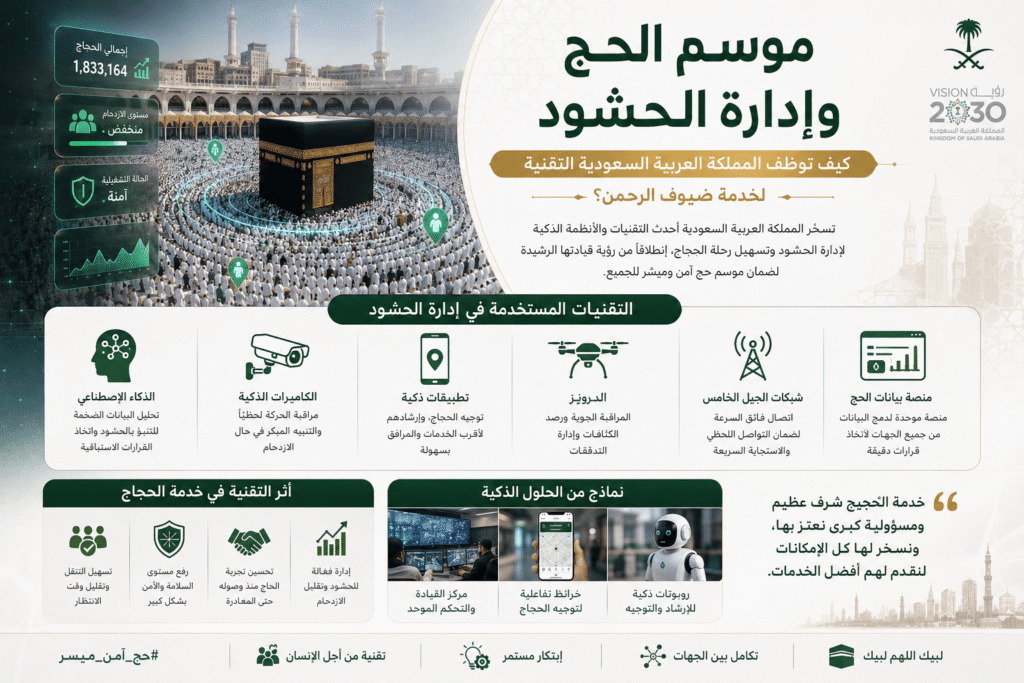
The kingdom increasingly relies on artificial intelligence systems and computer vision technologies to monitor crowd density in real time, with smart cameras analyzing pilgrim movement and alerting operations rooms the moment any abnormal congestion is detected. These systems enable rapid decisions to redirect human flows and prevent incidents before they occur. Big data analytics are also used to predict peak times and distribute human and service resources with greater efficiency.
These solutions integrate with smart applications that serve pilgrims directly, providing interactive maps and real-time information about routes, nearby services, and movement schedules between the holy sites. This digital transformation not only enhances safety but elevates the pilgrim’s experience, giving them a greater sense of reassurance and comfort while performing the rituals.
Infrastructure and Development Projects
Saudi Arabia has invested billions of dollars in developing the infrastructure of the holy sites, from expanding the Grand Mosque to developing transport networks and the Mashaer Metro that moves hundreds of thousands of pilgrims between the sites with high efficiency. Mina, Muzdalifah, and Arafat have also seen major improvements in facilities, services, canopies, and cooling to cope with high temperatures. These projects aim to raise capacity, improve the flow of movement, and provide a safe and comfortable environment for pilgrims.
Development plans also include expanding road networks, tunnels, and bridges to facilitate vehicle and pedestrian movement, in addition to developing firefighting, emergency, and field healthcare systems. This comes within a comprehensive vision that places the comfort and safety of pilgrims at the heart of national priorities.
Health Services and Emergency Preparedness
The health dimension is of paramount importance in the Hajj management system, with hospitals, health centers, and mobile medical teams deployed across all the holy sites to provide immediate care to pilgrims. Health authorities prepare to handle various emergencies through precise plans, advanced equipment, and trained medical staff. Health tracking and early warning technologies are also used to prevent the spread of diseases amid dense gatherings.
The kingdom pays special attention to the health awareness of pilgrims before and during the rituals, through multilingual guidance campaigns explaining key preventive measures and how to deal with heat stress and crowding. This comprehensive preventive approach helps reduce health risks and ensures a safe and reassuring Hajj season.
The Economic Dimension of the Hajj Season
The Hajj season is an important economic engine for the kingdom, energizing the tourism, hospitality, transport, trade, and logistics sectors. Revenues generated from serving pilgrims support the national economy and create seasonal and permanent jobs across various sectors. As the number of pilgrims and Umrah performers grows, the horizons for investment in the religious hospitality industry expand, forming a fundamental pillar within Saudi Vision 2030.
The kingdom is developing an integrated system to serve Umrah performers and pilgrims throughout the year, including simplifying visa procedures and developing accommodation, transport, and religious tourism experiences. This approach strengthens the kingdom’s position as a global destination for religious tourism and supports the diversification of national income sources.
A Forward Look: The Future of Hajj Management
The future of Hajj management is heading toward greater digitization and automation, with expectations of integrating Internet of Things technologies and digital twins to simulate crowd movement and proactively plan for various scenarios. Robots and autonomous vehicles are also expected to play an increasing role in providing logistical and guidance services. These developments reflect the kingdom’s continued commitment to enhancing the Hajj experience and making it safer and smoother year after year.
The ultimate goal remains enabling every pilgrim to perform the rituals with ease and serenity, through an integrated system that combines faith, technology, and meticulous organization. In doing so, the kingdom reinforces its historic role in serving the Two Holy Mosques and the guests of God to the highest international standards.
Logistics: Accommodation and Catering Management
Housing pilgrims and providing them with catering is one of the most complex logistical aspects of the Hajj season, as safe and well-equipped accommodation must be provided for millions of people within a limited geographical area and over a short period. The kingdom relies on an integrated system for managing the camps in Mina and distributing pilgrims according to their nationalities and organized groups, while ensuring the availability of water, food, and sanitary facilities to the required standard. This system is continuously developed to keep pace with growing numbers and raise the level of services provided to pilgrims.
Authorities also work to improve the quality of meals and ensure their safety through strict oversight of catering providers, in addition to providing innovative solutions for waste management and maintaining the cleanliness of the holy sites. This integration between logistics and health oversight ensures a healthy and safe environment befitting the sanctity of the place and the importance of the occasion.
Environmental Sustainability During the Hajj Season
In recent years, the kingdom has paid increasing attention to the environmental dimension of Hajj management, recognizing that massive human gatherings leave an environmental footprint requiring careful treatment. Environmental initiatives include developing advanced waste management and recycling systems at the holy sites, in addition to rationalizing water and energy consumption through smart solutions. The use of renewable energy sources is also expanding in operating some service facilities, in line with the kingdom’s environmental commitments under its vision for sustainable development.
Relevant authorities work to spread environmental awareness among pilgrims and encourage eco-friendly practices during the rituals, such as rationalizing water consumption and properly disposing of waste. This integrated approach combines serving the guests of God with preserving the sanctity and cleanliness of the holy sites for future generations, reflecting a comprehensive vision that balances the spiritual dimension with environmental responsibility.
Comparison: The Evolution of Hajj Management Over the Years
| Criterion | Hajj 2026 | The Past Decade | Traditional Model |
|---|---|---|---|
| Crowd monitoring | AI and computer vision | Cameras and human monitoring | Field monitoring only |
| Transport between sites | Mashaer Metro and smart buses | Mashaer Metro and buses | Traditional buses |
| Digital pilgrim services | Apps and interactive maps | Basic apps | Paper guidance |
| Healthcare | Health tracking and early warning | Field hospitals and centers | Limited first aid |
| Capacity | The highest ever | High | Limited |