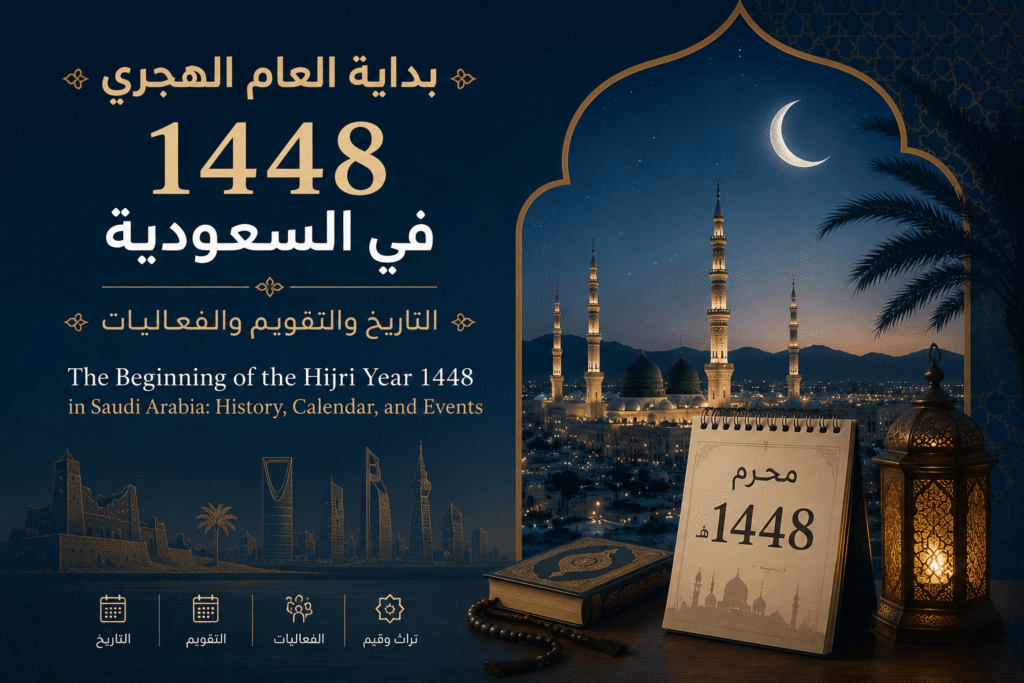
The start of the Hijri New Year is an occasion of deep religious, historical, and cultural significance in the Kingdom of Saudi Arabia. As the new Hijri year 1448 begins, Muslims around the world renew their connection to the memory of the migration (Hijrah) of the Prophet Muhammad (peace be upon him) from Makkah to Madinah, the event that was adopted as the starting point of the lunar Hijri calendar. In this article, we explore when the Hijri year 1448 begins, how the Hijri calendar is officially calculated in Saudi Arabia, with a table of the most important Hijri occasions throughout the year, as well as the meanings and events associated with this occasion.
When Does the Hijri Year 1448 Begin?
The new Hijri year begins with the first day of Muharram, the first month of the lunar Hijri year. Saudi Arabia relies on the Umm Al-Qura calendar to determine the beginning of the lunar months, as it is the official calendar adopted for government departments and official transactions in the Kingdom. The entry of a new lunar month is usually determined based on the sighting of the crescent moon or approved astronomical calculations. The Hijri year is approximately 354 days long — about 11 days shorter than the Gregorian year — which is why the Hijri New Year moves forward each year relative to the Gregorian calendar.
It is worth noting that the dates of Hijri occasions remain estimated until they are officially confirmed based on the sighting of the crescent by the competent authorities. Readers can access official services and information related to the calendar and occasions through the Kingdom’s Unified National Platform for government services.
Table of Key Hijri Occasions Throughout the Year
The following table shows the most prominent religious occasions associated with the Hijri calendar and their order during the year, noting that exact dates are officially confirmed through the sighting of the crescent:
| Occasion | Hijri Month | Date | Significance |
|---|---|---|---|
| Hijri New Year | Muharram | 1 Muharram | Start of the new Hijri year and commemoration of the migration |
| Day of Ashura | Muharram | 10 Muharram | A recommended day of fasting following the Prophetic tradition |
| Mawlid (historical occasion) | Rabi al-Awwal | 12 Rabi al-Awwal | Anniversary of the birth of the Prophet Muhammad (PBUH) |
| Isra and Mi’raj (historical occasion) | Rajab | 27 Rajab | Commemoration of the Night Journey and Ascension |
| Mid-Shaban Night | Shaban | 15 Shaban | A night observed by many Muslims with worship |
| Start of Ramadan | Ramadan | 1 Ramadan | Beginning of the month of fasting |
| Laylat al-Qadr | Ramadan | Last ten nights (often 27 Ramadan) | A night better than a thousand months |
| Eid al-Fitr | Shawwal | 1 Shawwal | Festival marking the end of Ramadan fasting |
| Day of Arafah | Dhu al-Hijjah | 9 Dhu al-Hijjah | The greatest pillar of Hajj; recommended fasting for non-pilgrims |
| Eid al-Adha | Dhu al-Hijjah | 10 Dhu al-Hijjah | Festival of Sacrifice and the greatest Muslim celebration |
| Days of Tashreeq | Dhu al-Hijjah | 11–13 Dhu al-Hijjah | Days of eating, drinking, and remembrance of God |
The Importance of the Prophet’s Migration in the Islamic Calendar
The Hijri calendar is closely tied to the blessed migration of the Prophet, which marked a major turning point in the history of Islam. After years of calling people to faith in Makkah, the Prophet Muhammad (peace be upon him) and his companions migrated to Madinah, where the first Islamic state was established on the principles of justice, solidarity, and brotherhood. Later, during the era of Caliph Umar ibn al-Khattab (may God be pleased with him), the year of the migration was adopted as the beginning of the Islamic calendar, commemorating this pivotal event that represented a new beginning for the nation.
The significance of the Hijrah is not limited to its historical dimension; it also carries renewed spiritual and moral meanings, including sacrifice for the sake of principles, wise planning, patience through hardship, and the belief that relief comes after difficulty. These are values from which many people draw lessons in their personal and professional lives at the beginning of each Hijri year.
Ashura and the Virtue of the First Ten Days of Muharram
Among the most prominent occasions associated with the start of the Hijri year is the Day of Ashura, the tenth day of Muharram. Many Muslims are keen to fast on this day in accordance with the Prophetic tradition, as its virtue is mentioned in the narrations. It is also recommended to fast the ninth day (Tasua) along with it. Muharram is one of the four sacred months honored in Islam, which are: Dhu al-Qadah, Dhu al-Hijjah, Muharram, and Rajab.
The Official Hijri Calendar in Saudi Arabia
The Umm Al-Qura calendar is the official reference adopted in the Kingdom of Saudi Arabia for determining Hijri dates, and it forms the basis for official holidays, religious occasions, and government transactions. In recent decades, this calendar has seen notable improvements in astronomical accuracy, serving the needs of institutions and individuals alike.
The Kingdom holds a special place among Muslims as the birthplace of revelation and home to the Two Holy Mosques in Makkah and Madinah. With the start of each Hijri year, interest in religious and cultural matters grows, and official bodies such as the Ministry of Islamic Affairs, Dawah and Guidance are keen to provide their services and awareness content to citizens, residents, and visitors.
The Difference Between the Hijri and Gregorian Calendars
The Hijri calendar is based on the lunar cycle, with a year consisting of twelve lunar months, each beginning with the sighting of the crescent. The days of a lunar month range between 29 and 30 days, making the total Hijri year about 354 days. In contrast, the Gregorian calendar is based on the Earth’s orbit around the sun, with a year of approximately 365 days.
Because of this difference of about 11 days per year, Hijri occasions such as the Hijri New Year, the month of Ramadan, and the two Eids (Eid al-Fitr and Eid al-Adha) gradually move forward through the Gregorian seasons. This makes tracking dates through official tools useful for planning and organization.
The Twelve Hijri Months
The Hijri year consists of twelve lunar months, in order: Muharram, Safar, Rabi al-Awwal, Rabi al-Thani, Jumada al-Awwal, Jumada al-Thani, Rajab, Shaban, Ramadan, Shawwal, Dhu al-Qadah, and Dhu al-Hijjah. Each of these months has its own status and occasions: Ramadan is the month of fasting, Dhu al-Hijjah witnesses the Hajj season and Eid al-Adha, while Muharram is one of the sacred months.
How Do Saudis Welcome the New Hijri Year?
Many families in the Kingdom are keen to welcome the new Hijri year in a warm spiritual and family atmosphere. Some people dedicate this period to reflection, self-review, and setting new goals, while others focus on connecting with family and relatives and exchanging greetings on the occasion of the new year. Conversations about the story of the migration and its lessons are also common in gatherings and homes.
On a community level, some mosques and cultural centers host lectures and lessons addressing the meanings of the Hijrah and its impact on building the Muslim community. Cultural initiatives within Saudi Vision 2030 seek to highlight national identity and the Islamic and Arab heritage, strengthening the connection of new generations to their history and authentic values.
Values and Lessons from the New Hijri Year
The dawn of the Hijri year is a valuable opportunity to draw on the lessons of the Prophet’s migration and apply them in contemporary life. The Hijrah was not merely a geographical move from one place to another; it was a complete project built on faith, planning, and collective effort. From this, individuals and communities can learn the importance of clarity of purpose, readiness to face challenges, and confidence that great outcomes require patience and perseverance.
The new year also reminds us of the value of time and the importance of using it for what is beneficial, whether on the religious, professional, or family level. Many people find in this occasion a motivation to renew their determination, reorganize their priorities, and strengthen the social bonds that form the essence of life in Saudi society.
Frequently Asked Questions About the Hijri Year 1448
What is the first month of the Hijri year?
The first month of the Hijri year is Muharram, one of the sacred months in Islam, with which the annual count of the lunar Hijri calendar begins.
How many days are in the Hijri year?
The Hijri year is about 354 days, roughly 11 days shorter than the Gregorian year, because it is based on the lunar cycle rather than the solar cycle.
What is the official reference for the Hijri calendar in Saudi Arabia?
The official reference is the Umm Al-Qura calendar, which government bodies in the Kingdom rely on to determine Hijri dates, religious occasions, and official holidays.
Are the dates in the table final?
The dates listed in the table are estimated according to the ordering of days within the Hijri months, and official dates are confirmed based on the sighting of the crescent by the competent authorities in the Kingdom.
Conclusion
The beginning of the Hijri year 1448 remains an occasion that carries renewed spiritual and historical meanings, reminding us of the values of the Prophet’s migration: sacrifice, patience, and determination. While Saudi Arabia relies on the Umm Al-Qura calendar as an accurate official reference, welcoming the new year remains an opportunity for reflection, goal-setting, and renewing one’s intention toward a better life. We wish you a blessed Hijri year full of goodness and success.
Related Articles
If you are interested in occasions, culture, and transformations in the Kingdom, you may also find these articles useful:
- Hajj 2026 and Crowd Management: How Saudi Arabia Uses Technology to Serve Pilgrims
- Tourism & Entertainment in Saudi Arabia 2026: A Revolution Reshaping the World’s Travel Map
- Saudi Vision 2030 and Its Impact on the Saudi Economy: A Comprehensive Transformation