Google has unveiled the Fitbit Air, a new addition to the world of fitness and health trackers. It is the company’s first screen-free smart band, featuring a lightweight design and powered by artificial intelligence. In this guide, we review the most important things you need to know about the new band before buying it, and we compare it with its main rivals in the market.
What Is the Fitbit Air and Why Is It Different?
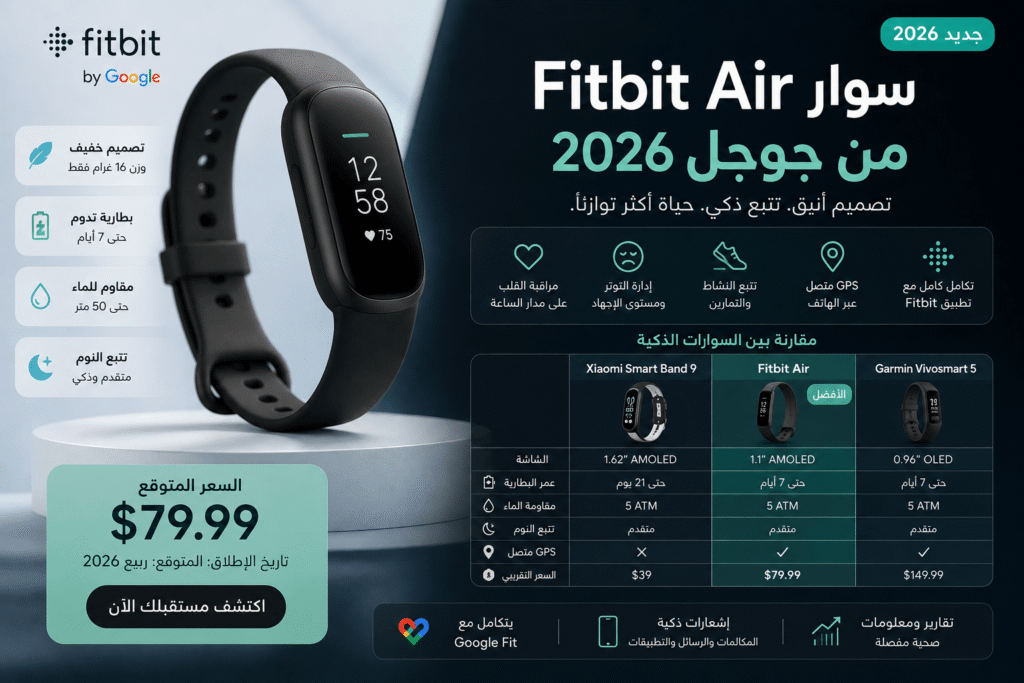
The Fitbit Air comes with a different design philosophy than traditional smartwatches; it is a lightweight band without a screen that focuses on accurately collecting health data and then analyzing it through the app. This approach targets those who want to track their fitness and sleep without constant notifications and distractions, which makes its philosophy closer to the category of dedicated fitness bands.
Key Specifications and Features
The band relies on a set of sensors that monitor heart rate, sleep stages, and daily activity level, with an extended battery life that frees you from frequent charging. It depends mainly on a smart health coach powered by artificial intelligence that provides personalized recommendations based on your data, which is the feature Google is betting on to stand out.
Price and Availability in the Saudi and Gulf Market
Google focused on offering a competitive, relatively low price compared to rival devices, aiming to attract a wide segment of users. Before buying, it is advisable to check the availability of the device at official retailers in the Kingdom, and to confirm its compatibility with your phone’s system, whether it runs on Android or iOS.
Fitbit Air vs. Its Main Competitors
The main rival to the Fitbit Air is the Whoop band, which also relies on the screen-free philosophy with a monthly subscription. Google’s strength lies in the band’s integration with the Fitbit ecosystem and Google’s health services, in addition to the lower price. Traditional fitness bands, on the other hand, still have the edge for those who want a screen that displays notifications and the time directly on the wrist.
Is the Fitbit Air Right for You?
If you are looking for a simple and lightweight way to track your health and fitness without being distracted by notifications, the Fitbit Air is an option worth considering, especially with its competitive price. But if you prefer a screen and multiple apps on your wrist, a traditional smartwatch may suit you better. The decision ultimately depends on your priorities, your budget, and your lifestyle.
Design, Comfort, and Build Quality
One of the strongest selling points of the Fitbit Air is how little you notice it on your wrist. The band is built from soft, skin-friendly materials and weighs only a few grams, which makes it comfortable to wear around the clock, including during sleep. Because there is no screen to protect, the device is more resistant to scratches and daily wear, and it carries a water-resistance rating that lets you keep it on while washing your hands, exercising, or swimming in shallow water. For users in the Gulf region, where high temperatures and humidity can affect wearable comfort, the lightweight and breathable design is a genuine advantage over bulkier smartwatches.
Health and Fitness Tracking in Daily Life
Beyond counting steps, the Fitbit Air focuses on the metrics that actually shape long-term health. It continuously measures resting heart rate, tracks sleep stages from light to deep and REM, and estimates daily readiness so you know whether to push hard in your workout or take it easy. The artificial intelligence coach then turns these raw numbers into plain-language guidance, suggesting when to move, when to rest, and how to improve your sleep routine. Over several weeks, this personalized feedback loop is where the band proves its real value, helping users build sustainable habits rather than chasing a single daily target.
Fitbit Air vs. Rivals: Comparison Table
The table below summarizes the key differences between the Fitbit Air and its main competitors to help you choose the device that best fits your needs:
| Feature | Fitbit Air | Whoop | Traditional Smartwatch |
|---|---|---|---|
| Screen | None (screen-free) | None (screen-free) | Full touchscreen |
| AI Health Coach | Yes, built-in | Yes, advanced | Varies by model |
| Battery Life | Several days | Several days | 1–2 days typically |
| Subscription | Optional (Fitbit Premium) | Required (monthly) | Usually none |
| Notifications | Via app only | Via app only | On-wrist, full |
| Water Resistance | Yes | Yes | Varies by model |
| Price Range | Budget-friendly | Mid-to-high + subscription | Wide range ($100–$500+) |
| Best For | Everyday health tracking | Serious athletes | All-in-one users |