
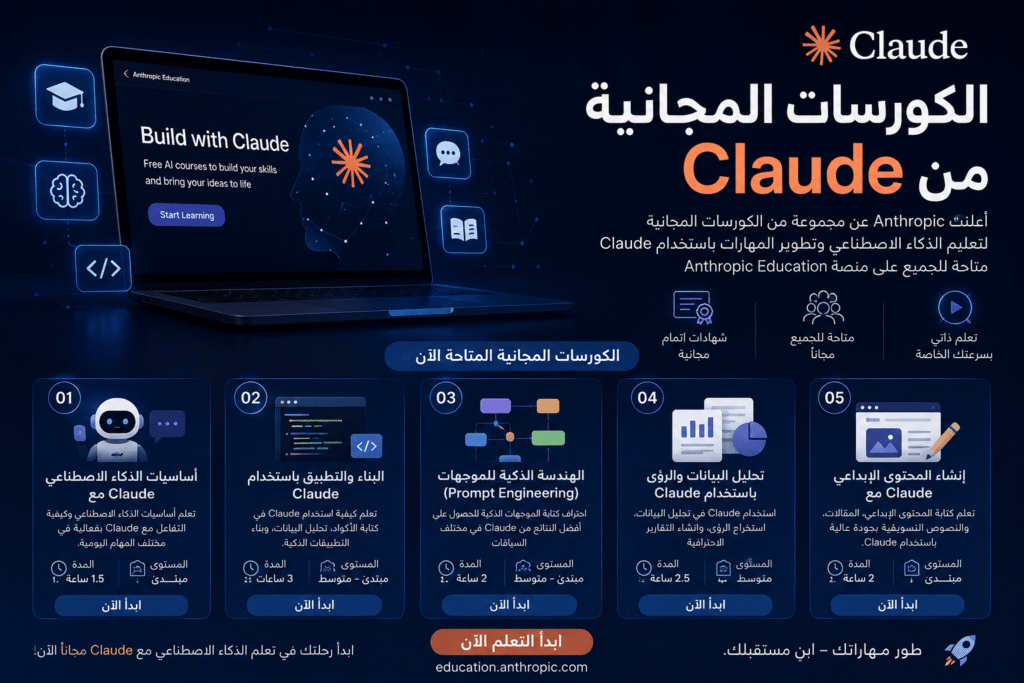
In a world where artificial intelligence advances year after year, continuous learning is no longer a luxury but a real necessity for anyone who wants to keep pace. As we move through 2026, Anthropic — the company behind safe, frontier AI — has significantly expanded its free educational library through its official Anthropic Academy platform, alongside its open-source course repository on GitHub. These resources give learners a golden opportunity to master working with Claude models in a practical, structured way, with completion certificates available on many of the learning paths.
What Is Claude Opus 4.5 and Why Does It Matter?
Claude Opus is the most capable tier in the Claude model family from Anthropic, and in 2026 it has reached the Claude Opus 4.5 generation, alongside Sonnet 4.5 and Haiku 4.5. This generation stands out for advanced logical reasoning, complex code generation, long-document analysis, and executing multi-step tasks with greater autonomy. What makes these models exceptional is Anthropic’s focus on safety and reliability as a core part of its development philosophy — which makes learning to use them a practical investment in your professional skills.
Anthropic Academy: The Official Free Courses for 2026
The biggest news this year is Anthropic Academy, an official learning platform offering structured paths that cover everyday use, development, and intelligent agents, with the option to earn a completion certificate. Here are the most important paths currently available:
1. Claude 101 — Start the Right Way
Link: Claude 101 on Anthropic Academy
A foundational course that explains how to use Claude for everyday work tasks and understand its core features. Ideal for non-developers and anyone starting their journey with the assistant. Level: Beginner.
2. AI Fluency — Collaborating Effectively with AI
Link: AI Fluency: Framework & Foundations
A path that teaches you how to collaborate with AI systems effectively, efficiently, ethically, and safely. It branches into dedicated tracks for educators, students, nonprofits, and small businesses, making it suitable for almost every audience. Level: Beginner.
3. Building with the Claude API
Link: Building with the Claude API
A comprehensive course for developers covering how to work with Anthropic’s models through the API: setting up your environment, sending messages and managing conversations, controlling outputs, and handling errors to build stable applications. Prerequisites: basic knowledge of Python or JavaScript. Level: Intermediate.
4. Claude Code — AI-Assisted Programming
Link: Claude Code 101 and Claude Code in Action
Two paths that teach you how to integrate the Claude Code tool into your daily development workflow, from the fundamentals through hands-on application inside real projects. Perfect for developers who want to boost their productivity. Level: Intermediate.
5. Model Context Protocol (MCP)
Link: Introduction to MCP and MCP: Advanced Topics
MCP is one of this year’s most important developments, providing a unified way to connect models to external data sources and tools. The path teaches you to build MCP servers and clients from scratch using Python, then moves on to advanced topics such as transport mechanisms and file-system access for production environments. Level: Intermediate to Advanced.
6. Intelligent Agents: Agent Skills and Subagents
Link: Introduction to Agent Skills and Introduction to Subagents
AI agents are the future of applied artificial intelligence. These paths teach you how to equip Claude with reusable skills and how to delegate complex tasks to specialized subagents to complete them efficiently. Level: Advanced.
7. Introduction to Claude Cowork — Working Side by Side with Claude
Link: Introduction to Claude Cowork
A hands-on course that teaches you how to work alongside Claude on your real files and projects, through interactive exercises that simulate everyday work tasks. Level: Beginner to Intermediate.
8. Cloud Deployment: Amazon Bedrock and Google Vertex AI
Link: Claude with Amazon Bedrock and Claude with Google Vertex AI
Two paths for anyone who wants to run Claude models inside major cloud environments such as Amazon Bedrock and Google Cloud Vertex AI — essential for organizations and developers working on large-scale production systems. Level: Intermediate to Advanced.
Open GitHub Courses (For Hands-On Coding Practice)
Alongside the Academy, the anthropics/courses repository on GitHub remains freely available, and it is ideal for those who prefer learning through Jupyter notebooks and runnable code examples. Its highlights include:
- Anthropic API Fundamentals: the basics of interacting with Claude models programmatically.
- Prompt Engineering Interactive Tutorial: an interactive guide to prompt engineering.
- Prompt Evaluations: how to measure and evaluate prompt quality systematically.
- Real World Prompting: applying prompts across various real-world scenarios.
- Tool Use: teaching Claude to call external tools and functions.
How Do You Get Started?
Getting started is simpler than you think. For the Academy paths: visit the official Anthropic Academy courses page, pick the course that matches your level, and sign in to track your progress and earn a certificate. For hands-on coding via GitHub, create a free account at console.anthropic.com and get an API key, then clone the repository with the command git clone https://github.com/anthropics/courses and work through the lessons in order.
Why Choose Anthropic’s Courses Specifically?
These courses stand out because they come straight from the company that builds the models, ensuring accurate information that stays aligned with the latest releases. They are also fully practical with applicable examples, completely free with no hidden fees, continuously updated, and they offer completion certificates on Academy paths that strengthen your professional profile. Add to that an active community of developers around the world.
The Future of Learning with Claude in 2026
With the Claude 4.5 generation, the models’ capabilities have expanded in programming, intelligent agents, and data analysis. According to the official documentation, mastering these tools today gives you a real competitive edge in a job market where demand for AI skills grows year after year. Investing in learning now is a smart decision that puts you ahead.
Additional Trusted Learning Resources
- Anthropic’s official Claude Courses page — the authoritative reference listing all learning paths with video lessons, assessments, and certificates.
- Anthropic’s official documentation — a complete reference for Claude’s features and capabilities.
- Anthropic’s research page — for diving into the scientific foundations of the models.
- DeepLearning.AI — free and paid courses from Andrew Ng.
- Hugging Face Learn — a comprehensive learning platform for open-source AI.
Frequently Asked Questions
Are Anthropic’s courses really free?
Yes. The Anthropic Academy paths and the GitHub repository are available for free. You may only need credit to use the API when running code examples.
Do I get a certificate after completing a course?
Many Anthropic Academy paths offer a completion certificate you can add to your professional profile, while the GitHub courses focus on hands-on coding without a certificate.
Do I need coding experience to start?
No, for foundational paths such as Claude 101 and AI Fluency. The API, MCP, and Claude Code paths, however, require basic knowledge of Python or JavaScript.
Final Thoughts
Anthropic’s 2026 courses represent a rare chance to learn directly from the source — whether you are a beginner who wants to understand Claude in your daily work, or a developer building applications and intelligent agents. Start with a path that fits your level on Anthropic Academy, then complement it with hands-on practice via GitHub, and within weeks you will find yourself able to put AI to work with confidence and professionalism. Learning never stops, and the opportunity is available right now — for free.