
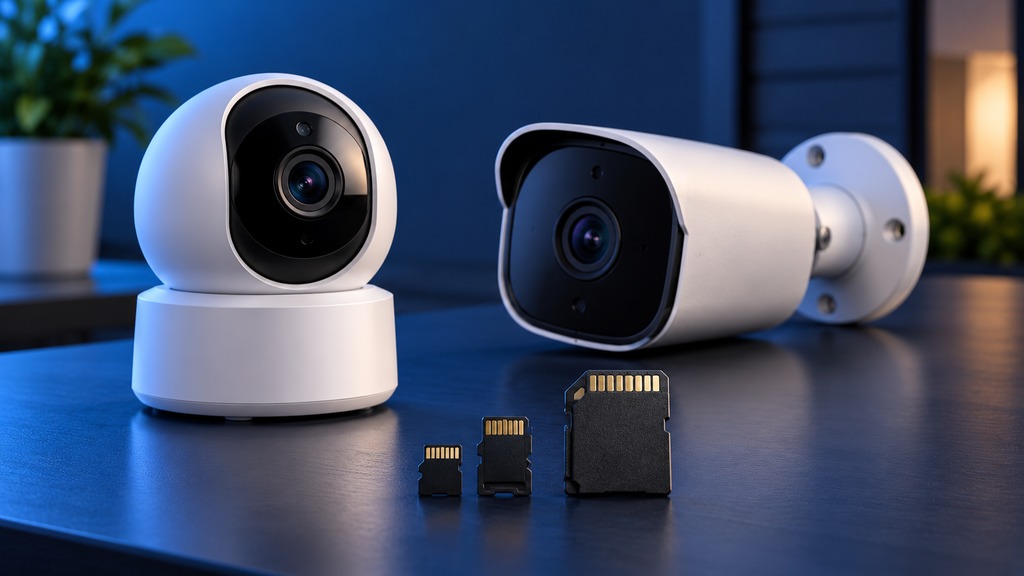
The best memory card for a security camera is the one that can handle repeated recording while meeting the exact camera’s requirements. A large capacity and an impressive read-speed figure are not enough. When footage matters, the complete process must work: the camera records it, the timeline can play it and an important clip can be exported. Choosing storage carefully is therefore part of setting up the camera, rather than a minor accessory decision.
Specifications reviewed: October 17, 2026. These are editorial recommendations based on official manufacturer information, not results from a controlled physical comparison conducted by SaudiWe. Our starting shortlist is Samsung PRO Endurance and SanDisk High Endurance in a supported capacity, with MAX ENDURANCE worth comparing when endurance is a priority. There is no universal winner for every camera and budget.
Why choose an endurance card?
With continuous recording and loop storage enabled, a camera writes video and replaces older files when space runs out, according to its settings. Endurance products target intensive writing applications. Kingston’s High Endurance page, for example, explicitly identifies surveillance and dash cameras as intended uses. A general-purpose card recording one successful clip does not demonstrate suitability for that repeated workload.
Compare compatibility first, then the intended workload, supported capacity and required speed, followed by price and warranty. That order prevents a misleading comparison between products designed for different jobs. Paying for a feature the camera cannot use is less useful than buying the correct card from a reliable seller and verifying that recording actually works after installation.
Security-camera memory card shortlist
| Card | Reason to compare it | Check before buying |
|---|---|---|
| Samsung PRO Endurance | General shortlist for repeated recording | Capacity, compatibility and local price |
| SanDisk MAX ENDURANCE | Purpose-built endurance option | Price difference against alternatives |
| SanDisk High Endurance | Surveillance-focused value candidate | Full series name and part number |
| Kingston High Endurance | Alternative for intensive writing | Required speed classification |
| Transcend High Endurance 350V | Multiple capacity options | Specifications of the selected capacity |
Samsung PRO Endurance: a balanced starting point
The official Samsung PRO Endurance 256GB page identifies surveillance as an intended application and lists Class 10, U3 and V30. Published speeds reach up to 100MB/s reading and 40MB/s writing under the manufacturer’s test conditions. This makes it a sensible shortlist candidate, provided the camera supports the selected capacity.
Compare it with other endurance products of the same capacity rather than with the cheapest unrelated card. A manufacturer sells different series for different workloads, so its logo alone is not a purchasing specification. Keep the invoice and product description, particularly when a marketplace listing combines several capacities and series under one page.
SanDisk MAX ENDURANCE and High Endurance
SanDisk MAX ENDURANCE lists up to 100MB/s reading and 40MB/s writing for its 256GB version, with Full HD and 4K support on compatible devices. Include it when comparing purpose-built endurance storage, but do not interpret the product name as a guarantee that a card cannot fail or footage cannot be lost.
SanDisk High Endurance also targets monitoring and dash-camera applications. Its official page lists Class 10, U3 and V30. It can be a value candidate when the required capacity costs less than alternatives from a trustworthy seller. That is a conditional buying recommendation, not a claim that it is always the lowest-priced option.
Check the complete series name in the selected option, basket and invoice. A product photograph may show one version while the chosen variant is another. Colour is not a reliable substitute for a part number. On marketplaces, distinguish the platform from the actual seller and review who provides returns and warranty support.
Kingston and Transcend alternatives
Kingston lists U1 and Class 10 for its High Endurance family, with capacities up to 256GB. If a camera specifically requires U3 or V30, do not disregard that requirement merely because a card is labelled Endurance. Suitability requires the right combination of workload design and the camera’s recording specification.
Transcend High Endurance 350V has specifications that vary by capacity; its 128GB and 256GB options list U3 and V30. Open the table for the version being purchased. Larger-capacity specifications should not automatically be applied to every smaller version in a family.
Read speed is not the whole recording story
The SD Association’s speed-class explanation describes classifications for minimum sequential performance under specified conditions and the importance of matching host and card requirements. UHS-I describes a bus interface; U3 describes a speed class. They are different labels, so a card marked UHS-I is not necessarily a U1-only card.
Begin with the symbols and requirements in the camera manual. If a shop omits them, consult the model’s documentation or manufacturer support before ordering. Resolution alone does not identify every recording requirement: bitrate, recording mode and the host’s specifications also matter. An unsupported store comment should not override a clear instruction from the camera manufacturer.
128GB or 256GB: start with the camera model
A larger capacity creates more room at the same settings; it does not improve picture quality. Support is model-specific. Eufy’s support page for a listed group of devices specifies a 128GB maximum, while the official Wired Cam C31 page advertises support up to 256GB. Neither statement should be generalised to every camera carrying the brand.
Find the model number on the device or in its app, then match it to the documentation. Reformatting does not establish that an unsupported capacity has become officially compatible. Another owner’s experience is also inconclusive if their model differs. Where the documented limit is 128GB, a suitable genuine card is a clearer purchase than a larger unsupported experiment.
How long will a 256GB card record?
The following figures are theoretical calculations using decimal storage capacity and a fixed total bitrate, before system overhead and operational differences. They are not measurements from a particular camera. Approximate daily use in gigabytes equals the bitrate in megabits per second multiplied by 10.8 for continuous recording.
| Assumed total bitrate | Daily storage use | Theoretical 256GB retention |
|---|---|---|
| 2Mbps | 21.6GB | 11.9 days |
| 4Mbps | 43.2GB | 5.9 days |
| 8Mbps | 86.4GB | 3 days |
Motion-only recording changes retention according to the frequency and length of events, while variable recording rates alter consumption through the day. Manufacturer endurance hours describe cumulative writing under test conditions, not the amount of footage stored simultaneously. Those figures also cannot provide a fair league table without matching the underlying test methods and capacities.
Format and verify the complete workflow
Back up important files before formatting because formatting erases card contents. Follow the camera’s setup procedure. The eufy support page cited above requires formatting in its app before using the card for encrypted recordings. After setup, play a timeline clip and export it. Seeing the capacity appear on screen does not verify the entire recording workflow.
Save essential clips separately instead of leaving them in loop storage. If a phone is part of your review routine, SaudiWe’s smartphone buying guide for Saudi Arabia provides related device-shopping context. Check the camera app’s requirements independently; a phone need not have a microSD slot to manage recordings through a supported app.
Final purchasing checklist
- Match the exact camera model and supported capacity.
- Choose a series designed for repeated recording.
- Check the speed class of the selected version.
- Review the seller, invoice, warranty and return terms.
- Test recording, playback and export after installation.
The right choice combines compatibility, endurance, authenticity and enough retention for the task. Compare prices for the same product, then monitor actual recording rather than relying on the packaging alone. The cover is a general conceptual illustration of cameras and memory cards, not a laboratory test photograph or a depiction of the recommended products’ packaging.