
Saudi Women’s Football Team Heads to Bangkok: A Camp That Means More Than Just Wins
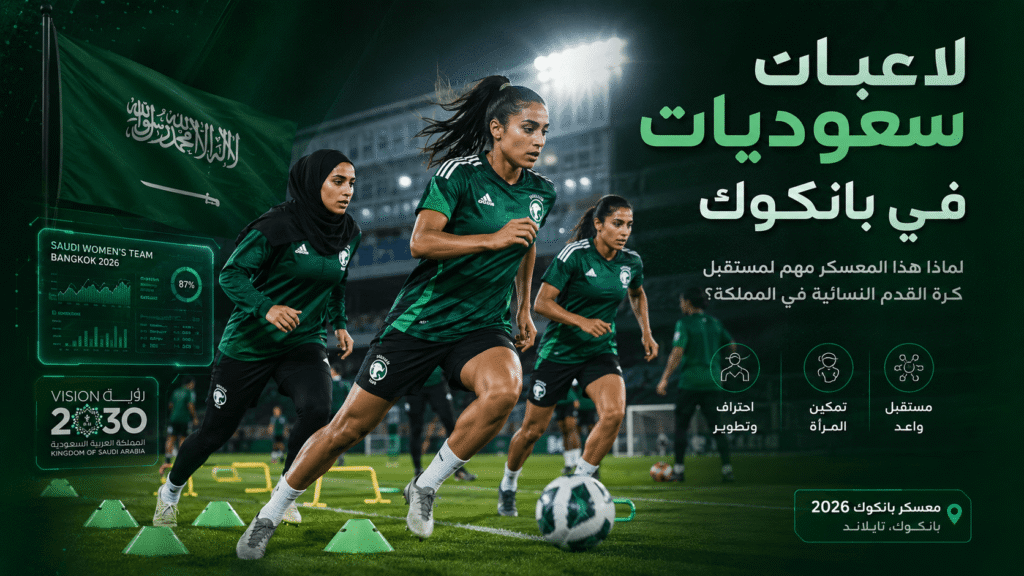
On May 31, 2026, a plane carrying 26 Saudi women departed for Bangkok, Thailand — not for tourism, but for an intensive training camp running until June 14. These players represent Saudi Arabia’s national women’s football team, and they carry on their shoulders dreams far larger than the results of a few friendly matches.
This camp is not an ordinary sports gathering. It is a living manifestation of a profound social and cultural transformation that Saudi Arabia has been undergoing for years — a transformation that few could have imagined even a decade ago. So how did we get here, and what does this camp truly mean?
From Zero to Bangkok: The Story of Saudi Women’s Football
For those who follow Saudi sports closely, the journey has been anything but sudden. In 2017, the Saudi Football Federation launched its first women’s school football tournament — a tentative step, but the first seed of something far greater. Within just a few years, the national women’s team was officially established, and began competing on regional and international stages.
Today, the squad is led by experienced Spanish coach Luis Cortés, whose background in developing women’s national teams is precisely why his appointment was deliberate. The Spanish footballing school is widely regarded as one of the most technically sophisticated in the world of women’s football — a choice that signals Saudi Arabia’s ambition to elevate the team’s technical quality in a systematic and accelerated manner.
26 Players, 26 Inspiring Stories
Cortés called up 26 players from across Saudi Arabia’s various regions and women’s league clubs. Each one carries her own story: Randa Al-Abdulqader, who hails from a community that barely knew women’s football existed a few years ago; Munira Al-Ghanam, a familiar face with the national team since its early days; and Layla Al-Fudhail and Yasmin Al-Fudhail, who share a surname and perhaps a shared dream.
What stands out about the squad is its geographical and age diversity — an indication that the federation is building a broad talent base rather than relying on a handful of established stars. This strategic thinking is precisely what distinguishes successful football programs worldwide.
Why Bangkok?
The choice of Bangkok as a camp destination is not random — it has both technical and logistical dimensions. First, climate: Thailand’s weather during this period bears resemblance to the conditions expected in upcoming competitive environments, allowing players to acclimatize gradually. Second, competition level: opponents Sri Lanka and Laos offer a suitable testing ground for formations and tactical plans without the high-stakes pressure of major tournaments — ideal during a development phase. Third, positive isolation: an overseas camp gives players full focus on training, free from daily distractions, dramatically accelerating team cohesion.
Director of Women’s Football, Alia Al-Rashid, describes these camps as “an important milestone in the team’s preparation journey,” adding that the goal is to give players “more international experience through encounters with diverse opponents.” These words may sound diplomatic, but they reflect a clear sporting philosophy: learning from varied experiences is the fastest path to growth.
The Competitive Schedule: Three Friendlies with Bigger Goals
The camp includes three friendly matches: against Sri Lanka on June 4, Laos on June 10, and a second fixture against Laos on June 13. While the opponents may not be headline names in Asian football, the real value lies not in who they are but in what can be learned from each match.
The first match against Sri Lanka will serve as a test of the starting lineup and the tactical system Cortés has been refining during the opening days of camp. The second will likely see rotation, evaluating new faces and backup options. The third will act as the camp’s culmination — its true final exam.
The Bigger Picture: Saudi Women’s Football in 2026
This camp cannot be read in isolation from the broader context. Saudi Arabia in 2026 is a country preparing to host the 2034 FIFA World Cup — a nation investing at an unprecedented scale in sports of every kind. Women’s football specifically is experiencing a qualitative leap: more professional leagues, developing infrastructure, and an audience still taking shape.
The numbers speak louder than any speech. Over 70,000 girls now play football across the Kingdom’s school leagues. The number of registered professional female players surged by 195% since 2021. Private clubs and academies more than doubled in a single year — jumping from 88 to 189. The Saudi Arabian Football Federation (SAFF) launched the first-ever Women’s Second Division in 2024 with 25 clubs — a figure that was unimaginable just a few years ago. These are not mere statistics — they are the footprint of a generation arriving with better skills and broader ambitions.
The Real Challenges: What Official Statements Don’t Say
The picture is not entirely rosy, and any honest analysis must acknowledge the existing challenges. Chief among them is the lack of fully integrated grassroots infrastructure in some regions, where the gap between major cities and other areas remains significant. Full professionalization of the women’s league is still in progress, and many players still balance sport with study or work.
Media coverage of women’s football also remains limited compared to the men’s game — directly affecting public awareness and stadium attendance. Yet these very challenges are precisely what makes initiatives like overseas camps so important: they generate the media buzz and public interest that women’s football deserves.
What This Camp Means in the Long Run
What Cortés is building in Bangkok goes beyond friendly match results. He is building a team culture, a sense of belonging to the national jersey, and an instinct for international competition. These intangible elements are what make the difference in the decisive moments of major fixtures.
The Saudi women’s national team is looking to steadily improve its FIFA ranking and qualify for higher-level Asian competitions. Given the current pace of development, it is no exaggeration to say that the next few years will see remarkable leaps in performance and recognition.
A Final Word: What This Moment Means
When a Saudi player leaves her country wearing the national badge to compete on foreign soil, she does not represent only herself — she represents an entire generation of young women who grew up in an environment that has only recently discovered that sport is a right, not an exception. This moment carries a symbolic weight that far exceeds anything recorded in match reports.
The Bangkok 2026 camp is one point on a long journey — but it is a luminous one. And in football, as in life, it is the luminous points that illuminate the road ahead.