Last updated: July 11, 2026
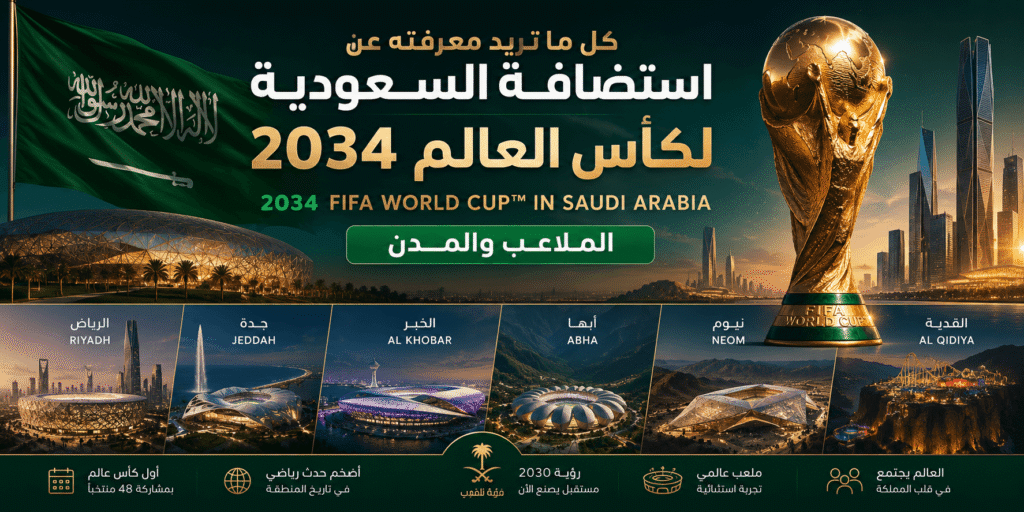
In December 2024, FIFA officially announced that the Kingdom of Saudi Arabia won the honor of hosting the 2034 FIFA World Cup, making it the second Arab nation to host the world’s biggest football event after Qatar 2022. This historic decision is a milestone within Saudi Vision 2030, placing the Kingdom at the heart of the global sports map. In this complete guide, we cover everything you need to know about the tournament: host cities, 2034 World Cup stadiums, readiness, and the expected impact on tourism and the economy.
Quick Facts About the 2034 World Cup
48
Teams
104
Matches
15
Stadiums
5
Host Cities
How Did Saudi Arabia Win the 2034 World Cup Bid?
The Kingdom secured the tournament after being the sole candidate to host this edition of the World Cup, with the FIFA Council confirming the bid during its meeting on 11 December 2024. The Saudi bid received the highest technical score among World Cup hosting bids according to the evaluation report issued by FIFA, thanks to its infrastructure readiness and massive investment plans in the sports and tourism sectors.
Through the Saudi World Cup, the Kingdom aims to cement its position as a global destination for major events, following a series of successful sporting events such as the Spanish and Italian Super Cups, boxing championships, and Formula 1.
Why Was Saudi Arabia Chosen to Host the World Cup?
The choice of the Kingdom was not coincidental; it was based on an integrated set of strengths that made the Saudi bid the highest-rated. The main reasons for hosting the World Cup in Saudi Arabia can be summarized as follows:
- Vision 2030: A comprehensive national strategy making sports, tourism, and entertainment key pillars of economic diversification.
- Infrastructure: A network of modern stadiums, advanced airports, and world-class hotels, with mega-projects under construction.
- Sports Investments: Massive investments in clubs, tournaments, and attracting international stars.
- Transport: An integrated transport system including high-speed trains, metro lines, and shuttle buses.
- Tourism: Diverse tourism assets from heritage and nature to modern destinations, making the Kingdom ready to welcome fans.
2034 World Cup Host Cities
According to the official bid submitted to FIFA, the tournament matches will be held across five main cities distributed throughout the Kingdom’s regions, reflecting its geographic and cultural diversity:
Riyadh
Riyadh is the heart of the tournament and holds the largest share of 2034 World Cup stadiums, with around eight of the fifteen venues located there according to the official bid. The most prominent is King Salman International Stadium, expected to host both the opening match and the final with a capacity exceeding 92,000, alongside the redeveloped King Fahd International Stadium, the Prince Mohammed bin Salman Stadium in Qiddiya, and the New Murabba Stadium — making the capital the main hub of the Saudi World Cup.
Jeddah
Jeddah, the “Bride of the Red Sea,” blends heritage and modernity and, based on current official information, features several venues — most notably King Abdullah Sports City Stadium (The Jewel) with a capacity of around 62,000, Jeddah Central Stadium within the downtown development project, and King Abdullah Economic City Stadium. The city serves as a historic gateway for visitors arriving via the Red Sea.
Al Khobar
Al Khobar, in the Eastern Province overlooking the Arabian Gulf, is among the 2034 World Cup host cities through the new Aramco Stadium with a capacity of around 47,000. The city stands out for its proximity to Gulf cities and easy access for visiting fans.
Abha
Abha, the capital of mountain tourism in the Asir region, is a unique destination with its mild climate and green landscapes. The city hosts tournament matches through King Khalid University Stadium with a capacity of around 45,000, adding a distinctive tourism dimension to the event.
NEOM
NEOM, the futuristic city and one of the flagship symbols of Saudi Vision 2030, participates among Saudi Arabia’s new stadiums through NEOM Stadium with a capacity of around 46,000. The venue reflects the innovative character of the project as one of the most design-distinctive stadiums of the Saudi World Cup.
2034 World Cup Stadiums Announced in the Official Bid
The Saudi bid includes 15 stadiums, both new and redeveloped, across five cities, designed to the latest global standards and environmental sustainability. The table below lists the stadiums according to current official information, noting that some are still under development and their names and capacities may be updated later:
| # | Stadium | City | Approx. Capacity | Status |
|---|---|---|---|---|
| 1 | King Salman International Stadium | Riyadh | ~92,000 | New |
| 2 | King Fahd International Stadium (redeveloped) | Riyadh | ~70,000 | Redeveloped |
| 3 | New Murabba Stadium | Riyadh | ~46,000 | New |
| 4 | Prince Mohammed bin Salman Stadium (Qiddiya) | Riyadh | ~46,000 | New |
| 5 | Prince Faisal bin Fahd Sports City Stadium | Riyadh | ~46,000 | Redeveloped |
| 6 | King Saud University Stadium | Riyadh | ~46,000 | Redeveloped |
| 7 | Roshn Stadium | Riyadh | ~46,000 | New |
| 8 | South Riyadh Stadium | Riyadh | ~46,000 | New |
| 9 | King Abdullah Sports City Stadium (The Jewel) | Jeddah | ~62,000 | Redeveloped |
| 10 | Jeddah Central Stadium | Jeddah | ~45,000 | New |
| 11 | King Abdullah Economic City Stadium | Jeddah | ~46,000 | New |
| 12 | Qiddiya Coast Stadium | Jeddah | ~46,000 | New |
| 13 | Aramco Stadium | Al Khobar | ~47,000 | New |
| 14 | King Khalid University Stadium | Abha | ~45,000 | New |
| 15 | NEOM Stadium | NEOM | ~46,000 | New |
Will All Stadiums Be Ready Before the Tournament?
Saudi Arabia is working according to the timeline approved by FIFA to complete the stadiums and infrastructure before the tournament kicks off, with testing phases and trial tournaments held beforehand to ensure the readiness of facilities and accompanying services.
Fast Facts About the 2034 World Cup
- The first FIFA World Cup ever hosted by Saudi Arabia.
- The second edition to be held in an Arab country after Qatar 2022.
- Scheduled to be played with 48 teams and 104 matches under the expanded format (unless officially changed).
- The Saudi bid received the highest technical score among hosting bids according to FIFA’s evaluation report.
- Matches will be spread across 15 stadiums in five host cities according to the official bid.
What Will Fans Gain From the World Cup in Saudi Arabia?
The tournament is not limited to matches; it offers a complete experience for fans coming from inside and outside the Kingdom. Here are the key points that matter to fans:
- Visa: Entry facilitations for fans are expected, similar to previous major tournaments.
- Hotels: Thousands of hotel rooms and giant hospitality projects across the host cities in various price ranges.
- Transport: A modern network connecting stadiums to airports and hotels via trains, metro, and buses.
- Weather: The tournament is likely to be held in a milder climate period to ensure comfort for fans and players.
- Best Cities for Tourism: An opportunity to visit Riyadh, Jeddah, AlUla, Abha, and Diriyah and enjoy heritage and nature.
2034 World Cup Date and Preparations
FIFA has not yet announced the final schedule or the exact date of the tournament, but holding it during a milder climate period remains an option, similar to Qatar 2022. Saudi Arabia is developing an integrated transport and hospitality system to welcome millions of visitors. If you want to follow the nearest major football event, you can check our complete 2026 World Cup guide for the match schedule, stadiums, and teams.
Expected Economic and Tourism Impact
The 2034 World Cup is expected to give a strong boost to the Saudi non-oil economy by energizing the tourism, hospitality, transport, and entertainment sectors, and creating hundreds of thousands of jobs. The event will also accelerate Vision 2030’s mega-projects such as NEOM, Qiddiya, and Diriyah, while enhancing the Kingdom’s image as a global tourism destination open to cultures.
Trusted Sources
For the latest official information, you can visit the FIFA Official Website, the Saudi Ministry of Sport, the Saudi 2034 Official Bid Website, and Saudi Vision 2030.
Frequently Asked Questions
When will the 2034 World Cup take place?
FIFA has not announced the final date yet, but it is likely to be held during a milder climate period to ensure suitable conditions for players and fans.
How many host cities are there?
Five main cities: Riyadh, Jeddah, Al Khobar, Abha, and NEOM, distributed across the Kingdom’s regions.
Where will the final be held?
The final is likely to be held at King Salman International Stadium in Riyadh, with a capacity exceeding 92,000 spectators, pending final confirmation from FIFA.
How many stadiums are allocated for the tournament?
The Saudi bid includes 15 stadiums, both new and redeveloped, across the various host cities.
Will all stadiums be ready before the tournament?
Saudi Arabia is working according to FIFA’s approved timeline to complete the stadiums and infrastructure before the tournament, with testing phases and trial tournaments to ensure readiness.
Related Articles
- Top 10 Laptops in Saudi Arabia 2026 – Prices, Specs & Use Cases
- 10 Profitable Small Business Ideas in Saudi Arabia with Low Capital (2026)
Conclusion
Saudi Arabia’s hosting of the 2034 World Cup represents a historic milestone in the journey of Saudi sport, and an opportunity to showcase its organizational capabilities and development projects to the world. With ongoing work on developing stadiums, transport networks, and tourism facilities, all eyes are on an edition expected to be among the most technologically and infrastructurally advanced World Cups. We will continue to update this guide as soon as FIFA announces any official developments regarding the tournament schedule, stadiums, and host cities.
References
This article was prepared based on the official sources mentioned above, most notably FIFA, the Saudi Ministry of Sport, the Saudi 2034 official bid website, and Saudi Vision 2030, as of 11 July 2026.