Introduction: A Vision for a Prosperous Future
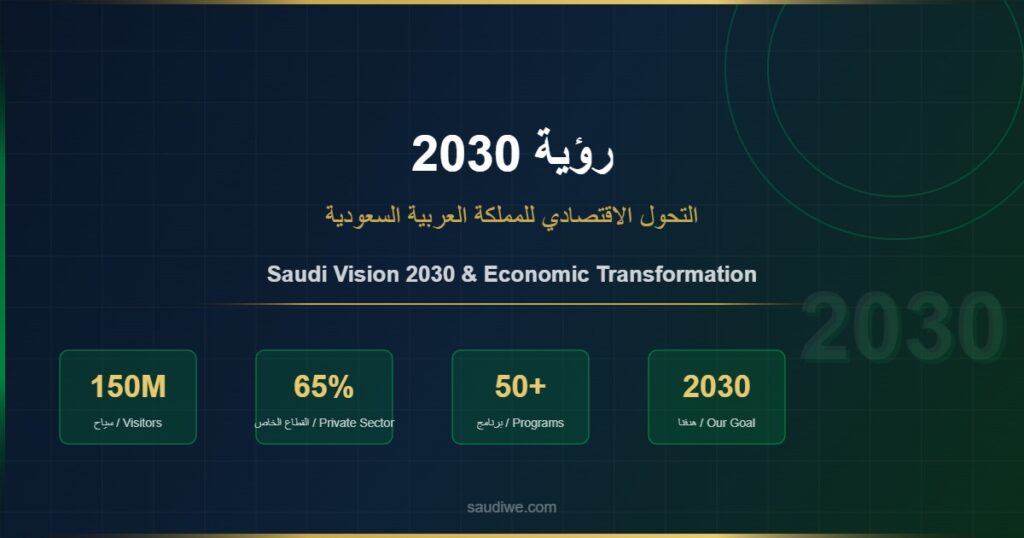
In April 2016, Saudi Arabia unveiled one of the most ambitious national transformation plans the world has ever seen: Saudi Vision 2030. Announced by Crown Prince Mohammed bin Salman, this comprehensive national strategy aims to diversify the Saudi economy away from its heavy dependence on oil and transform the Kingdom into a global investment powerhouse and a vibrant hub for business, culture, and tourism.
Vision 2030 rests on three fundamental pillars: a Vibrant Society, a Thriving Economy, and an Ambitious Nation. Each pillar encompasses dozens of programs and initiatives designed to reshape the Kingdom’s economic, social, and institutional landscape. To explore the full scope of the vision, visit the official Vision 2030 website.
Economic Diversification: Breaking Free from Oil Dependency
For decades, Saudi Arabia’s economy remained heavily dependent on hydrocarbon revenues, which at times represented over 70% of government income. Vision 2030 aims to break this cycle through an ambitious economic diversification strategy, targeting high-potential sectors including tourism, entertainment, mining, manufacturing, financial services, and technology.
The plan targets raising the private sector’s contribution to GDP from 40% to 65%, reducing unemployment from 11.6% to 7%, and increasing women’s workforce participation from 17% to 30%. These are not merely aspirational targets — they are backed by concrete programs, regulatory reforms, and massive capital investment from the Public Investment Fund (PIF).
In the tourism sector, Saudi Arabia aims to attract 150 million visitors annually by 2030, up from just a few million a decade ago. Since launching its e-tourist visa in 2019, the Kingdom has seen a dramatic surge in international arrivals. In 2023, the country recorded over 100 million tourist visits — a testament to the momentum behind Vision 2030’s tourism ambitions. For the latest tourism statistics, visit the Saudi Tourism Authority.
Giga-Projects: Engineering the Future
No discussion of Vision 2030 is complete without mentioning the Kingdom’s giga-projects — transformative developments that are redefining what is architecturally and economically possible. These projects are not merely large-scale constructions; they represent entirely new visions for how cities, tourism destinations, and communities can be built.
- NEOM: A 26,500 km² smart city being built from scratch in northwestern Saudi Arabia. At its heart is “The Line” — a 170-kilometer linear city powered entirely by clean energy and designed to be car-free, operating on a fully connected, AI-driven infrastructure.
- Red Sea Project: A luxury sustainable tourism destination spanning over 200 islands and inland sites along Saudi Arabia’s Red Sea coast, targeting eco-conscious travelers seeking world-class experiences.
- Qiddiya: A vast entertainment, sports, and arts destination being developed just outside Riyadh, set to become one of the largest entertainment cities on the planet.
- Amaala: An ultra-luxury wellness and lifestyle destination on the Red Sea coast, inspired by the rich heritage of the Hejaz region.
These giga-projects are primarily financed through the Public Investment Fund (PIF), which has grown into one of the largest sovereign wealth funds in the world with assets exceeding $700 billion. The PIF serves as the financial engine of Vision 2030, channeling capital into domestic and international investments that support the Kingdom’s transformation.
Labor Market Reform: Empowering Saudi Citizens
One of Vision 2030’s central challenges — and greatest achievements — has been reshaping the Saudi labor market. Historically, the private sector was dominated by expatriate workers, while many Saudi nationals preferred the stability and benefits of government employment. Vision 2030 set out to reverse this dynamic through a series of reforms known broadly as “Saudization” or Nitaqat programs.
The results have been remarkable. Women’s participation in the workforce surpassed 33% in recent years, significantly exceeding the original 30% target set for 2030. The Human Resources Development Fund (HADAF) has played a pivotal role in facilitating this growth by subsidizing the wages of newly employed Saudi workers in the private sector and financing vocational training programs. For up-to-date labor statistics, the General Authority for Statistics publishes regular labor market reports.
Fiscal Reform: Building Financial Sustainability
Saudi Arabia’s Vision 2030 is also fundamentally a story of fiscal transformation. The Kingdom launched the Fiscal Balance Program to reduce budget deficits and diversify government revenue beyond oil. The key fiscal reforms introduced include:
First, the introduction of Value Added Tax (VAT) at 5% in 2018, subsequently raised to 15% in 2020, which significantly broadened the government’s non-oil revenue base. Second, the energy subsidy reform program, which gradually raised fuel and electricity prices to reduce the financial burden on the state. Third, the launch of Aramco’s partial IPO in 2019 — the world’s largest at the time — which brought in over $25 billion and signaled Saudi Arabia’s integration into global capital markets.
As a result of these reforms, non-oil revenues rose from SAR 163 billion in 2016 to over SAR 400 billion in recent years. Saudi Arabia achieved budget surpluses in 2021 and 2022. For the latest budget and fiscal reports, visit the Ministry of Finance Saudi Arabia.
Digital Transformation: Building a Knowledge Economy
Digital transformation is central to Vision 2030’s vision for a thriving economy. Saudi Arabia has invested heavily in building a world-class digital infrastructure, launching the Digital Economy Program, rolling out 5G networks, and positioning Riyadh as a regional hub for global tech companies. Major technology corporations including Google, Amazon, Microsoft, and SAP have established regional headquarters in the Kingdom.
Internet penetration in Saudi Arabia exceeds 95%, among the highest in the world. The government’s digital services have been comprehensively overhauled, with the Absher platform becoming a model for e-government globally. A vibrant startup ecosystem is flourishing in sectors including fintech, artificial intelligence, e-commerce, and health tech. The Communications and Information Technology Commission (CITC) oversees the Kingdom’s digital transformation agenda.
Education and Innovation: Investing in Human Capital
Sustainable economic transformation requires more than financial capital — it demands investment in human potential. Vision 2030’s Education Development Program has overhauled school curricula, expanded technical and vocational education, and fostered a culture of entrepreneurship and innovation among Saudi youth.
The Custodian of the Two Holy Mosques Scholarship Program has sent tens of thousands of Saudi students to top universities worldwide, creating a generation of internationally educated professionals ready to drive the Kingdom’s knowledge economy. King Abdullah University of Science and Technology (KAUST) continues to lead cutting-edge research in fields aligned with Vision 2030 priorities. For information on education initiatives, visit the Ministry of Education.
Social Transformation: A More Open and Dynamic Society
Perhaps the most visible changes under Vision 2030 are the profound social transformations taking place across the Kingdom. After decades of ban, cinemas reopened in 2018. Music concerts, sporting events, and cultural festivals have become regular features of Saudi life. Women were granted the right to drive in 2018. Mixed-gender entertainment and social spaces are now commonplace in major Saudi cities.
These changes serve both social and economic purposes. By improving quality of life and creating a vibrant domestic entertainment sector, Saudi Arabia is reducing the significant outflow of leisure spending abroad (estimated at over $20 billion annually before Vision 2030), while simultaneously creating thousands of jobs in hospitality, arts, and entertainment. The entertainment sector alone is projected to contribute over 1.5% of GDP by 2030. Learn more at the Vision 2030 Vibrant Society page.
Assessment: Progress, Achievements, and Challenges
With 2030 approaching, the time has come to assess Vision 2030’s progress against its ambitious benchmarks. The results are a mixed picture of genuine achievements and ongoing challenges. On the positive side, non-oil GDP has grown substantially, women’s workforce participation has already exceeded its 2030 target, the entertainment and tourism sectors have been transformed, and Saudi Arabia’s international competitiveness rankings have improved markedly.
However, significant challenges remain. Deep structural economic diversification takes generations, not years. The cultural shift needed to make the private sector as attractive as government employment for Saudi nationals is still a work in progress. Some giga-projects face delays and cost overruns, prompting questions about timelines and execution. Moreover, global economic headwinds and the volatility of oil prices continue to influence the Kingdom’s fiscal position.
Conclusion: A Vision that is Reshaping the Future
Vision 2030 remains one of the most ambitious and consequential national transformation programs of the 21st century. Whether all targets are achieved precisely by 2030 or not, the Kingdom of Saudi Arabia has already demonstrated an extraordinary capacity for change, and the direction of travel is unmistakably toward a more diversified, sustainable, and dynamic economy.
As the world watches this transformation unfold, Saudi Arabia’s Vision 2030 offers valuable lessons about the power of strategic planning, political will, and economic ambition. For a full overview of realization programs, milestones, and progress reports, visit the Vision 2030 Realization Programs portal and the General Authority for Statistics reports.