EDUCATION · CAREERS · VISION 2030 | May 2026
The careers of tomorrow are being built in classrooms today. Here is everything Saudi students need to know before choosing their university major in 2026.
Table of Contents
- Introduction: The Decision That Shapes Your Entire Life
- Why Choosing the Right Major Matters More Than Ever in 2026
- The AI Revolution: How Artificial Intelligence Is Reshaping Every Career
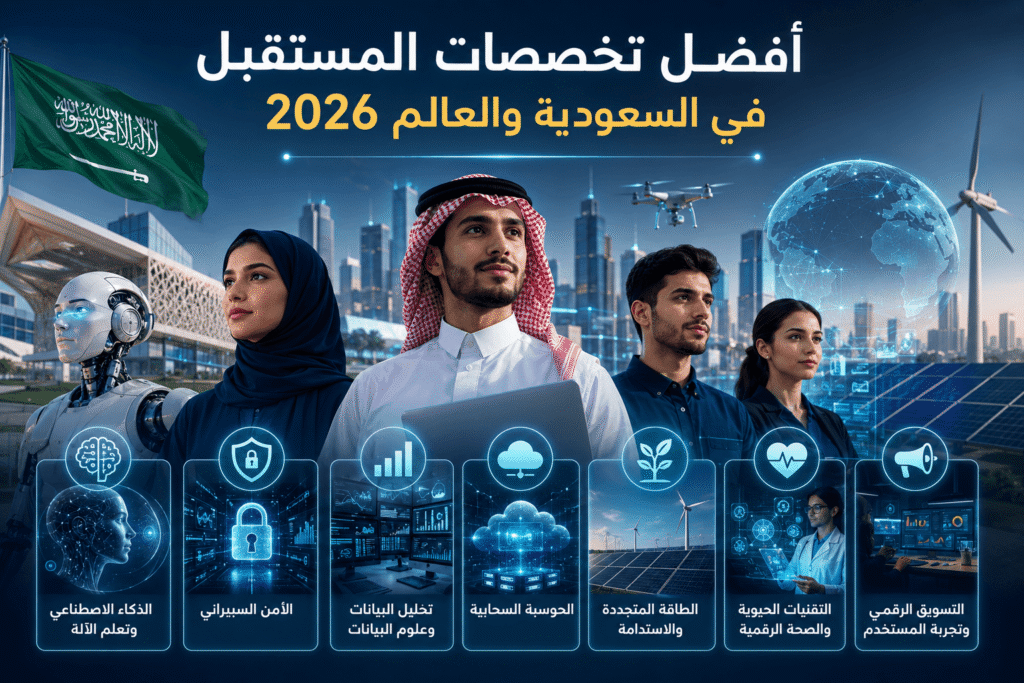
- Top Future Majors in Saudi Arabia
- Top Global Future Careers in 2026
- Highest Paying Future Jobs and Majors
- Majors That Are Disappearing
- Best Majors Aligned with Saudi Vision 2030
- Technology and AI Careers
- Healthcare and Biotechnology Careers
- Cybersecurity Careers
- Business and Digital Marketing Careers
- Renewable Energy Careers
- Best Universities for Future Majors
- Tips for Students Choosing Their Major
- FAQ Section
- Final Conclusion
Quick Answer: The top future university majors in Saudi Arabia and the world for 2026 include Artificial Intelligence, Cybersecurity, Data Science, Biomedical Engineering, Renewable Energy, Cloud Computing, and Digital Marketing. These fields offer the highest job demand, strongest salary growth, and best alignment with Saudi Vision 2030 priorities. Students choosing these majors position themselves at the forefront of the global economy.
Introduction: The Decision That Shapes Your Entire Life
Every year, hundreds of thousands of young men and women across Saudi Arabia and the Gulf face the same moment of pressure and possibility: choosing their university major. It is a decision that will shape not just their career, but the entire arc of their lives — their income, their passions, the problems they will help solve, and the world they will help build.
In 2026, that decision is more consequential than ever — and also more exciting. The world is undergoing the fastest economic and technological transformation in human history. Artificial intelligence is automating millions of routine jobs. The Kingdom of Saudi Arabia is investing hundreds of billions of dollars to diversify its economy under Vision 2030. Entire new industries are emerging that did not exist a decade ago.
The students who understand this transformation — who align their education with where the world is actually going — will find themselves in extraordinary demand. The students who do not risk graduating into a market that has already moved on without them.
This guide is built for Saudi students, GCC students, and every young person navigating the university decision in 2026. We have combined job market data, Vision 2030 hiring projections, global labor forecasts from the World Economic Forum, and insights from Saudi universities to give you the most complete, honest, and practical roadmap available.
“Choose a career that will exist in ten years, not one that barely exists today.”
— Saudi Ministry of Human Resources Career Development Report, 2025
Why Choosing the Right Major Matters More Than Ever in 2026
For decades, the advice was simple: study hard, get a degree, and the rest will follow. That advice is dangerously outdated. In 2026, what you study matters just as much as the fact that you studied at all — and in some fields, far more.
Here is the uncomfortable reality: the World Economic Forum’s Future of Jobs Report projects that by 2027, 85 million jobs globally will be displaced by automation — while 97 million new roles will emerge that are adapted to the new division of labor between humans, machines, and algorithms. The gap between those who prepared for the new roles and those who prepared for the displaced ones will be one of the defining economic inequalities of this generation.
In Saudi Arabia, this shift has a specific name and a specific deadline: Vision 2030. The Kingdom’s national transformation program has set clear priorities for workforce development — and those priorities translate directly into which graduates will be hired, which careers will be subsidized, and which sectors will receive the most investment over the next decade.
The Saudi government has publicly committed to creating 1.2 million new private-sector jobs by 2030, with priority hiring in technology, healthcare, tourism, entertainment, renewable energy, and financial services. Graduates in these fields will benefit from active government support, Saudization (Nitaqat) programs, and the highest salary growth projections in the Kingdom.
The AI Revolution: How Artificial Intelligence Is Reshaping Every Career
Let us be direct: artificial intelligence is the single most disruptive force in the global economy right now, and it is accelerating. In 2026, AI is no longer a futuristic concept discussed in academic papers. It is reshaping hospitals, law firms, newsrooms, logistics companies, banks, and classrooms in real time.
But the story of AI and careers is more nuanced than “robots will take all jobs.” The reality is that AI is eliminating repetitive, rule-based tasks while simultaneously creating enormous demand for people who can design, deploy, manage, and improve AI systems. The question for every student is simple: will you be the person who builds and directs AI, or the person whose job AI replaces?
In Saudi Arabia, the government’s national AI strategy has set ambitious targets: the Kingdom aims to be among the top 15 countries in AI readiness by 2030, with a dedicated AI ecosystem in NEOM, King Abdullah University of Science and Technology (KAUST), and the Saudi Data and Artificial Intelligence Authority (SDAIA) driving national adoption across all sectors.
| Career Area | AI Impact Level | Expected Job Growth by 2030 |
|---|---|---|
| AI Engineering & Development | High Demand Created | +340% |
| Data Science & Analytics | High Demand Created | +280% |
| Cybersecurity | High Demand Created | +320% |
| Routine Administrative Work | Heavy Automation Risk | -45% |
| Basic Data Entry & Processing | Heavy Automation Risk | -60% |
| Healthcare & Biotech | AI-Augmented Growth | +180% |
| Renewable Energy Engineering | High Demand Created | +250% |
| Digital Marketing & UX | AI-Augmented Growth | +150% |
Top Future Majors in Saudi Arabia for 2026
Saudi Arabia in 2026 is a country in the middle of one of the most ambitious national reinventions in modern history. From the futuristic city of NEOM rising in the northwest desert, to the Red Sea tourism megaproject, to the rapid expansion of the Saudi tech ecosystem — the Kingdom is creating an unprecedented demand for skilled, specialized graduates. These are the majors that will define careers in Saudi Arabia over the next decade.
1. Artificial Intelligence and Machine Learning
SDAIA projects a shortage of over 20,000 AI specialists in the Kingdom by 2028. Programs at KAUST, Prince Sultan University, and several newer institutions now offer dedicated AI bachelor’s and master’s degrees. Graduates can expect starting salaries between SAR 18,000 and SAR 35,000 per month — among the highest in the Saudi market.
2. Cybersecurity
With Saudi Arabia managing critical infrastructure for Aramco, NEOM, Vision 2030 giga-projects, and the expanding fintech sector, cybersecurity is a national security priority — not just a career option. The National Cybersecurity Authority (NCA) has issued talent development mandates that guarantee strong employment for certified graduates for the foreseeable future.
3. Data Science and Business Analytics
Every major Saudi industry — from Saudi Aramco and SABIC to STC and Stc Pay — is undergoing digital transformation that requires professionals who can turn raw data into strategic decisions. Data Science graduates in Saudi Arabia command some of the highest starting salaries in the non-petroleum private sector.
4. Biomedical Engineering and Health Informatics
Vision 2030’s healthcare transformation program is one of the largest in the world. Saudi Arabia is building new hospitals, deploying AI diagnostic tools, and expanding its health infrastructure at scale. Biomedical engineers and health informatics specialists are central to this transformation.
5. Renewable Energy Engineering
Saudi Arabia has pledged to generate 50% of its electricity from renewable sources by 2030. Projects like NEOM’s 100% renewable energy grid, the Sudair Solar Farm, and the national green hydrogen program are creating massive demand for solar, wind, and energy storage engineers. This is a career where Saudi Arabia is actively building a global leadership position.
6. Cloud Computing and Software Engineering
Amazon Web Services, Microsoft Azure, Google Cloud, and Oracle have all established major data center and cloud infrastructure operations in Saudi Arabia. This has created a deep and growing ecosystem of software and cloud engineering jobs that did not exist five years ago.
7. Tourism, Hospitality, and Event Management
Vision 2030 has set a target of attracting 150 million tourists per year by 2030. The Red Sea Project, Diriyah, AlUla, and dozens of other destinations are creating massive demand for hospitality, event management, and tourism management professionals. This is a uniquely Saudi opportunity with no equivalent in any other GCC market.
Top Global Future Careers in 2026
Beyond Saudi borders, the global economy is undergoing a fundamental restructuring. These are the careers that top international employers — from Silicon Valley to London to Singapore — are competing hardest to fill.
- AI Ethics and Governance Specialists — As governments worldwide rush to regulate AI, experts who understand both the technology and its societal implications are in extraordinary demand.
- Quantum Computing Engineers — Still emerging, but already being hired by IBM, Google, and defense agencies. The first generation of quantum-skilled graduates will have near-zero competition for extraordinary roles.
- Climate Technology Engineers — Green hydrogen, carbon capture, battery technology, and sustainable infrastructure are trillion-dollar investment areas creating millions of new jobs.
- Genomics and Precision Medicine Scientists — The combination of AI and genomics is enabling personalized medicine at scale. Graduates in this intersection are among the most sought-after in the world.
- Blockchain and Web3 Developers — Digital asset infrastructure, decentralized finance, and smart contract development continue to attract premium salaries.
- UX and Product Design for AI Systems — As AI becomes part of every digital product, UX designers who understand how to make AI interfaces human-friendly are essential at every major tech company.
- Supply Chain Technology Specialists — Technology-driven supply chain optimization has become a board-level priority at most global companies.
Highest Paying Future Jobs and Majors in 2026
| Major / Career | Avg. Starting Salary (Saudi Arabia) | Avg. Senior Salary | Global Demand |
|---|---|---|---|
| AI / Machine Learning Engineer | SAR 20,000–35,000/mo | SAR 50,000–90,000/mo | Extreme |
| Cybersecurity Specialist | SAR 15,000–28,000/mo | SAR 45,000–80,000/mo | Extreme |
| Data Scientist | SAR 18,000–30,000/mo | SAR 40,000–70,000/mo | Extreme |
| Cloud Solutions Architect | SAR 16,000–28,000/mo | SAR 38,000–65,000/mo | Very High |
| Biomedical Engineer | SAR 12,000–20,000/mo | SAR 30,000–55,000/mo | Very High |
| Renewable Energy Engineer | SAR 14,000–22,000/mo | SAR 32,000–58,000/mo | Very High |
| Digital Marketing Specialist | SAR 8,000–15,000/mo | SAR 22,000–40,000/mo | High |
| Software Engineer | SAR 12,000–22,000/mo | SAR 28,000–55,000/mo | High |
| Health Informatics Specialist | SAR 10,000–18,000/mo | SAR 25,000–45,000/mo | High |
Majors That Are Disappearing — And What to Choose Instead
This section may be the most important in this entire guide. Because alongside the fields that are growing explosively, there are majors and career paths that are contracting sharply. Understanding which fields are declining is not about pessimism. It is about protecting your future.
- General Business Administration (without specialization) — Being replaced by data-driven management. Only valuable when combined with tech or analytics skills.
- Traditional Accounting — Basic accounting is being fully automated by AI. The future belongs to financial analysis and strategic CFO-track roles, not bookkeeping.
- Traditional Journalism (without digital skills) — Print media continues its structural decline. Digital media, content strategy, and AI-assisted journalism are the future.
- Basic Translation — Machine translation has advanced to near-professional quality for most language pairs. Human translators must specialize in legal, medical, or literary translation to remain competitive.
- General Geography and Pure Social Sciences (without applied focus) — Graduates face significant employment challenges without a clear industry application.
The key insight is not to avoid these subjects entirely — it is to combine them with technology, data, or specialized expertise. A business graduate who is also a certified data analyst is far more employable than one who studied either subject alone.
Best Majors Aligned with Saudi Vision 2030
Saudi Vision 2030 is not an abstract policy document — it is a hiring blueprint. The Kingdom has committed to specific, measurable targets across twelve national strategic pillars, and each pillar translates directly into workforce demand. Students who align their education with Vision 2030 priorities are, in effect, choosing careers that the Saudi government is actively investing in creating.
| Vision 2030 Pillar | Priority Majors | Key Employers |
|---|---|---|
| Digital Economy | AI, Software Engineering, Cloud Computing, Data Science | SDAIA, STC, Elm, Stc Pay, Aramco Digital |
| Healthcare Transformation | Medicine, Biomedical Engineering, Health Informatics, Pharmacy | SEHA, Ministry of Health, Saudi German Hospitals |
| Tourism & Entertainment | Hospitality Management, Event Management, Tourism Studies | Red Sea Global, Diriyah Company, NEOM |
| Renewable Energy | Renewable Energy Engineering, Environmental Science | ACWA Power, Saudi Aramco, NEOM Green Hydrogen |
| Financial Sector Development | FinTech, Financial Engineering, Risk Management | SAMA, Al Rajhi, STC Pay |
| Defense Industries | Aerospace Engineering, Cybersecurity, Systems Engineering | GAMI, Saudi Aramco, SAMI |
Technology and AI Careers: The New Gold Rush
If the oil boom of the 20th century defined Saudi Arabia’s economic story, the technology and AI boom of the 21st century is writing the next chapter. The Saudi government is deliberately investing in technology the same way it once invested in petroleum infrastructure: with national-scale commitment and long-term strategic patience.
For students considering a career in technology and AI, the opportunity landscape in 2026 is extraordinary. Saudi Arabia is building NEOM, a $500 billion futuristic city that will be one of the most AI-integrated urban environments on earth. The Kingdom is deploying AI in healthcare, education, logistics, government services, and financial systems simultaneously. And the domestic talent pool to fill all these roles is still far smaller than the demand.
The most in-demand technology careers in Saudi Arabia right now include machine learning engineers, AI product managers, large language model (LLM) specialists, robotics engineers, full-stack developers, DevOps and cloud engineers, and blockchain architects. Every major Saudi corporation — from Aramco to the National Commercial Bank — has active AI and digital transformation programs competing to hire the same small pool of qualified graduates.
Do not wait until you graduate to build your portfolio. Saudi tech companies actively hire interns and junior developers with demonstrable project skills — even before graduation. Start building AI projects and participating in Saudi hackathons from your very first year.
Healthcare and Biotechnology Careers: Saving Lives and Building Wealth
Healthcare is the one sector that grows in every economic climate, because the demand for it is universal and inescapable. In Saudi Arabia, that universal truth is amplified by three powerful forces: a young and growing population, an aging population that will need intensive care in coming decades, and a government that has committed to radically expanding and upgrading healthcare infrastructure across the Kingdom.
The intersection of healthcare and biotechnology is where the most exciting and lucrative opportunities are emerging. Biomedical engineers design the diagnostic devices, prosthetics, and implantable technologies that modern medicine depends on. Bioinformaticians and genomics scientists are mapping the genetic basis of diseases that have resisted treatment for generations. Health informatics specialists ensure that massive healthcare systems can use data intelligently to improve patient outcomes and reduce costs.
Vision 2030’s healthcare goals include raising the private sector’s share of healthcare from 40% to 65%, increasing life expectancy, reducing preventable chronic disease rates, and developing the Kingdom as a regional medical tourism hub. Every one of these goals requires a new generation of highly trained healthcare professionals — and the Kingdom is actively recruiting both internationally and from within.
“Saudi Arabia will need over 30,000 additional healthcare professionals by 2030, with the most critical shortages in biomedical engineering, health informatics, and clinical data science.”
— Saudi Health Council Workforce Development Report, 2025
Cybersecurity: The Most Urgent Career of Our Era
Every digital transformation creates a new attack surface. Every new connected device, every cloud migration, every AI deployment, every digital government service — all of it must be protected. In 2026, the global cybersecurity talent shortage has reached crisis proportions: estimates suggest a worldwide deficit of over 4 million cybersecurity professionals.
For Saudi Arabia, cybersecurity is not just a career opportunity — it is a national security imperative. Saudi Aramco, which manages the world’s largest petroleum infrastructure, has been a target of some of the most sophisticated cyberattacks in history. NEOM and the giga-projects are building entirely new digital cities that must be secured from the ground up. The Saudi fintech sector is a prime target for financial cybercrime. And the Saudi government’s extensive digital services infrastructure represents a critical national asset that must be protected.
The National Cybersecurity Authority (NCA) has implemented mandatory cybersecurity standards across all critical infrastructure sectors and actively supports Saudi cybersecurity talent through the “Cybersecurity Academy” initiative and significant scholarship programs. For students with a genuine aptitude for analytical thinking, problem-solving, and technology, cybersecurity represents one of the clearest pathways to a high-impact, high-income career that will remain in demand for decades.
| Cybersecurity Specialization | Demand Level | Key Certifications |
|---|---|---|
| Penetration Testing & Ethical Hacking | Extreme | CEH, OSCP, CISSP |
| Security Operations Center (SOC) Analyst | Extreme | CompTIA Security+, CySA+ |
| Cloud Security Engineer | Extreme | AWS Security, CCSP |
| Digital Forensics Specialist | Very High | CHFI, EnCE |
| OT/ICS Security (Critical Infrastructure) | Very High | GICSP, CSSA |
Business and Digital Marketing Careers
Business and marketing are not disappearing — they are being radically transformed. The business professionals who will thrive in 2026 and beyond are those who combine traditional commercial acumen with deep digital literacy, data fluency, and AI tool proficiency.
Saudi Arabia’s non-oil private sector is growing at its fastest pace in decades. The Kingdom’s Vision 2030 diversification has created a booming domestic consumer economy — driven by a young, digitally native population — that needs sophisticated marketers, brand strategists, e-commerce managers, and growth hackers. The entertainment sector alone — from gaming and streaming to live events and theme parks — represents a massive new frontier for digital marketing careers.
The most sought-after business and marketing skills in Saudi Arabia today include performance marketing, SEO and GEO (Generative Engine Optimization), AI content strategy, data analytics for business, UX research, e-commerce management, and social media strategy with a deep understanding of local platforms including Snapchat, TikTok, and X (formerly Twitter), all of which have extraordinarily high engagement rates in the Saudi market.
Renewable Energy Careers: Riding the Saudi Green Wave
Saudi Arabia’s energy transition is one of the most dramatic pivots in the history of global energy. A nation that built its entire modern economy on petroleum is now racing to become a global leader in solar power, green hydrogen, and clean energy technology — not because it is forced to, but because it has recognized that being first in the new energy economy is as strategically important as being first in the old one.
For students considering engineering, the renewable energy sector offers perhaps the most compelling combination of immediate job availability, long-term career security, competitive salaries, and genuine contribution to addressing climate change. The Kingdom’s gigawatt-scale solar projects, green hydrogen export ambitions, and smart grid development programs are all creating demand for engineers, project managers, environmental scientists, and policy specialists for the next two decades.
Key renewable energy roles in demand in Saudi Arabia include solar PV systems engineers, wind turbine specialists, energy storage and battery systems engineers, green hydrogen production specialists, smart grid and energy management systems professionals, and environmental impact assessment experts.
Best Universities for Future Majors in Saudi Arabia and Globally
Top Saudi Universities for Future Majors
- King Abdullah University of Science and Technology (KAUST) — World-class research in AI, data science, biotech, and energy. KAUST graduates are recruited globally.
- King Abdulaziz University (KAU), Jeddah — Strong programs in engineering, computer science, and medicine with active industry partnerships.
- King Fahd University of Petroleum and Minerals (KFUPM), Dhahran — The gold standard for energy engineering, now rapidly expanding into AI and renewable energy programs.
- Prince Sultan University, Riyadh — Leading private university with dedicated cybersecurity, AI, and data science programs recognized by ABET and international accreditation bodies.
- Effat University, Jeddah — One of the top institutions for women in STEM, with strong engineering and computer science programs.
- Imam Abdulrahman Bin Faisal University — Strong health sciences and biomedical programs aligned with Vision 2030 healthcare goals.
Top Global Universities for Future Majors
- MIT (Massachusetts Institute of Technology) — Consistently ranked number one globally for AI, computer science, and engineering.
- Stanford University — The heart of Silicon Valley’s AI and tech ecosystem.
- ETH Zurich — Europe’s leading STEM university with world-class AI, robotics, and energy programs.
- National University of Singapore (NUS) — Asia’s top destination for AI and cybersecurity programs.
- Imperial College London — Leading biomedical engineering, data science, and clean energy programs.
Tips for Students: How to Choose the Right Major
- Follow the market, not the tradition. The most respected major in your family may be one that the market is moving away from. Research actual job postings in the field you are considering — not five-year-old salary data, but current 2026 hiring trends.
- Choose a major with multiple career paths. The best majors of 2026 are versatile ones. A data science degree can lead to careers in healthcare, finance, retail, government, or media. Avoid majors that lock you into a single narrow path.
- Add technology as a second language. Whatever you study — whether it is architecture, law, medicine, or business — adding programming, data analysis, or AI literacy as a complementary skill set dramatically increases your market value.
- Consider the Vision 2030 alignment. Saudi students have a home-field advantage: the government is actively subsidizing careers in specific sectors. Use this advantage. Check whether your planned major appears in Vision 2030’s priority workforce development areas.
- Talk to professionals, not just professors. Academic advisors can tell you about the degree program. Professionals in the field can tell you what the job is actually like, what the hiring market looks like, and what skills are actually valued versus what is taught in class.
- Think internationally from day one. The most successful Saudi graduates of the next decade will be those who are globally competitive — not just locally employable. Choose programs with international accreditation, study abroad opportunities, and industry partnerships.
- Start building your portfolio before you graduate. Degrees open doors. Portfolios get you hired. In AI, software engineering, design, and digital marketing, employers routinely hire junior candidates based on demonstrated project work rather than GPA alone.
Frequently Asked Questions (FAQ)
What is the best major for the future in Saudi Arabia?
Based on job market data and Vision 2030 priorities, the top majors for future careers in Saudi Arabia are Artificial Intelligence, Cybersecurity, Data Science, Biomedical Engineering, and Renewable Energy Engineering. These fields combine high demand, strong salaries, and direct alignment with national development goals.
Which majors offer the highest salaries in Saudi Arabia in 2026?
AI and Machine Learning Engineers, Cybersecurity Specialists, and Data Scientists consistently top the salary charts in Saudi Arabia in 2026, with starting packages between SAR 18,000 and SAR 35,000 per month and senior professionals earning SAR 50,000 to SAR 90,000 per month.
Is medicine still a good major in Saudi Arabia?
Yes, medicine remains one of the most valuable and respected careers in Saudi Arabia. However, the highest opportunities and salary growth are now at the intersection of medicine with technology — particularly health informatics, AI diagnostics, biomedical engineering, and precision medicine. A medical degree combined with digital health skills is exceptionally powerful.
Which majors are aligned with Vision 2030?
Vision 2030 specifically prioritizes graduates in: technology and AI, healthcare and biomedical sciences, renewable energy, tourism and hospitality, financial technology (FinTech), and entertainment and creative industries. Choosing any of these areas places you directly in the path of active Saudi government investment and hiring.
Is cybersecurity a good major for Saudi students in 2026?
Cybersecurity is one of the strongest career choices available to Saudi students in 2026. The Kingdom faces a critical shortage of cybersecurity talent, and the National Cybersecurity Authority actively supports career development in this field through scholarships, training programs, and guaranteed employment pathways in critical infrastructure sectors.
What about studying abroad for Saudi students?
Studying abroad — particularly in AI, engineering, and business — remains highly valuable for Saudi students. The Saudi government’s scholarship programs continue to fund study at top international universities. A degree from an internationally ranked institution, combined with a return to the Saudi job market, puts graduates in an extraordinarily competitive position.
Will traditional engineering majors like civil or mechanical still have demand?
Yes — but traditional engineering is being transformed. Civil engineers working on smart cities and sustainable construction, mechanical engineers working on robotics and advanced manufacturing, and chemical engineers working on green hydrogen and carbon capture are all in very strong demand. The key is ensuring your engineering degree includes modern technology, AI, and sustainability components.
Final Conclusion: Your Major Is Your First Investment
In 2026, choosing a university major is not just an academic decision. It is your first major investment in your own future — and like any investment, the returns depend on how well you understand the market you are entering.
The good news for Saudi students is remarkable: you are entering the job market at a moment when Saudi Arabia is investing more in workforce development, technology infrastructure, and economic diversification than at any point in its history. Vision 2030 is not just a government program — it is a multi-decade guarantee of demand for skilled, specialized graduates in exactly the fields this article has identified.
The students who will thrive are those who combine technical skills with adaptability, global awareness with local knowledge, and academic credentials with real-world portfolio building. The students who will struggle are those who choose a major based on what was prestigious a generation ago rather than what the world actually needs today.
The world in 2026 is creating extraordinary opportunities for young Saudis who are willing to prepare seriously for it. The question is not whether those opportunities exist. The question is whether you will be ready to seize them.
The best time to choose the right major was yesterday. The second best time is today. Start now — with the right information, the right mindset, and the right ambition.
Published by SaudiWe.com — نحن السعودية للحياة والأعمال. Saudi Arabia’s premier digital magazine covering business, technology, education, and culture.