
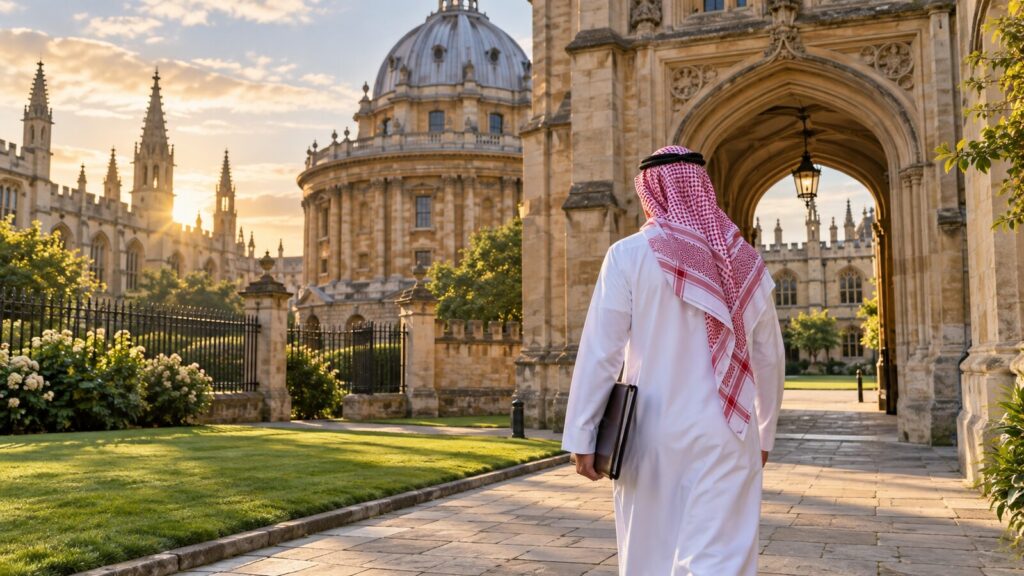
Saudi students and graduates have an opportunity to compete for two Rhodes Scholarships for postgraduate study at the University of Oxford beginning in October 2027. Applications opened on 1 June 2026 and close at 11:59 p.m. Arabia Standard Time on Wednesday, 23 September 2026. References must arrive by the same deadline.
The Rhodes Scholarship is not a conventional university application decided by grades alone. Academic strength is essential, but selectors also consider leadership, service, character and a candidate’s ability to use their talents in response to meaningful challenges. A high GPA can support an application, but it cannot replace a coherent academic plan or an authentic personal statement.
This guide explains the official requirements for the Saudi Arabia constituency. It is designed to help applicants organise their work, not to replace the Rhodes Trust’s own eligibility checker, candidate guide or course rules. Every applicant should verify the latest information before submitting.
What is the Rhodes Scholarship?
The Rhodes Scholarship is a postgraduate opportunity at the University of Oxford that brings together candidates from constituencies around the world. Two awards are available for Saudi Arabia in partnership with Muhammad Alagil. The current competition is for entry to Oxford in October 2027, not for immediate study in 2026.
The scholarship normally supports an eligible course combination covering at least two years, subject to its conditions of tenure. Selection as a Rhodes Scholar does not automatically secure admission to Oxford. A scholar-elect must still submit a successful graduate application and meet the chosen course’s academic and language requirements.
Applicants should therefore think about two connected questions. Are they competitive for the scholarship’s leadership and service criteria, and are they academically ready for the Oxford programme they have selected?
Key dates for Saudi applicants
| Stage | Date |
|---|---|
| Applications open | 1 June 2026 |
| Online application deadline | 23 September 2026 at 11:59 p.m. AST |
| Reference deadline | 23 September 2026 at 11:59 p.m. AST |
| Final interviews and social engagement event | 6-7 November 2026 in Riyadh |
| Applicants informed of outcomes | By December 2026 |
| Successful candidates begin at Oxford | October 2027 |
Submitting the application is not enough if the required references have not arrived. Applicants are responsible for registering referees early, monitoring their status in the portal and sending polite reminders before the deadline.
Citizenship and residency requirements
Applicants through the Saudi Arabia constituency must be citizens of Saudi Arabia. They must also have lived in the Kingdom for at least five of the previous ten years. Supporting evidence may include school records or other appropriate documentation.
Anyone with substantial ties to more than one Rhodes constituency, or an unusual citizenship and residency history, should use the official eligibility checker. Individual circumstances can be complex, and the rules applied to one candidate may not match another person’s case.
The age requirement
Saudi applicants can satisfy one of two age routes:
- They must be aged 18 to 24 on 1 October 2026, meaning they were born after 1 October 2001 and before 2 October 2008.
- Alternatively, candidates who completed their first undergraduate degree later than usual must be under 27 on 1 October 2026, meaning they were born after 1 October 1999, and must have completed their first undergraduate degree on or after 1 October 2025.
The date on which a degree is academically completed can differ from the graduation ceremony or the date printed on a certificate. The university’s policy determines the completion date, and ambiguous cases may need clarification from the National Secretary.
Academic qualification and GPA
Applicants must complete an undergraduate degree, usually a bachelor’s degree, by July 2027. Their academic record must meet or exceed the entry requirements of the Oxford course they intend to pursue.
The Saudi candidate guide explains that candidates are more likely to be competitive for Oxford admission if they hold a first-class honours degree or equivalent, or a GPA of 3.70 out of 4.00 or higher. This is not a guaranteed admission threshold. Individual courses may demand a specific background, professional experience, research preparation or stronger grades.
Before writing an application, candidates should examine the Oxford course page carefully. They need to understand the curriculum, prerequisites, application deadline, language level and evidence required. Selecting a famous programme without a convincing connection to prior study and future goals can weaken the academic statement.
Students still planning their undergraduate path may also consult our guide to Saudi university admissions in 2026 for a broader view of higher-education options.
English-language requirements
Candidates must meet the University of Oxford’s higher-level English-language requirement unless they formally qualify for a waiver. Most applicants will need an accepted test result, such as IELTS, with scores that meet Oxford’s current standard for the chosen course.
An applicant who believes they qualify for a waiver—for example, because their undergraduate degree was taught and assessed in English—must provide a short letter explaining the basis of the request and upload relevant evidence.
This step needs careful attention. The candidate guide warns that an invalid waiver request can leave the application incomplete and may prevent it from being considered. Applicants should check Oxford’s accepted tests, minimum scores, validity periods and waiver conditions directly rather than relying on informal advice.
Documents and materials required
The online form asks for evidence of eligibility as well as information about the candidate’s academic and personal development. The principal items include:
- A birth certificate confirming the age requirement.
- A valid passport confirming Saudi citizenship.
- Official university transcripts showing grades achieved.
- Evidence of residence in Saudi Arabia for five of the last ten years.
- An accepted English test result or a documented waiver request.
- A CV completed using the official PDF template and limited to two pages.
- A colour head-and-shoulders photograph in JPG format.
- A personal statement of no more than 1,000 words.
- An academic statement of no more than 450 words.
- Four to five referees.
Documents must be submitted in English. When an official document is in Arabic, the applicant should upload the original and an official English translation. For an academic transcript, the guide specifies a translation certified by a professional translator, the issuing institution or an authorised notary.
Applicants should not upload extra certificates, testimonials or links unless requested. Following the instructions demonstrates judgement and makes the application easier to assess. Unrequested volume does not strengthen a file.
Choosing the right referees
The application requires at least four and no more than five referees. At least three should be academic referees who have formally taught and assessed the candidate and can discuss academic ability, motivation and readiness for Oxford.
At least one referee should be able to write about character, leadership, service and extracurricular involvement. A person who knows the applicant’s work well is generally more useful than a famous individual who can offer only a generic endorsement.
Candidates must obtain permission before entering a referee’s details. An institutional or professional email address is preferred. The system then sends the referee an individual link through which the confidential letter is submitted in English.
References must arrive by 11:59 p.m. AST on 23 September. Applicants can monitor progress inside the application platform, and they should leave enough time for a referee to handle technical problems or competing commitments.
Writing an authentic personal statement
The personal statement has a maximum length of 1,000 words. It should not duplicate the CV. Its purpose is to reveal the applicant’s voice, values, development and understanding of service.
The guidance asks candidates to weave several themes into one coherent narrative. Which Rhodes Scholar quality do they display most strongly? How have people and different settings helped them develop other qualities? How would they contribute to and learn from communities at Oxford? How will they use their energy and talents to address pressing human challenges from their own place in the world?
Specific experience is more persuasive than inflated language. Instead of writing, “I am a transformational leader,” a candidate can describe a difficult responsibility, the decision they made, the effect on others and what they learned. Honest reflection, including an awareness of limits and growth, creates a more credible portrait.
Accuracy is essential. Candidates declare that the application fairly represents their achievements, and the Trust may investigate questionable documents or claims. Embellishment can lead to withdrawal of an application or rescission of an offer.
The academic statement and course selection
The academic statement is limited to 450 words. It should explain the proposed academic direction, motivation and long-term goals, as well as why Oxford and the selected field are necessary for those goals.
Candidates must show how their course choices form a coherent two-year path and how their background has prepared them for graduate work. Those considering an MPhil or DPhil may need to identify a research area, the relevant department and potential Oxford academics whose work aligns with the project.
If the proposed course differs substantially from the applicant’s previous field, the statement should explain the transition and demonstrate relevant skills or preparation. A vague claim of “passion” is not enough; the committee needs evidence that the plan is academically realistic.
The Rhodes Scholarship covers at least two years, so the course or course combination should fit that period. Initial choices are not necessarily binding at the scholarship application stage, but changing programmes after study begins can be difficult and may have visa consequences.
Step-by-step application process
- Use the official eligibility checker for the Saudi Arabia constituency.
- Research suitable Oxford graduate courses and their entry requirements.
- Create an online application and enter details exactly as shown in official records.
- Prepare the passport, birth certificate, transcripts, translations and residency evidence.
- Resolve the English-language requirement early through a test result or valid waiver request.
- Ask referees for consent and register them well before the deadline.
- Draft the personal and academic statements, then revise them for clarity and accuracy.
- Complete the official CV template and keep it within two pages.
- Review every section, confirm reference progress and submit before the portal closes.
There is no fee to submit a Rhodes Scholarship application. Applications are accepted online only. The guidance advises candidates to apply for the scholarship before applying to the proposed Oxford course; selected candidates then receive support from Rhodes House with the university application.
What happens after submission?
Applications are checked for completeness and eligibility before a longlist and shortlist are developed. Final interviews and the social engagement event are scheduled in Riyadh on 6 and 7 November 2026.
Finalists must be available to attend both elements in person. The guide states that no candidate can be selected without an interview. All applicants are expected to receive an outcome by December 2026.
Successful candidates must then act quickly on their Oxford applications. Some graduate programmes, including certain public-policy, medical-sciences, computer-science and engineering courses, may close in early December. Preparing course research in advance prevents a successful scholar-elect from facing an unnecessary last-minute rush.
The award is for entry in October 2027 and cannot be brought forward or deferred to another academic year under the rules of this cycle.
Common mistakes that can weaken an application
- Selecting a course that does not fit previous study or future goals.
- Assuming that a strong GPA is sufficient by itself.
- Repeating the CV in the personal statement.
- Making broad leadership claims without evidence.
- Choosing prestigious referees who barely know the candidate.
- Delaying language tests or certified translations.
- Failing to monitor whether references were submitted.
- Uploading documents and links that were not requested.
- Waiting until the final hour, when a technical problem may become impossible to resolve.
Frequently asked questions
How many Rhodes Scholarships are available for Saudi Arabia?
Two scholarships are available for the Saudi Arabia constituency in the 2027 competition.
What is the deadline?
The application and references must be submitted by 11:59 p.m. Arabia Standard Time on 23 September 2026.
Is there an application fee?
No. The Rhodes Trust does not charge a fee for submitting the scholarship application.
Does a 3.70 GPA guarantee selection?
No. The candidate guide presents 3.70 out of 4.00 or higher as a level that can improve competitiveness for Oxford admission. Selection considers the complete record, including academic fit, service, leadership, statements and references.
Does winning the scholarship guarantee Oxford admission?
No. A scholar-elect must still secure admission to an eligible Oxford graduate course before the scholarship is confirmed.
Can the scholarship be deferred?
The 2027 Saudi candidate guide states that the award is for entry in October 2027 and cannot be moved forward or deferred to another academic year.
Conclusion
The Rhodes Scholarship for Saudi Arabia is a rare opportunity, but a competitive application requires more than polished phrases. Candidates need to verify their eligibility, choose a credible academic path, organise official documents, secure committed referees and present their experiences in an honest voice.
With the deadline approaching, the first priorities should be references, translations, language evidence and any missing official records. The statements can then be reviewed for clarity, accuracy and genuine connection between past experience and future purpose.
Submitting early is the safest final step. It creates time to resolve an upload or reference problem and allows the candidate to finish with confidence rather than risk losing months of preparation to a last-minute technical issue.
Official sources: Rhodes Scholarships for Saudi Arabia and the 2027 Saudi Arabia Information for Candidates.