
Updated: September 21, 2026
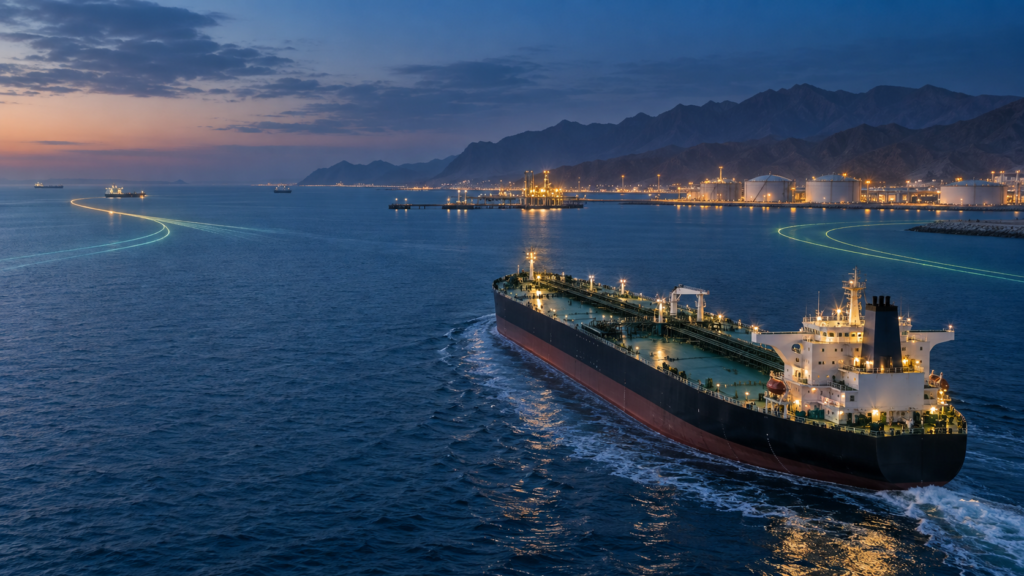
When tensions rise around the Strait of Hormuz, one question quickly moves to the center of the energy market: can Saudi Arabia continue delivering oil to its customers? The short answer is yes, but not through one route and not without additional cost. The Kingdom relies on a network of pipelines, ports, tankers, storage sites and commercial arrangements, shifting volumes as conditions change across the Gulf and the Red Sea.
Developments in September 2026 show why Saudi resilience should not be confused with complete independence from Hormuz. When the western export route faced operational and security pressure, Saudi Aramco increased Gulf loadings and used the strait more heavily. At the same time, ship-to-ship transfers expanded near Oman, allowing some large long-haul tankers to remain outside the highest-risk area. These measures can keep substantial volumes moving, although they require more ships, more time and much higher freight and insurance spending.
Why the Strait of Hormuz still matters to Saudi Arabia
The Strait of Hormuz connects the Arabian Gulf with the Gulf of Oman and, from there, the Arabian Sea and global shipping lanes. Saudi Arabia’s eastern coast contains major production, processing, storage and export infrastructure. For many cargoes, the natural route is therefore to load at a Gulf terminal and pass through Hormuz before sailing to Asian or other international customers.
The International Energy Agency says nearly 20 million barrels a day of oil moved through the strait in 2025. That scale explains why disruption is not merely a Saudi or Gulf issue. It affects refiners, shipping companies and consumers around the world. The IEA estimates that Saudi and Emirati pipelines provide only a limited amount of available alternative capacity outside the strait. Those routes matter greatly, but they cannot replace every barrel normally carried through Hormuz.
The East-West Pipeline provides a strategic outlet
Saudi Arabia’s most important geographical advantage is the East-West Pipeline, also known as Petroline. It carries crude from the Kingdom’s eastern production and processing areas to Yanbu on the Red Sea. Saudi Arabia can therefore load part of its exports on the western coast rather than sending every cargo through Hormuz.
The pipeline’s value goes beyond its role as a spare pipe. It connects the production system to a port on a different sea, allowing planners to redistribute cargoes when one route is safer, faster or less expensive than the other. That is a level of optionality that many producers inside the Gulf do not have.
Yet Petroline is not a perfect substitute. It has finite operating capacity and depends on the safety of pumping stations, storage facilities and the Yanbu terminal. Tankers departing Yanbu can also face delays or security concerns in the Red Sea and around Bab el-Mandeb. Saudi Arabia consequently treats Yanbu as a crucial part of a wider system, rather than a route that can replace all Gulf exports under every condition.
What changed in September 2026?
Vessel traffic monitored through Hormuz fell sharply compared with pre-crisis levels, according to shipping data reported by Reuters on September 21. Tankers nevertheless continued to transit the waterway. Some ships reportedly switched off their automatic identification systems for parts of their voyages, which means real-time counts are less complete than usual.
Reuters cited shipping estimates showing that 22 tankers carrying about 42 million barrels of Saudi crude exited the strait during the week beginning September 13. The news agency also said it had not observed Saudi crude loadings at Yanbu since September 16 at the time of publication. These figures do not show that Saudi Arabia has permanently chosen one route. They illustrate crisis management in practice: when the western system is under heavier pressure, Gulf terminals may carry more of the load; when conditions change, volumes can be redirected again.
Ship-to-ship transfers near Oman
One of the most visible workarounds has been the expansion of ship-to-ship transfers, commonly called STS operations. Under this model, shuttle tankers carry crude from Gulf ports through the sensitive area and discharge it into very large crude carriers waiting in a comparatively safer location near Oman or outside the Gulf. The larger vessel then begins the long journey to the buyer.
The main benefit is that a valuable long-haul tanker spends less time inside the highest-risk corridor. Large vessels can remain focused on international voyages while other ships repeat the shorter shuttle journey. Reuters reported that regional STS transfers rose to about 2.5 million barrels a day in September from 1.4 million in August, with Saudi Aramco and other producers making greater use of the arrangement.
Every additional transfer, however, adds cost and operational complexity. The two vessels must meet at the right time and location, crews need appropriate equipment and safe sea conditions, and every cargo requires clear insurance and contractual coverage. STS transfers keep oil flowing, but they do not restore the supply chain to normal efficiency.
Four tools supporting export resilience
| Tool | How it helps | Main limitation |
|---|---|---|
| East-West Pipeline and Yanbu | Provides a Red Sea outlet that avoids Hormuz | Finite capacity and potential Red Sea risks |
| Gulf terminals and Hormuz | Use large established loading infrastructure | Exposure to strait security and insurance costs |
| Ship-to-ship transfers near Oman | Keep some long-haul tankers outside the highest-risk zone | Need more vessels, coordination and money |
| Storage and delivery scheduling | Create time to adjust routes and cargo priorities | Cannot offset a prolonged disruption indefinitely |
Storage, scheduling and contracts are part of the solution
Oil exports are not managed only at the moment a tanker leaves port. Producers and refiners hold operating inventories, while terminals and trading hubs maintain storage close to shipping routes or consumer markets. These stocks provide a buffer when a tanker is delayed or a loading program must be rearranged.
Companies can also reschedule deliveries, combine cargoes, prioritize urgent contracts or offer discounts to compensate buyers for part of the added freight burden. A Reuters analysis said producers were absorbing some extra transportation expense and using commercial incentives to protect refinery demand. These decisions are less visible than a tanker on a tracking map, but they materially affect whether exports continue.
A diversified customer base also helps distribute risk. Some refineries can change their delivery windows or crude blends more easily than others. Long-term commercial relationships may make it easier for a producer and buyer to agree on a temporary adjustment instead of cancelling a shipment.
Why freight costs have risen so sharply
Logistical resilience requires more ships. A tanker that once completed a direct voyage may now perform a shuttle run, wait for an offshore transfer or travel a longer route. Each change keeps that vessel occupied for more time, reducing the number available to the wider market and pushing charter rates higher.
Reuters said the cost of moving crude on very large carriers had exceeded $30 per barrel in some crisis-related arrangements. That is an extraordinary burden compared with normal conditions. It is not necessarily paid by one party: depending on the contract and bargaining power, the expense can be shared among the producer, trader, refiner and ultimately consumers.
War-risk insurance premiums, port delays, escorts and diversions add another layer. Oil may therefore continue arriving while fuel and refined-product prices remain elevated. Maintaining supply reduces the risk of a deeper shortage, but it does not remove the price impact of disruption.
Are Saudi exports fully protected?
No. Saudi Arabia has more routing options than many producers inside the Gulf, but every option has a ceiling. One pipeline cannot instantly replace a full network of Gulf terminals, and STS activity cannot expand without limit. It depends on available tankers, trained crews, insurance cover and safe transfer areas.
Simultaneous pressure on Hormuz and the Red Sea also weakens the benefit of diversification. In normal conditions, two coasts allow Saudi planners to favor the more attractive route. When both are exposed to disruption, the decision becomes a daily choice of the route facing the smaller obstacle rather than the route offering normal efficiency.
This is where facility security and business continuity become essential. Our report on Saudi Arabia’s unified industrial security platform explains the broader effort to protect critical facilities and accelerate emergency response. Pipelines, pumping stations, tanks and ports form one chain; a failure at one link affects the rest.
What does this mean for consumers and the economy?
For consumers, there is no fixed or immediate relationship between disruption in Hormuz and local petrol prices. Retail fuel prices also reflect government policy, taxes, subsidies, refining margins and the price of crude. A prolonged disturbance can nevertheless increase shipping and insurance costs across global trade, with possible effects on aviation fuel, marine transport and imported goods.
For the Saudi economy, the equation cuts both ways. A higher oil price can increase the value earned per barrel, while freight costs, discounts and delays consume part of that benefit. Watching Brent alone is therefore not enough. Export volumes, tanker rates, crude differentials and voyage times all matter when judging the real economic effect.
Three scenarios to watch
1. Rapid de-escalation and more regular passage
War-risk premiums would gradually fall, tankers would return to more direct voyages and the need for offshore transfers would ease. Costs would not normalize overnight because schedules and contracts take time to reorganize, but efficiency would begin to recover.
2. A prolonged disruption with limited corridors remaining open
This scenario tests logistics more than production capacity. Cargoes could continue through a mix of Hormuz, Yanbu and STS transfers, but at higher cost and with longer delays. Destinations and loading priorities could change from week to week.
3. Simultaneous pressure on Hormuz and the Red Sea
This is the most difficult case because it reduces the value of switching between coasts. Infrastructure security, tanker availability and inventories near customers would become decisive. Governments and international organizations would also face stronger pressure to protect navigation and stabilize the energy market.
The bottom line
Saudi Arabia keeps oil exports moving through flexibility, not through a single guaranteed corridor. The East-West Pipeline creates an outlet at Yanbu, Gulf ports provide extensive loading capacity whenever Hormuz remains passable, STS transfers near Oman reduce the exposure of some large tankers, and inventories and contractual changes absorb delays.
This system has kept substantial volumes in the market despite severe disruption, but at a high cost and with risks that cannot be ignored. The real measure of success is not simply whether a tanker leaves port. It is whether the cargo reaches its customer within an acceptable time and at a manageable cost. The longer regional tension persists, the more logistics and facility protection matter alongside production itself.
Frequently asked questions
Can Saudi Arabia bypass Hormuz completely?
It can redirect a significant share of exports to Yanbu through the East-West Pipeline, but alternative capacity is limited and cannot replace every Gulf cargo under all conditions.
What is a ship-to-ship transfer?
It is the transfer of crude from a shuttle tanker to a larger vessel at sea, often in a comparatively safer location, after which the large tanker continues to the final market.
Do disruptions immediately raise retail fuel prices?
Not necessarily, and the effect differs by country. It depends on the duration of the crisis, crude prices, freight and insurance costs, refining margins and local fuel-pricing policy.
Editorial note: vessel counts change rapidly and may exclude ships that switch off tracking equipment. This report uses information published by Reuters and the International Energy Agency through September 21, 2026. It is not investment advice.
Sources: Reuters on tanker shuttles and costs, Reuters on vessel traffic and Saudi crude flows, and the IEA on Hormuz and alternative export routes.