
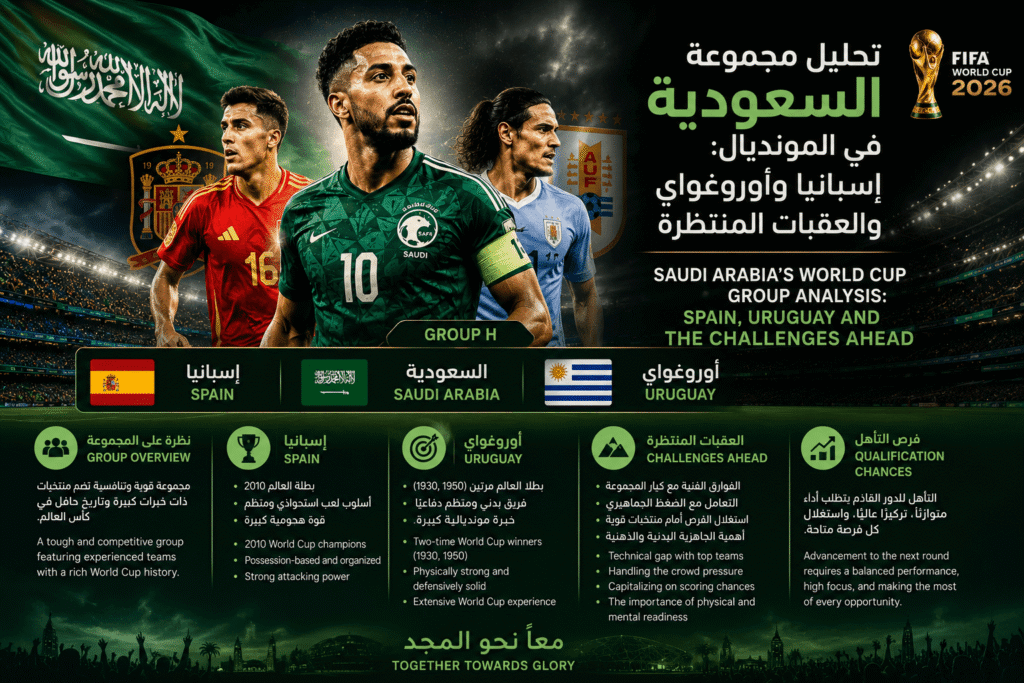
Introduction: Saudi Arabia at the Crossroads of Champions
In one of the most pivotal moments in Arab football history, the Kingdom of Saudi Arabia is preparing for an extraordinary World Cup experience at FIFA World Cup 2026, co-hosted by the United States, Canada, and Mexico. The group stage draw has placed the Saudi Green Falcons in what many analysts consider one of the most challenging and exciting groups in the tournament, going head-to-head with two giants from the most prestigious football traditions in the world: Spain and Uruguay, alongside a fourth team yet to be determined. These matchups serve as a genuine test of the progress the Saudi national team has made in recent years — and whether the historic upset against Argentina at Qatar 2022 was a one-off flash or the beginning of a serious upward trajectory.
Spain: The Heavyweights of the Group
Little analysis is needed to understand that the Royal Spanish Football Federation represents the most formidable challenge in this group. The Matadors — three-time European Champions and 2010 World Cup winners — continue to carry a unique tactical DNA that sets them apart from every other national team on the planet. Under the guidance of manager Luis de la Fuente, who led Spain to the UEFA Euro 2024 title in Germany, the team continues to build on its attacking identity founded on possession play, quick transitions, and high pressing that exhausts opponents from the first minute to the last.
Spain relies on a golden new generation featuring talents like Lamine Yamal — widely regarded as one of the most exciting footballing talents in the world for his age — alongside Nico Williams, whose dribbling ability and electric pace mesmerized audiences at Euro 2024, as well as engine-room players like Pedri and Fabián Ruiz. This formidable trio of attacking threats, supported by reliable goalkeeping from David Raya or Unai Simón, makes Spain capable of inflicting damage from virtually any angle on the pitch — a nightmare proposition for any opponent in the group stage.
Historically, Saudi Arabia has never secured a positive result against Spain in any official fixture, which makes the upcoming encounter a challenge that transcends the purely footballing dimension, touching on questions of sporting pride and the will to break psychological and historical barriers. However, football’s collective memory also holds the moment when Saudi Arabia shocked Argentina in Qatar — proving that the impossible is always within reach.
Uruguay: The Indomitable Fighting Spirit
Despite their relatively small geographical footprint and population, Uruguay remains one of the most storied football nations in the world. As holders of the first two World Cup titles in history (1930 and 1950), they have taught the world the art of defensive resilience and battling until the final whistle. Under the management of Marcelo Bielsa — nicknamed “El Loco” (The Madman) in the world of football coaching — the Uruguayan national team has transformed into a disciplined football machine that blends its legendary fighting spirit with a more complex, high-energy attacking style of play that demands total commitment from every player on the pitch.
Uruguay possess a powerful attacking arsenal featuring Darwin Núñez, one of the most fearless centre-forwards in European club football; Federico Valverde, the dynamic midfield engine who dominates transitions; and Ronald Araújo, the ferocious defensive rock who adds composure and physicality at the back. While the legendary Luis Suárez has retired from international football, the new generation carries the same warrior spirit that has defined Uruguayan football for generations.
Historically, Saudi Arabia and Uruguay have never faced each other in a World Cup fixture, which makes this anticipated encounter a genuine first — filled with all the mystery and excitement that come with the unknown. This match will serve as a true barometer of Saudi Arabia’s readiness to handle the high-press, structured defensive system that Bielsa demands of his players with uncompromising intensity.
Saudi Arabia: Strengths and Reasons for Optimism
Despite the daunting difficulty of the group, Saudi Arabia under manager Hervé Renard holds a number of cards worth building on. The team that left Qatar 2022 with that historic victory against Argentina has evolved significantly — both technically and tactically. This evolution has been driven by the massive investment in the Saudi Pro League and the influx of world-class stars into Saudi clubs, which has dramatically raised the standard of domestic competition and reshaped the footballing awareness and habits of local players in fundamental ways.
Among the standout Saudi cards, Salem Al-Dawsari remains the inspirational captain with an incredible knack for decisive goals in high-pressure moments. Mohammed Al-Qahthani has developed impressively, while Firas Al-Buraikan brings speed and attacking depth that can trouble even organized defences. Hamdallah Al-Koumé adds a different attacking dimension to the team’s approach, while defensively the team benefits from strong goalkeeping led by Mohammed Al-Yami, supported by a defensive line with reasonable continental experience. These individual qualities, harnessed collectively, could form the foundation of a competitive campaign that surprises the watching world.
The Asian Football Confederation notes that Saudi Arabia’s FIFA ranking has shown a consistent upward trend in recent cycles, reflecting the tangible improvements in the national team’s overall performance and competitive profile on the international stage.
The Awaiting Obstacles: Tactical and Physical Challenges
Any realistic assessment of Saudi Arabia’s prospects in this World Cup group must acknowledge a series of fundamental obstacles that the team will need to overcome. Tactically, the Green Falcons must construct a defensively solid, organised unit capable of handling Spain’s rapid-fire passing combinations that routinely disorganise backlines, while simultaneously developing the high-capacity defensive block needed to neutralise Uruguay’s intense pressure on the ball. Physically, both Spain and Uruguay operate at elite levels of fitness and intensity that will demand Saudi Arabia to arrive at peak condition and maintain it across 90+ gruelling minutes.
The gap in World Cup experience between Saudi Arabia and each of Spain and Uruguay remains a genuinely influential factor in the equation. Both European and South American powerhouses have entire generations of World Cup participation behind them, endowing their players with the composure to manage defining moments with a level of professional calm that only comes from living through those high-pressure experiences repeatedly. Additionally, the weight of intense global media and public scrutiny may present an additional psychological burden for Saudi players performing under the brightest international spotlight.
Possible Scenarios: Can Saudi Arabia Advance to the Round of 16?
Analysts outline three primary scenarios for Saudi Arabia’s journey through the group stage:
Scenario One — Pessimistic: Saudi Arabia loses to both Spain and Uruguay, stumbles in the third match, and exits in the group stage carrying important lessons and experience. This is statistically the most likely scenario based on the current technical differential between the sides.
Scenario Two — Realistic: Saudi Arabia achieves a positive result or outright victory against the group’s fourth team, puts up credible resistance against Uruguay and Spain, and embodies genuine progress — keeping the flame of hope burning at the critical juncture as the group stage draws to a close.
Scenario Three — Optimistic: The most beautiful and the most demanding of all possibilities — Saudi Arabia repeats the magic of 2022, stunning one of the giants, and qualifies in second or even first place in the group. This scenario is far from impossible, particularly if the team’s management deploys a well-crafted tactical plan and chooses the right moment and matchup to strike decisively.
Preparation and Readiness: What Saudi Arabia Must Do
For Saudi Arabia to realise its ambitions at this World Cup, the coaching and administrative staff must work across several strategic pillars with focused precision:
First: Deep Opponent Intelligence Analysis — a thorough, meticulous study of Spain’s and Uruguay’s playing styles, identifying specific weaknesses in each opponent’s system that can be exploited given the right speed of transition and precise positional organization. Every opposition has areas of vulnerability when pressed with intelligence.
Second: Collective Defensive Development — specifically the ability to organize coherently along the defensive line and minimize the spaces that top European and South American teams exploit with rapid, incisive movement. This demands intensive work on pressing systems, covering rotations, and defensive repositioning drills in training.
Third: Psychological Readiness — arguably the single most decisive factor in big matches. The team that takes the pitch with a fighter’s mentality rather than a survivor’s instinct is the one that creates historic upsets and carves its name into the memory of the tournament forever.
Fourth: Team Cohesion and Unity — achieving a positive result in matches of this magnitude demands a state of collective solidarity and squad unity in which every individual, including those on the bench, feels centrally important to the team’s journey and purpose throughout the campaign.
World Cup 2026: A Once-in-a-Generation Opportunity
This World Cup arrives at an exceptional moment for Saudi football. After years of investment in infrastructure, the domestic league, and the recruitment of global stars, Saudi football has reached a stage where its new identity is taking gradual shape. The Saudi Arabian Football Federation enjoys unprecedented support from the leadership and relevant authorities within the framework of Vision 2030, which places sport as a fundamental pillar of social and economic transformation in the Kingdom.
Facing Spain and Uruguay is not simply two matches in a football tournament — it is a confrontation with established footballing schools in the fullest sense of the phrase. Every goal scored and every moment of resistance will remain etched in the hearts of Saudi fans for years to come. The mission is undeniably difficult, but Saudi football’s determination has proven time and again that it is capable of far more than the cold calculations and pre-tournament predictions suggest.
Conclusion: The Battle Before the Battle
In the end, the World Cup remains the greatest arena of challenges — where dreams collide with reality and statistical projections wrestle with the irreducible human element. Before the whistle blows on the first match of FIFA World Cup 2026, Saudi Arabia must define its footballing identity with clarity: identify its strengths, absorb the lessons of the past, and plan with a mindset of ambition rather than apprehension. Armed with all of that, the Round of 16 is not a distant dream — and the world may well be surprised once more, just as it was in November 2022.
Sources and References: FIFA Official Website | Saudi Arabian Football Federation | Royal Spanish Football Federation | Uruguayan Football Association | Asian Football Confederation