Editorial Note: This article combines factual news reporting with sports analysis. Analytical opinions are clearly labeled and are based on verified data.
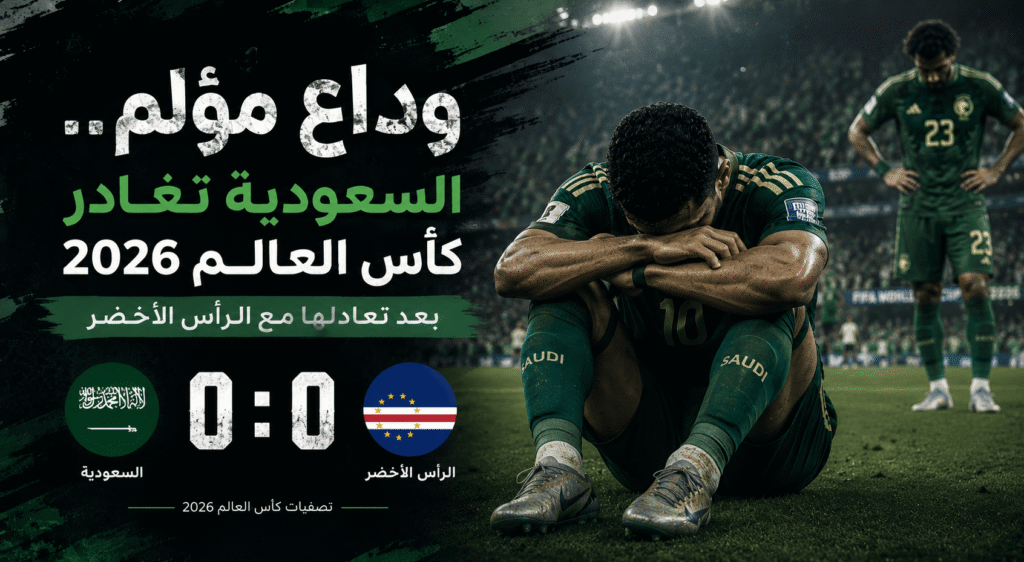
Saudi Arabia have drawn the curtain on their 2026 FIFA World Cup campaign, exiting the tournament at the group stage after a goalless draw with Cape Verde (0–0) in Round 3, finishing with just two points from three matches.
Saudi Arabia’s Group H Journey
Saudi Arabia were drawn into Group H alongside Spain, Uruguay, and Cape Verde. The Saudi Arabian Football Federation had hoped the team would advance past the group stage, but the results fell well short of expectations:
- Round 1: Drew 1–1 with Uruguay (Saudi goal: Abdulelah Al-Amri, 41′)
- Round 2: Lost 0–4 to Spain
- Round 3: Drew 0–0 with Cape Verde
Saudi Arabia’s 2026 World Cup Campaign Summary
| Stat | Figure |
|---|---|
| Matches Played | 3 |
| Wins | 0 |
| Draws | 2 |
| Losses | 1 |
| Goals Scored | 1 |
| Goals Conceded | 5 |
| Points | 2 |
| Final Position | 4th in Group H |
Group H Final Standings
The 2026 World Cup Group H concluded with the following final table. Notably, Cape Verde reached 3 points through three draws: 0–0 with Spain, 2–2 with Uruguay, and 0–0 with Saudi Arabia:
| Pos | Team | Played | Goal Diff | Points |
|---|---|---|---|---|
| 1 | Spain | 3 | +5 | 7 |
| 2 | Cape Verde | 3 | 0 | 3 |
| 3 | Uruguay | 3 | -1 | 2 |
| 4 | Saudi Arabia | 3 | -4 | 2 |
Saudi Arabia finished fourth despite matching Uruguay on points — goal difference proved the decisive factor, with Uruguay at -1 versus Saudi Arabia’s -4.
Saudi Arabia vs Cape Verde: Match Statistics
Match statistics from Sofascore for the Saudi Arabia and Cape Verde match reveal striking performance indicators from both sides:
| Statistic | Cape Verde | Saudi Arabia |
|---|---|---|
| Ball Possession | 51% | 49% |
| Expected Goals (xG) | 1.39 | 0.39 |
| Total Shots | 15 | 7 |
| Goalkeeper Saves | 3 | 2 |
| Corner Kicks | 4 | 2 |
| Fouls Committed | 10 | 16 |
| Passes | 451 | 444 |
| Tackles | 15 | 29 |
| Big Chances | 1 | 1 |
Source: Sofascore – Cape Verde vs Saudi Arabia, June 27, 2026
Performance indicators — particularly expected goals (xG) — show that Cape Verde created the more dangerous opportunities throughout the match, while the Saudi national team managed to secure a point through defensive resilience and solid goalkeeping.
Reactions to Saudi Arabia’s World Cup Exit
Social media saw wide engagement following the confirmation of Saudi Arabia’s exit from the 2026 World Cup, with discussion centering on four main themes:
- Criticism of tactical approach: A significant strand of commentary focused on the defensive setup adopted against Cape Verde, which many felt did not reflect Saudi Arabia’s attacking ambitions.
- Calls for squad renewal: Calls emerged for investing in younger players rather than relying solely on established names irrespective of current form.
- Praise for the goalkeeper: The Saudi goalkeeper drew positive attention for a series of saves that kept the scoreline level and prevented a heavier defeat in what was an otherwise difficult campaign.
- Criticism of attacking inefficiency: Observers noted that Saudi Arabia failed to score in their final two group matches, reflecting a broader concern about the team’s effectiveness in front of goal.
Analysis: Has Sports Investment Reflected on Team Results?
[Editorial opinion based on verified data]
Saudi Arabia has invested significantly in the sports sector in recent years, from the Saudi Pro League (Roshn League) attracting global stars to infrastructure development and grassroots programs. According to the Confederation of African Football (CAF), Cape Verde is recognized as a rising continental force. For context, according to the latest available data on Transfermarkt — noting that valuations fluctuate continuously — there is a significant financial gap between the teams in Group H. Spain leads by a wide margin, followed by Uruguay, then Cape Verde, while Saudi Arabia’s squad market value comes in below all three, according to currently available data.
These results suggest that financial investment, important as it is, needs to be accompanied by sustainable academy development, long-term player preparation, and technical stability before it can meaningfully reflect on the Saudi national team’s results at major tournaments.
Saudi Arabia 2034: A Turning Point, Not a Dead End
As this World Cup chapter closes, all eyes turn to the far greater challenge awaiting Saudi football in the years ahead.
Saudi Arabia is preparing to host the 2034 FIFA World Cup — a historic milestone that gives every result involving the national team amplified significance. The Saudi Arabia World Cup 2026 elimination could serve as the catalyst for genuine structural reform. Hosting the tournament is not enough; the national team must be worthy of the stage, performing in front of its own fans on home soil.
Saudi Arabia’s exit from the 2026 World Cup can be reframed not as a dead end, but as a starting point — a moment of honest reckoning that compels the Saudi Arabian Football Federation to build a team capable of truly competing on the world stage by 2034.
Related Articles
- Saudi Arabia vs Cape Verde – Match Details
- Saudi Arabia Loses to Spain
- Saudi Arabia Recalls Hassan Tambakti
- FIFA World Cup 2026 Team Rankings
- 2026 World Cup Shocks
- Saudi National Team 2026
- 5 Key Decisions in the Roshn League
Frequently Asked Questions
What was the result of Saudi Arabia vs Cape Verde at the 2026 World Cup?
The match ended 0–0, confirming Saudi Arabia’s exit from the World Cup at the group stage.
Which group was Saudi Arabia in at the 2026 World Cup?
Saudi Arabia were placed in Group H alongside Spain, Uruguay, and Cape Verde.
How many points did Saudi Arabia earn in the 2026 World Cup group stage?
Saudi Arabia earned just 2 points from three matches (a draw with Uruguay, a loss to Spain, and a draw with Cape Verde). They were eliminated on goal difference, finishing level on points with Uruguay who placed third.
Who scored Saudi Arabia’s goal against Uruguay?
Abdulelah Al-Amri scored Saudi Arabia’s equalizer in the 41st minute of the Round 1 match against Uruguay, earning the team a 1–1 draw. (Source: Sofascore)
When will Saudi Arabia host the FIFA World Cup?
Saudi Arabia will host the 2034 FIFA World Cup, as officially awarded by FIFA.
What were the match statistics for Saudi Arabia vs Cape Verde?
According to Sofascore, Cape Verde attempted 15 shots to Saudi Arabia’s 7, held 51% ball possession versus 49%, and generated an expected goals (xG) figure of 1.39 compared to just 0.39 for Saudi Arabia.
For more sports analysis and news, follow Nahnu Saudi.