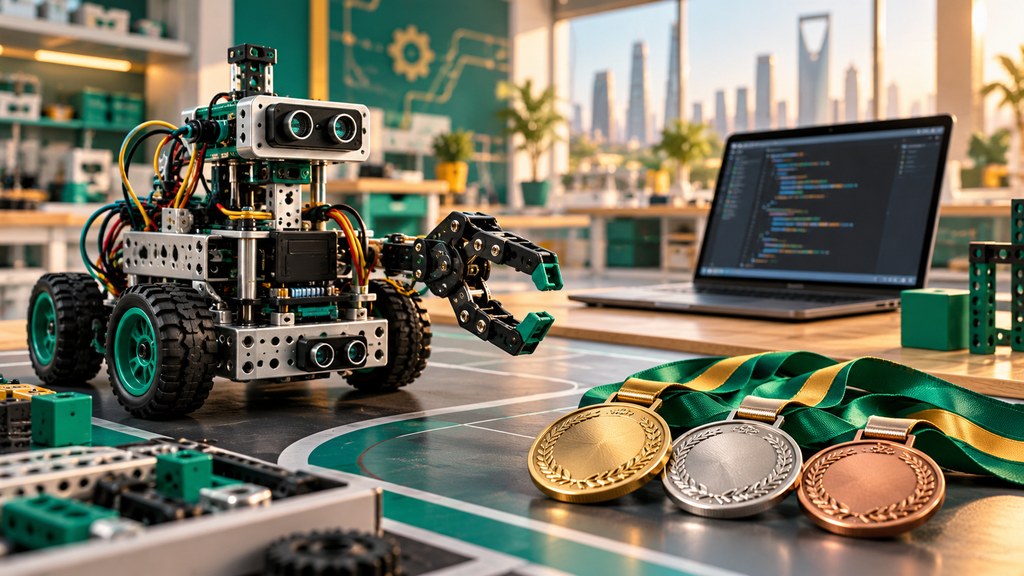
Students from Riyadh’s General Directorate of Education earned 21 medals and six awards at the national final of the 2026 World Robot Olympiad, WRO, according to the Saudi Press Agency’s October 25 announcement. Beyond the medal total, the story offers families and schools a useful opportunity to explore what students learn when they move from a simple program to building and testing a robot.
The essential qualification is the stage of competition: this was the national final. The figures do not describe results at a world final, identify the total number of individual winners or confirm which teams will attend an international event. This report separates the announced achievement from general WRO background and SaudiWe’s practical suggestions for learning.
Riyadh students’ WRO 2026 medal results
The official Saudi Press Agency announcement gives the medal breakdown alongside awards recognizing different aspects of technical work. The table records the published numbers without adding an overall national ranking for Riyadh that the announcement does not establish.
| Medal | Announced total |
|---|---|
| Gold | 5 |
| Silver | 3 |
| Bronze | 13 |
| Total | 21 |
The six awards comprised one for best strategy, two for technical excellence, two for innovation and creativity, and one for engineering excellence. The announcement also reports congratulations from Riyadh education director Dr. Nayef bin Abed Al Zarea to the students, their schools and families. This report does not add student names, school names or project descriptions that were not included in the reviewed announcement.
Why medals and specialist awards should stay separate
The original distinction matters: there is a medal total and an award total. Calling the combined figure “27 medals” would change the information. Nor does the number of recognitions automatically reveal how many people or teams were involved. Students may work together, and the way recognition is allocated can vary. A confirmed participant or team count requires an appropriate official list.
As an educational reading of the result, the range of award names encourages a broader conversation than how impressive a robot looks. How was the solution chosen? How did the team respond to a failed test? Can its members explain an engineering decision? These are useful learning questions, rather than a claim that we have obtained the local judging criteria for the six awards.
What is the World Robot Olympiad?
The WRO Association’s category guide lists four main formats: RoboMission, RoboSports, Future Innovators and Future Engineers. Their challenges range from completing missions to developing solutions and competing through robots. Age groups and rules depend on the category.
This is an overview of the competition, not a breakdown of Riyadh’s medals across those four formats. The reviewed news announcement does not provide that distribution. A team planning to participate should read the current rules for its chosen category instead of assuming that a robot suitable for one classroom task will automatically be suitable for any robotics event.
How the national stage relates to international events
WRO’s official participation guidance explains that teams register through events in their own country. National organizers handle the regional and national stages, and winning teams can qualify for international events. It also notes that not every country offers every category and age group.
A national medal can therefore be celebrated on its own terms, without announcing travel or international representation for a particular team unless that has been confirmed. Families and schools should follow the organizer’s next-stage notices, eligibility requirements and dates. An award announcement does not establish that registration for the same edition remains open or that participation has no conditions.
What can a student learn by building a robot?
Consider an illustrative classroom task: move a robot to a marked point and stop it there. The description is short, but the experiment raises worthwhile questions. Should stopping depend on a fixed time or a sensor reading? What happens on a different surface? How can students distinguish a programming mistake from a wheel that is not secured properly? The educational value starts with turning those questions into tests.
When the model behaves unexpectedly, observation becomes more useful than guessing. A team can record attempts, adjust one factor and compare results. If it changes the motor speed, sensor position and program length simultaneously, identifying the cause of improvement becomes difficult. This example is a suggested learning exercise, not a description of a project submitted by one of the Riyadh winners.
Programming is part of a larger system
Code operates alongside a mechanical structure and the inputs it receives. A correct instruction can produce an unwanted movement if a wheel rubs against the body or a sensor measures something different from what the student expects. Before rewriting the entire program, students can inspect connections, mounting and the behaviour of individual components. That makes the next change easier to explain.
Sharing responsibilities is also useful when knowledge does not remain locked with one person. One student might focus on code, another on test notes and another on construction, before each explains the decisions to the others. If a member is absent or the task changes, the group can continue more confidently when everyone understands the essential choices rather than depending on a single memory or undocumented file.
A sensible starting point for families
The news does not need to become an immediate shopping list. Ask the school about available activities, supervision and equipment, then consider the learner’s interests and experience. An introductory exercise or simulation may be a useful first step before buying hardware. Competition equipment should follow the current category rules, rather than a product appearing in an award photograph or training advertisement.
Families can support steady engagement by making time for experiments and encouraging students to describe the outcome in their own words. Alongside asking whether they won, ask what they tested and what they would change next. A medal should not become the only reason to value the activity. Children have different interests, and there are several ways to begin learning about technology.
A small training plan for a school or club
The following is an adaptable editorial suggestion, not an official WRO admission program or a promise of an award. Start with an observable goal and keep a short record that allows another learner to understand and repeat the experiment.
- Define the task: write down what the robot should do and the conditions in which it will operate before choosing the build.
- Run a basic experiment: test one movement or one sensor reading, checking that students understand what is happening.
- Record attempts: describe the change and the outcome rather than marking an attempt only as success or failure.
- Improve gradually: adjust one factor at a time and compare it with the previous version.
- Present and review: ask the team to explain what it learned, the model’s limits and its next step.
The review can include a real failure and how the team investigated it. A model working once does not establish consistent performance, while a successful short video may omit earlier attempts. Repeating a test under described conditions makes progress easier to assess. It also helps a coach choose a question that advances the students’ thinking instead of doing the work for them.
Official resources for further learning
The association offers WRO Learn, its free learning platform, with resources for students, coaches and teachers. Read the selected resource’s level, description and equipment requirements first. Free access to a lesson does not mean that every physical component needed to carry it out is supplied. Check the available language for the chosen content rather than assuming every lesson is fully translated.
For another example of practical technology learning, see SaudiWe’s report on the Madinah artificial intelligence camp. That is a separate event, not part of the robot olympiad. Its discussion of testing ideas and building prototypes provides further context for the difference between learning to operate a tool and using it to address a clearly defined problem.
Questions about Riyadh’s achievement
Were these medals awarded at the world final?
No. The announcement identifies the national final of the 2026 World Robot Olympiad. The competition’s international name should not be confused with the stage at which the achievement occurred.
How many teams won?
The reviewed announcement does not establish a total team count or name every winner. Its numbers describe medals and awards, so they should not be converted into a headcount.
Does every robot use artificial intelligence?
Not necessarily. Programmed rules, control logic and sensors can produce robotic behaviour. Movement alone is not sufficient evidence that a project uses an artificial intelligence system.
Reviewed October 25, 2026. News source: Saudi Press Agency. Background sources: WRO Association. Examples and learning suggestions are editorial additions, not reported projects or rules attributed to the winners. The cover is an original conceptual illustration, not a documentary photograph of the competition.