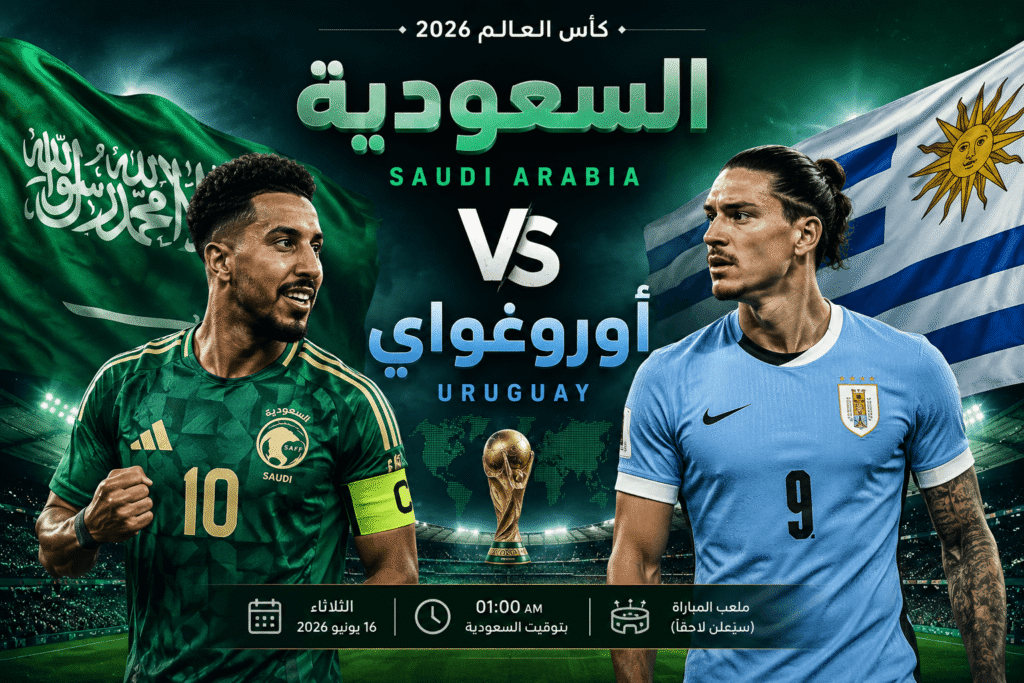
Eight years ago, Uruguay sent Saudi Arabia home from Russia 2018 with a 1–0 victory. On June 16, 2026, the Green Falcons return — this time on neutral ground in Miami, Florida, fuelled by revenge, ambition, and the weight of a nation’s expectations.
Their FIFA World Cup 2026 Group H showdown is one of the most emotionally charged fixtures of the opening round. More than points and form, it is a clash of footballing identities: a Saudi program that has undergone a genuine renaissance against a Uruguayan side integrating a new generation of world-class talent alongside experienced campaigners.
⚽ Match Information
| Detail | Info |
|---|---|
| 📅 Date | June 16, 2026 |
| 🕘 Kick-off | 01:00 KSA / 22:00 GMT |
| 🏟️ Venue | Hard Rock Stadium, Miami Gardens, Florida, USA |
| 📺 Broadcast | SSC 1 (KSA) / beIN Sports (MENA) / FS1, Telemundo, Peacock (USA) |
| 🏆 Stage | FIFA World Cup 2026 — Group H |
📺 Where to Watch
| Region | Broadcaster |
|---|---|
| 🇸🇦 Saudi Arabia | SSC Sports (satellite & SSC app) |
| 🌍 Middle East & North Africa | beIN Sports / beIN Connect |
| 🇺🇸 United States | FS1 / Telemundo / Peacock |
| 🌐 Global (select markets) | FIFA+ (coverage may be available in select countries subject to local broadcast rights) |
| 🇺🇾 Uruguay & Latin America | Official licensed broadcasters per country |
📊 Head-to-Head History
Saudi Arabia and Uruguay have met twice in recorded fixtures. At the 2018 FIFA World Cup in Russia (Group A), a first-half strike from Luis Suárez proved decisive — Uruguay’s defensive organization absorbing everything Saudi Arabia offered to claim a 1–0 victory. The teams also drew 1–1 in an international friendly in October 2014. The overall balance reads: one win each, one draw.
The context, however, has shifted considerably. Saudi Arabia’s stunning 2–1 defeat of Argentina at Qatar 2022 — one of the most celebrated upsets in World Cup history — signalled a new era for the Green Falcons. Uruguay, meanwhile, has gradually integrated a younger generation alongside experienced veterans, continuing to build one of CONMEBOL’s most competitive squads.
🌟 Key Players to Watch
Saudi Arabia
- Salem Al-Dawsari (Al-Hilal) — The creative engine of the Saudi setup. His ability to unlock compact defenses and deliver from set pieces makes him Saudi Arabia’s most dangerous attacking weapon.
- Mohamed Al-Owais — A goalkeeper who has consistently performed on the biggest stages. His shot-stopping and command of the penalty area give Saudi Arabia’s defensive structure genuine confidence.
- Firas Al-Brikan — A clinical finisher with the pace and intelligence to exploit gaps behind a high defensive line.
Uruguay
- Darwin Núñez (Liverpool) — Explosive, physically imposing, and relentless in his movement. Saudi Arabia’s centre-backs will need their best game to contain him over 90 minutes.
- Federico Valverde (Real Madrid) — One of the most complete midfielders in world football. His capacity to break lines, track back, and arrive late into the box makes him a constant threat.
- Rodrigo Bentancur (Tottenham Hotspur) — A composed orchestrator in central midfield. His ability to control the tempo of play could prove a decisive factor in how the match unfolds.
🧠 Tactical Analysis
Saudi Arabia — The Green Falcons
Saudi Arabia deploy a structured 4-4-2 built on defensive organization and rapid transitions. The system demands that the team remain compact without losing shape before exploiting vertical breaks before defenses can reorganize. Saudi Arabia qualified for this tournament through the AFC process, confirming their place among Asia’s top sides. Against Uruguay, the opening phase will be critical: the Green Falcons must remain defensively disciplined and resist Uruguay’s physical opening exchanges.
Uruguay — La Celeste
Uruguay line up in a disciplined 4-4-2, retaining their traditional defensive grit while expressing genuine attacking ambition in transition. Bentancur and Ugarte form one of CONMEBOL’s most balanced central midfield partnerships, while Núñez and Viñas provide a physical and mobile strike partnership. Saudi Arabia’s wide defensive channels will be tested consistently throughout the match.
📋 Confirmed Starting Lineups
Source: ESPN / FIFA World Cup 2026 — June 16, 2026
🇸🇦 Saudi Arabia (4-4-2)
| Position | Player |
|---|---|
| GK | Mohamed Al-Owais |
| RB | Sater Abdulhamid |
| CB | Hassan Al-Tambakti |
| CB | Ali Al-Amri |
| LB | Ali Al-Harbi |
| RM | Salem Al-Dawsari |
| CM | Mohamed Kanno |
| CM | Hassan Abu Al-Shamat |
| LM | Sultan Al-Khaibari |
| ST | Firas Al-Brikan |
| ST | Haitham Al-Juwayr |
🇺🇾 Uruguay (4-4-2)
| Position | Player | Club |
|---|---|---|
| GK | Fernando Muslera | Galatasaray |
| RB | Guillermo Varela | — |
| CB | Sebastián Cáceres | — |
| CB | Mathías Olivera | Napoli |
| LB | Matías Viña | — |
| RM | Federico Valverde | Real Madrid |
| CM | Rodrigo Bentancur | Tottenham Hotspur |
| CM | Manuel Ugarte | Manchester United |
| LM | Maximiliano Araújo | — |
| ST | Darwin Núñez | Liverpool |
| ST | Federico Viñas | — |
🏆 Why This Match Matters
For Saudi Arabia, every appearance at FIFA World Cup 2026 carries added significance ahead of the Kingdom’s hosting of the 2034 FIFA World Cup — a landmark moment in the development of Saudi football. For Uruguay, this is an important early opportunity for a talented generation to assert itself on the World Cup stage.
Beyond the narrative, the practical stakes are real: in a group that also contains Spain and Cape Verde, every point in Miami counts toward securing a place in the Round of 16. This is a match neither side can afford to lose.
Match information sourced from ESPN and official FIFA World Cup 2026 records. Lineups confirmed as of match day, June 16, 2026.