Introduction: A Woman Writing Her Own History
At the heart of an unprecedented historical transformation, the Saudi woman today stands at a crossroads where a deep-rooted heritage meets a future wide open with possibility. Since the launch of Vision 2030, Saudi Arabia has witnessed a genuine revolution in women’s rights and their roles in society — from driving cars, to attending stadiums, to leading companies and ascending the highest ranks of government. Yet behind the gleam of statistics and headlines, there lie stories of flesh and blood: silent daily struggles, and victories that are rarely told in full.
In this article, we don’t speak of women as a number in a report — we speak of her as a human being carrying ambitions, facing obstacles, and forging success in an environment changing at remarkable speed. This is her story in 2026.
I. What Has Actually Changed? — Real Achievements
The Workforce Transformation: From the Margins to the Forefront
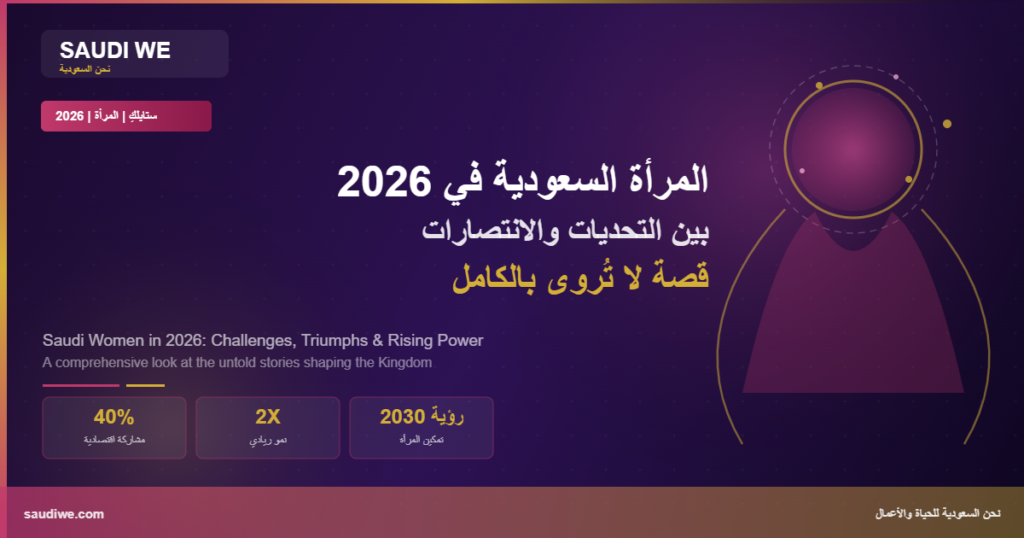
Perhaps the most dramatic shift has occurred in the Saudi labour market. In 2017, women’s labour force participation barely exceeded 17%. By 2026, that figure has surpassed 33% and is tracking towards Vision 2030’s target of 40%. These are not just numbers — behind them stand millions of women who stepped out of their homes and into workplaces, often carrying higher qualifications than many of their male peers.
Saudi women today work in banking, medicine, law, engineering, media, and the arts. They have reached ministerial positions, the boardrooms of publicly listed companies, and decision-making roles at the highest levels of the state.
Female Entrepreneurship: Numbers Doubled in Less Than a Decade
One of the most inspiring scenes in Saudi Arabia’s economic landscape is the remarkable flourishing of women-led entrepreneurship. According to the latest data, women-owned businesses now exceed 700,000, with women accounting for nearly 40% of all microfinance beneficiaries in the Kingdom. From fashion and design to restaurants, technology, consulting, and healthcare — Saudi women are building their own economic kingdoms.
Education: The Saudi Woman’s Enduring Stronghold
In education, the Saudi woman was never in a position of weakness — quite the contrary. Women constitute over 52% of university enrolment in Saudi Arabia, and female students frequently top the honour rolls in the most demanding scientific, medical, and technical disciplines. This accumulated educational capital is the true fuel powering Saudi women’s rise across every field.
II. Real Challenges — What the Statistics Don’t Always Reveal
Yet the full picture requires an honest look at the challenges that remain, because acknowledging them is the first step towards overcoming them.
1. Work–Life Balance: The Difficult Equation
Balancing professional ambition with family responsibilities remains one of the deepest challenges facing working women in Saudi Arabia. Despite legal reforms, many still carry the weight of two full-time roles: the professional and the domestic. Childcare and paid maternity leave have improved meaningfully, but the cultural gap in the distribution of household responsibilities still requires further transformation.
2. The Pay Gap: A Global Challenge with a Local Face
Despite visible progress, women in some sectors still earn less than men for equivalent work. This is not a uniquely Saudi phenomenon — it is a global challenge confronting even the most advanced economies. The positive signal is that this issue has entered the official agenda, with legislative reforms targeting equal opportunity in workplaces.
3. The Ceiling of Social Expectations: The Invisible Pressure
Sometimes the challenge is not a restrictive law but a social expectation that weighs heavily. The ambitious Saudi woman frequently faces questions such as: “When will you marry?”, “Isn’t what you’ve achieved enough?”, “Will you sacrifice your family for your career?” — this gentle pressure can be more draining than any legal barrier, because it comes from those closest and most loved.
4. Harassment and Safety in the Workplace
As women’s roles in public and professional spaces expand, the urgent need for safe working environments and robust anti-harassment legislation has come into sharp focus. Saudi Arabia has taken positive steps by issuing clear regulations in this area, but effective enforcement and genuine cultural change require sustained time and effort.
5. Mental Health: The Conversation That Needs to Be Louder
In the context of rapid social change and the pressures of multiple roles, some women experience high levels of stress, anxiety, and emotional burnout. Women’s mental health in Saudi Arabia still needs greater openness and stronger social and institutional support — especially given the pace of change that can leave some navigating between two worlds simultaneously.
III. Saudi Women in High-Potential Sectors
Technology and AI: A Revolution Led by Women
It may surprise many that Saudi Arabia has a notably high proportion of women in tech compared to many Western nations. National training programmes like Tuwaiq Academy and the Massar programme have produced thousands of Saudi developers, analysts, and designers now working at leading technology companies locally and globally. These women are not simply building applications — they are building the future of Saudi Arabia’s digital economy.
Arts and Creativity: A Voice Rising Boldly
Saudi Arabia’s artistic and creative scene is experiencing its most vibrant flourishing, and women stand at its heart. From visual artists participating in the Venice Biennale and Art Basel, to Saudi filmmakers winning international awards, to musicians, writers, and designers — the creative Saudi woman is telling her story loudly to the whole world.
Sport: A Body That Deserves Respect and Challenge
From players in the women’s football league, to athletes at the international Olympics, to coaches in sports clubs — Saudi women are entering arenas with growing confidence. The female athletic body is no longer the subject of awkward social debate, but a source of national pride celebrated at official championships and on television screens.
Driving and Mobility: A Freedom That Transforms Lives
Since the lifting of the driving ban in 2018, this development has evolved into something far deeper than simply sitting behind a wheel. It represents genuine independence of movement, financial savings, and the freedom to make daily decisions autonomously. Thousands of women who once depended on private drivers or family members now manage their lives with complete self-reliance.
IV. Voices That Deserve to Be Heard
- Women in Rural and Remote Areas: The transformations visible in major cities have not reached all corners of the Kingdom equally. Women in less developed regions need deeper opportunities and more targeted programmes.
- Divorced and Widowed Women: Despite improvements in the legal frameworks governing women’s rights in marriage, divorce, and child custody, certain gaps remain and require serious attention.
- Women with Disabilities: Their dual challenges — as women and as people with disabilities — deserve dedicated attention and targeted empowerment policies.
V. What Does the Saudi Woman Actually Need to Complete Her Story?
- Subsidised childcare embedded in workplaces and residential communities to ease the dual-role burden.
- Flexible working hours and remote work as an institutional norm, not a special exception.
- Effective legislation to protect women from harassment and discrimination, with safe and confidential reporting mechanisms.
- Accessible psychological support through mental health programmes integrated into workplaces and universities.
- Visible female role models in leadership, media, and public life to expand the scope of possibility in the minds of rising generations.
- Educating men and society in the concept of genuine partnership in family and professional life — because women’s empowerment cannot be complete without a parallel transformation in men’s culture.
Conclusion: A Woman Who No Longer Waits for Permission
The Saudi woman of 2026 no longer waits for anyone’s permission to pursue her dream — she steps forward, innovates, sometimes fails and returns, builds and never stops. The challenges she faces are real and should never be minimised, but even more real is her astonishing determination to press forward in spite of everything.
Her story is not one of a victim waiting to be rescued, nor a flawless tale stripped of complexity — it is the story of a woman writing her own history with her own hands, in a society that is changing, a world that is watching, and a heart that never stops dreaming.
Explore more content for Saudi women in the She section at SaudiWe.