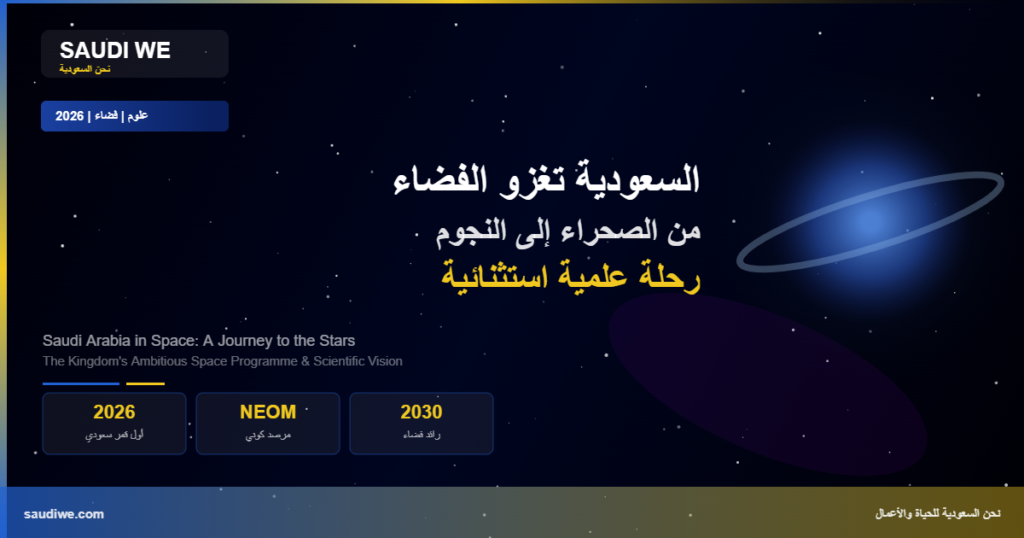
It was a scene that could not have been imagined just a few decades ago: a Saudi astronaut orbiting Earth aboard an American spacecraft, followed by a Saudi woman astronaut — the first Arab woman to live aboard the International Space Station. Saudi Arabia is writing a new chapter today, one never written before in humanity’s journey toward the stars. It does so with unwavering determination and ambitions that transcend mere symbolic participation to reach genuine leadership and substantive contribution to the exploration of the universe.
The Origins of the Saudi Space Dream
The roots of Saudi Arabia’s interest in space extend back to the 1980s, when Prince Sultan bin Salman became the first Arab Muslim to venture into outer space in 1985 aboard the American Space Shuttle Discovery. That historic journey was like a spark that ignited the collective Saudi imagination and proved that the dream was achievable. The fundamental transformation in Saudi space strategy came with the launch of Vision 2030 and the founding of the Saudi Space Agency in 2018, which mapped a comprehensive roadmap to transform the Kingdom from a consumer of space services to a producer and exporter of them.
Saudi Space Achievements: Numbers That Speak for Themselves
Saudi Arabia has achieved remarkable space milestones in recent years that merit careful attention. The Kingdom has launched more than twenty satellites into orbit for diverse purposes including communications, navigation, remote sensing, and Earth photography. It sent two astronauts to the International Space Station as part of the Axiom Space Mission 2 in 2023, with mission specialist Rayyanah Barnawi making history as the first Arab woman to live on the International Space Station. The Kingdom is currently developing a satellite constellation for direct broadcasting and communications that will strengthen its independence in this strategically vital sector.
Axiom-2 Mission: A Qualitative Leap in Arab History
The Axiom-2 mission in 2023 marked a historic turning point in the Saudi and Arab space journey. Participants included astronaut Ali Al-Qarni and Rayyanah Barnawi, who spent two weeks aboard the International Space Station conducting dozens of scientific experiments in biology, materials science, and plant cultivation techniques in microgravity. The mission proved Saudi Arabia’s ability to engage in genuine space research — not mere orbital symbolism — and wrote a luminous page in the history of diversity and inclusion in space exploration, inspiring millions across the Arab world.
The SaudiSat Program: Local Manufacturing, Global Ambition
The SaudiSat program represents the fundamental technical pillar of the Saudi space industry. Under this program, the Kingdom has launched a series of locally manufactured satellites built in the facilities of the King Abdulaziz City for Science and Technology (KACST). These satellites perform vital functions in environmental monitoring, natural disaster management, and the development of geographic information system services. This program stands as a successful example of converting external technological dependence into a comprehensive local autonomous capability in one of the most complex and challenging sectors in human history.
The Saudi Space Agency: Vision and Mission
The Saudi Space Agency adopts an ambitious vision centered on three main pillars: building specialized human capabilities, developing the local space industry, and strengthening international cooperation in universe exploration. The Agency seeks to position the Kingdom among the world’s top ten space nations by 2030, with space sector revenues contributing meaningfully to non-oil GDP. To achieve this, the Agency encourages partnerships with global private companies such as SpaceX, Boeing, and Airbus, and attracts leading Saudi talent from graduates of the world’s top universities in aerospace engineering, planetary sciences, and space artificial intelligence.
Space Science Education in the Kingdom
Saudi Arabia has recognized that building a genuine space future begins in the classroom. Space science is now taught in school curricula from primary to secondary levels, and national and international science competitions are organized to discover and refine young talent. King Abdullah University of Science and Technology and King Abdulaziz University offer advanced specialized programs in space science, satellite engineering, and astrophysics. The Kingdom also participates in student exchange programs with international space agencies including NASA and the European Space Agency, allowing Saudi talents to interact with world-leading expertise and expertise from the most advanced space programs on Earth.
Space in Service of Development Goals
Saudi Arabia does not view its space program as a scientific luxury or mere symbolic participation in an exclusive club. Rather, it is a strategic investment serving tangible and immediate development goals. Remote sensing technologies are deployed to monitor climate changes, agricultural yields, and groundwater movements. Communications satellites strengthen connectivity in remote areas and support satellite internet services. Precise navigation systems contribute to the development of infrastructure for roads, ports, and smart cities. This practical application gives the Saudi space program additional importance that goes beyond pure scientific scope to directly touch the lives of Saudi citizens and contribute to their improvement in genuinely meaningful ways.
The Future: Toward a Crewed Arab Moon Mission and Beyond
Saudi Arabia’s ambitions do not stop at satellites and the International Space Station. The goals are larger and far-reaching: the future agenda includes sending a lunar probe in international collaboration, participating in the development of the Lunar Gateway orbital station, and potentially sending a Saudi astronaut on a lunar mission by the end of the current decade. The Saudi space dream has not stopped at earthly boundaries — it extends to Mars and beyond in a long-term strategic horizon that makes the Kingdom an active partner in humanity’s future in space, contributing to a story whose greatest chapters have not yet been written.
💡 Enjoyed this content? Follow the latest Saudi science and technology news on Saudi We — your window into the future of Saudi Arabia.