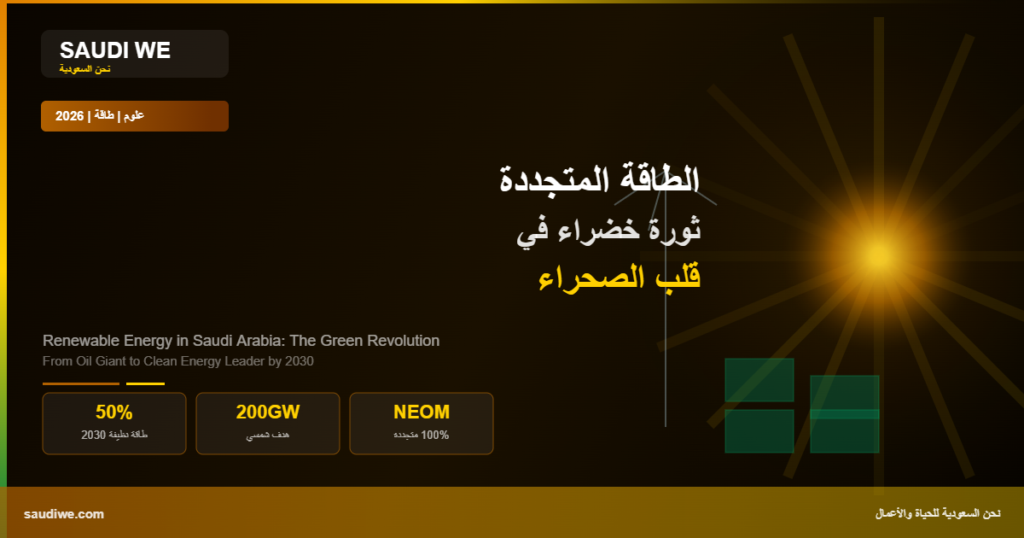
What seemed like a distant dream just two decades ago is today a tangible reality visible with the naked eye in every corner of Saudi Arabia. Solar panels gleaming beneath the blazing desert sky, wind turbines turning tirelessly in the Kingdom’s highest elevations, and ambitious plans boldly announcing that the Kingdom which built its glory on oil is redrawing its future in the colors of clean energy. Renewable energy in Saudi Arabia is not merely an economic choice — it is a strategic bet on the future of the planet and the future of coming generations simultaneously, a declaration of intent that carries historic significance.
Why Renewable Energy When Saudi Arabia Has the World’s Largest Oil Reserves?
An observer might ask: why does Saudi Arabia — possessing the world’s largest proven oil reserves — seek to transition toward renewable energy? The answer is multifaceted and profound. First, a large portion of Saudi oil production is consumed domestically to generate electricity and operate desalination plants, consumption that escalates with population growth. Generating electricity from solar and wind frees this oil for export and increases revenues. Second, Saudi leadership recognizes that a world moving toward decarbonization requires diversifying income sources and not relying on a single resource no matter how abundant. Third, the Kingdom possesses sun and wind resources sufficient to make it a global source of clean energy in the same way it was a source of oil — but this time, the commodity will never run out.
Major Solar Energy Projects in Saudi Arabia
Saudi Arabia possesses success factors in the solar energy sector that most countries in the world cannot match. Exceptional sunshine hours exceeding 3,000 annually, vast desert expanses available for solar farm construction, and an absence of cloud cover for most of the year. The Kingdom has invested these natural advantages through gigantic projects, most prominently the NEOM integrated solar energy project within the city of the future, and the Sudair Solar Project considered one of the largest solar projects in the Middle East. These projects are already delivering measurable contributions to Saudi electricity supply, demonstrating that the transition from fossil fuel dependence is not merely theoretical but practically achievable at massive scale.
NEOM: The Clean City of the Future
NEOM is the most ambitious project in Saudi Arabia’s history, designed from the ground up to operate on 100% renewable energy. Designs include massive solar farms, offshore wind farms, and advanced energy storage systems. NEOM does not merely present an advanced city — it embodies a living model proving the possibility of building complete, sophisticated urban environments operating entirely on clean energy. This model may well be emulated by future cities in various parts of the world, giving Saudi Arabia a role as a pioneer of sustainable urban living rather than simply a beneficiary of fossil fuel wealth.
Wind Energy: The Hidden Treasure
Although solar energy occupies the forefront of collective thinking when Saudi Arabia and renewable energy are mentioned, wind energy represents a hidden treasure that Saudi planners are beginning to harness. Mountainous regions such as Tabuk and the northwest possess excellent wind speeds that promise onshore and offshore wind farms with high productive capacity. The first projects have already launched and confirm the economic feasibility of this investment in light of the continuous global decline in wind turbine costs — making wind power increasingly competitive even against the Kingdom’s own abundant oil resources.
Green Hydrogen: Saudi Arabia’s Fuel of the Future
Saudi Arabia is placing a major bet on green hydrogen as the fuel of the future that will revolutionize the transportation and industrial sectors. Green hydrogen is produced using electricity generated from renewable energy to electrolyze water into its components, with the resulting hydrogen serving as a clean fuel whose combustion emits nothing but water vapor. NEOM includes the world’s largest green hydrogen plant, developed in cooperation with Saudi energy giant Aramco and several international companies. The Kingdom aspires to export green hydrogen to Europe and Asia in the near future, replicating the success of its oil experience — but this time with a fuel that does not pollute our planet or accelerate the climate crisis.
The National Renewable Energy Program and Its Goals
Saudi Arabia launched the National Renewable Energy Program with ambitious and clear objectives: raising renewable energy’s share to 50% of the electricity mix by 2030, and reducing carbon dioxide emissions by 278 million tons annually. The program seeks to attract investments of hundreds of billions of dollars and create hundreds of thousands of jobs for Saudi citizens in the clean energy sector. These goals are not mere slogans — they are commitments governed by detailed implementation plans and precise timelines monitored regularly at the highest levels of Saudi government and verified through transparent international reporting mechanisms.
Energy Storage: The Critical Missing Piece
One of the most significant technical challenges in the renewable energy transition is storage: the sun doesn’t shine at night, and wind doesn’t always blow with consistent force. Advanced battery technologies, electrochemical storage systems, and green hydrogen itself serve as the promising solutions the Kingdom is actively deploying. Saudi Arabia is investing heavily in grid-scale battery storage facilities and conducting research partnerships with leading global technology companies to develop next-generation storage solutions. Solving the storage equation is the key that will unlock the full potential of Saudi renewable energy resources and enable reliable 24/7 clean electricity supply to the entire Kingdom.
Creating Jobs and Building a Green Economy
Beyond environmental benefits, Saudi Arabia’s renewable energy revolution is creating a new economic foundation aligned with Vision 2030’s diversification goals. The renewable energy sector is generating highly skilled engineering jobs, manufacturing opportunities for solar panels and wind components, project management positions, and research and development careers. Saudi universities are rapidly scaling up their renewable energy engineering programs to supply the domestic talent pipeline. This human capital development ensures that the clean energy transition creates lasting economic value for Saudi citizens — not merely transferring wealth from one foreign technology dependency to another, but building genuine domestic expertise and industrial capability.
💡 Enjoyed this content? Follow energy and sustainability news in the Kingdom on Saudi We — your trusted source for tracking Saudi Arabia’s remarkable transformation journey.