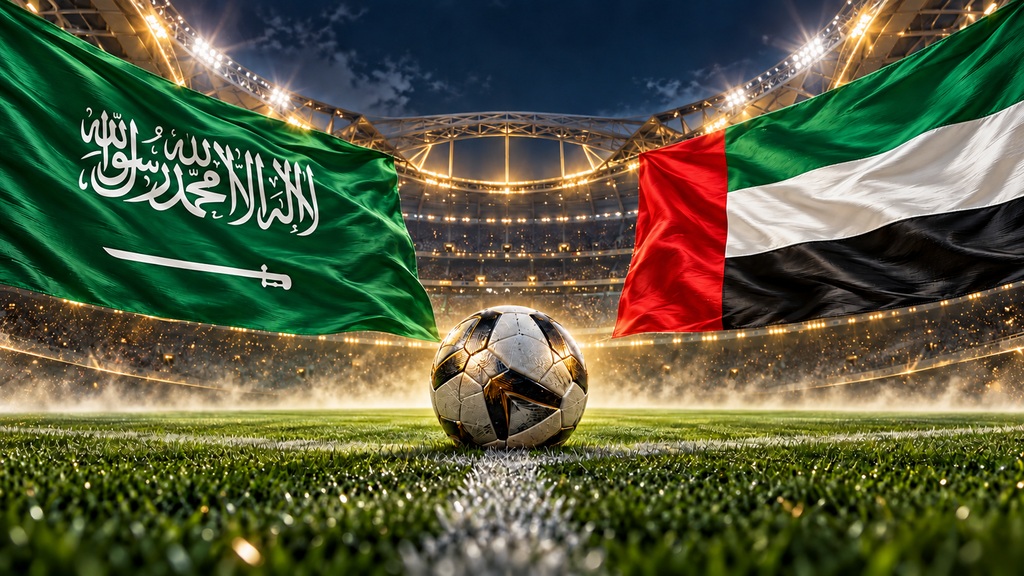

Saudi Arabia have returned to the top of Gulf football, turning a successful home tournament into a championship that supporters can celebrate across generations. The final in Jeddah provided the decisive moment, but the wider story is about a team negotiating different competitive tests and arriving at the end with a trophy. For the Green Falcons, the achievement offers confidence and a useful foundation for the work that follows.
The final took place on Tuesday, October 6, 2026, at Alinma Stadium in King Abdullah Sports City. Saudi Arabia beat the United Arab Emirates 2–0 to claim their fourth title and first since 2004, as confirmed in FIFA’s official Gulf Cup 27 review. The 22-year interval gives the victory its historical significance, while the next stage will determine how effectively the team builds on it.
The final result and individual awards
Hammam Al Hammami scored in the 11th minute and Feras Al Brikan added the second in the 13th. The Saudi Pro League’s championship report also confirmed Al Hammami as best player, Mohammed Al Owais as best goalkeeper and Al Brikan as top scorer. The awards recognized contributions in several areas of the winning team.
Readers who want the background to the fixture can revisit SaudiWe’s earlier final preview. That article explains the occasion before kickoff; this report considers the completed tournament and its implications. The analysis below is SaudiWe’s editorial assessment, rather than a claim to reproduce the coaching staff’s instructions or unpublished match statistics.
Saudi Arabia’s route to the trophy
The following sequence is drawn from the Saudi Arabian Football Federation’s national-team fixture record. It helps place the final within the campaign instead of treating the trophy presentation as the entire story.
| Date | Stage | Result |
|---|---|---|
| September 23 | Group | Saudi Arabia 1–0 Kuwait |
| September 26 | Group | Oman 0–3 Saudi Arabia |
| September 29 | Group | Saudi Arabia 2–0 Iraq |
| October 3 | Semifinal | Saudi Arabia 0–0 Qatar; 3–2 on penalties |
| October 6 | Final | Saudi Arabia 2–0 UAE |
The results produce a total of eight Saudi goals and none conceded across five matches. Shootout kicks are excluded from that scoring total: they settle qualification after a draw and do not become goals in the match score. Keeping those categories separate matters when comparing attacking records or explaining the semifinal to readers.
SaudiWe analysis: why the opening mattered
A two-goal advantage early in a final changes the choices available to both sides. The team in front can decide how much risk to take, while the team behind must find a route back without exposing itself further. This is an interpretation of the score and its timing, not an assertion about a particular formation, possession percentage or tactical instruction that has not been documented.
The difference between one early goal and two in quick succession is substantial. One goal creates an advantage; a second makes the next mistake more expensive for the trailing side. Yet a comfortable-looking score can create its own danger if the leaders retreat too far and surrender every opportunity to relieve pressure. Protecting a lead requires the balance to defend sensibly while retaining a credible attacking threat.
That makes the final a test of managing an advantage as well as earning one. Football continues to offer set pieces, transitions and moments of pressure after the scoreboard changes. Small decisions can help preserve a result or make it more difficult to control. The completed score confirms Saudi Arabia maintained their lead, but it cannot describe every passage of the remaining game on its own.
A defensive record built by the group
A clean sheet rightly draws attention to the goalkeeper, but defending is a connected activity. A forward can influence where an opponent plays the next pass. A midfielder can cover a space before it becomes a problem. A defender can prevent the final ball from reaching its target. The goalkeeper then provides the last response when the earlier layers are tested.
For that reason, the most useful reading of a strong defensive record looks beyond one position. It asks how the team moves together after losing possession, whether players communicate effectively and how well they protect dangerous areas. These are general football principles, rather than claims that specific training instructions were issued during this tournament.
The headline number also has limits. Conceding no goals does not reveal how many chances opponents created, how dangerous those chances were or how much work the goalkeeper performed. A deeper evaluation would require footage and reliable shooting data. What the recorded results do establish is that Saudi Arabia had a defensive foundation capable of supporting progress through different stages of the competition.
The Qatar test adds another dimension
The Saudi Press Agency’s final preview confirmed that the semifinal remained goalless through regulation and extra time before the shootout. Our Saudi Arabia–Qatar semifinal coverage provides further background to that fixture.
A match that extends beyond normal time creates a different challenge from a victory secured earlier. Players must continue making decisions as fatigue accumulates, while substitutes need to understand the state of the contest quickly. A shootout then reduces the immediate task to individual attempts under concentrated pressure. Advancing through that situation adds an experience of composure without making penalties a complete measure of team quality.
The contrast between the last two rounds is instructive. One contest required patience before its deciding process; the other offered an early advantage to protect. Tournament football rarely presents exactly the same problem twice. A team’s ability to respond to changing scenarios can therefore matter more than reproducing an identical rhythm in every match.
What the awards mean beyond the ceremony
Individual recognition helps supporters identify players who made important contributions. It should also be placed inside the collective achievement. The final touch on an attacking move often follows several useful decisions elsewhere, while successful defending includes work that a short highlight package may never show. Awards and teamwork are complementary ways of understanding a championship.
Recognition also changes the demands on a player. Attention grows, expectations become more visible and future performances are compared with a memorable tournament. Sustained development depends on readiness, consistent habits and a measured response to praise. For the national team, the sensible challenge is to preserve confidence while continuing to select players according to present performance and the requirements of each opponent.
A fourth title connects different generations
A long wait gives a championship an emotional reach beyond the final itself. Some supporters remember previous success vividly, while others experience a Gulf title as a defining moment in their own football lives. A home victory can connect those groups through a shared memory, giving the players a relationship with the crowd that extends beyond a single result.
Celebration need not bring evaluation to a halt. Successful teams still benefit from asking what can be repeated and what depends on circumstances. The answers involve preparation, competition for places, decision-making and the management of playing time and recovery. A trophy provides motivation; the work after the ceremony determines whether that motivation becomes durable performance.
Building toward the next challenge
Saudi Arabia’s hosting of the Asian Cup creates a different competitive setting, with a wider range of opponents and playing styles. Readers can explore SaudiWe’s coverage of the 2027 Asian Cup preparations for that broader context. A Gulf championship improves confidence, but it does not predetermine the outcome of another tournament.
In our assessment, the next review should connect three questions. How good are the chances the team creates? How does it respond when the score or the opponent’s pressure changes? And how many players are ready to fulfil a clear role? Those questions are more useful than assuming the same conditions will appear again simply because a recent campaign ended successfully.
- Review the spaces left after possession is lost and the speed of the collective response.
- Develop different routes to goal, including combinations between the lines and effective set pieces.
- Maintain meaningful competition for positions while giving players responsibilities that can be evaluated.
- Coordinate physical readiness and recovery with clubs so a demanding schedule supports rather than interrupts continuity.
These are editorial priorities for following the team’s development, not an announced official plan or a guaranteed forecast. They give supporters a practical framework for the coming matches: look for balance, repeatable chance creation and the ability to adjust when the opening does not go perfectly. Evidence gathered over those matches will be more informative than a sweeping judgement made during the celebration.
Jeddah nevertheless deserves to be remembered for what was achieved there. Saudi Arabia reached the decisive match, won it and gave their supporters a long-awaited championship. The next responsibility is to carry that confidence into everyday preparation, turning a successful tournament into habits that remain useful when the circumstances, pressure and opposition change.