
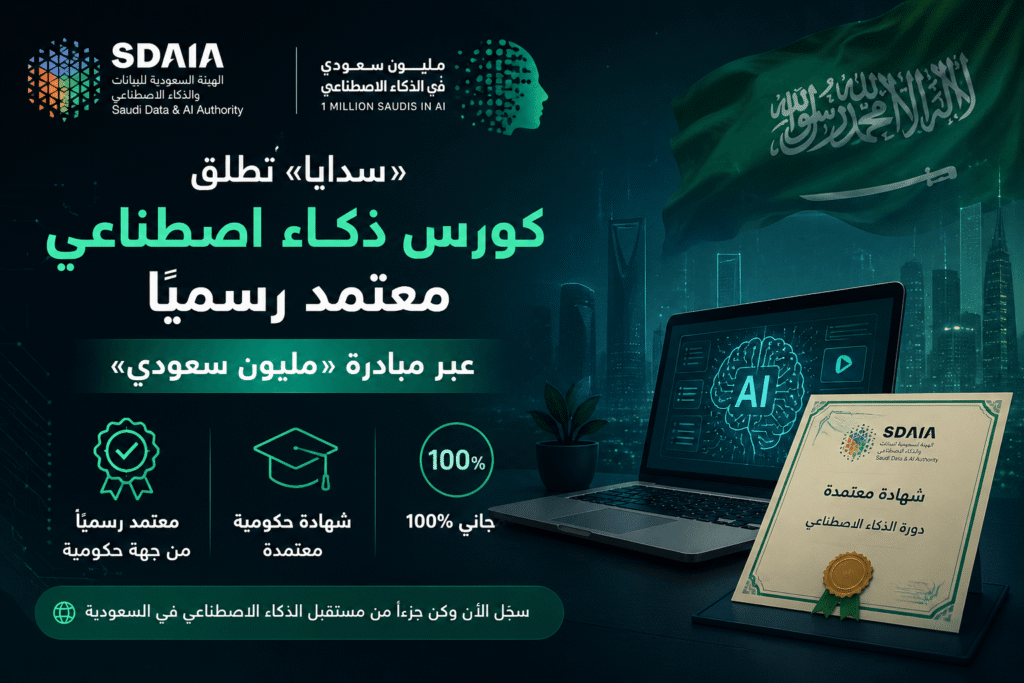
Artificial intelligence has quietly moved from a conference buzzword to a baseline workplace skill. Recruiters ask about it, managers measure productivity by it, and entire government workflows are being redesigned around it. In Saudi Arabia, that shift is not being left to individual improvisation: the Saudi Data & AI Authority (SDAIA) runs a national programme known as SAMAI — One Million Saudis in AI, which delivers fully free, remote AI training and awards a certificate accredited by a Saudi government authority upon successful completion.
This guide walks through what the course actually is, how it is delivered, what the certificate is worth, how to register step by step, and a realistic four-week plan to finish it without disrupting your job or studies. Everything below is based on the initiative’s official pages.
Quick summary: the course at a glance
- Organiser: SDAIA, in collaboration with the Ministry of Education and the Ministry of Human Resources and Social Development.
- Cost: 100% free. There is no enrolment fee and no charge to issue the certificate.
- Format: Delivered remotely through a self-paced learning model.
- Duration: Flexible. The foundational track can comfortably be completed in around four weeks at a few hours per week.
- Language: The content is available in Arabic, with standard English technical terminology retained.
- Certificate: A certificate accredited by SDAIA on successful completion of the programme.
- Who it is for: Saudi citizens interested in learning artificial intelligence, across all ages and professions.
- Official registration: samai.futurex.sa
What exactly is the SAMAI initiative?
SAMAI is the short name for “One Million Saudis in AI”, a national initiative launched by SDAIA together with the Ministry of Education and the Ministry of Human Resources and Social Development. Its stated goal is to train one million citizens in AI skills and knowledge, supporting national capacity building and advancing the objectives of Saudi Vision 2030.
According to the official initiative page, the programme is designed to international standards and delivered remotely through self-paced learning, which lets participants schedule the training material around their own commitments. That detail matters more than most news coverage suggests: there is no fixed lecture time to miss and no classroom attendance requirement. You move at your own speed, and the platform keeps your progress.
The initiative’s objectives are officially framed around three pillars: raising awareness of AI and its role in development across sectors, promoting lifelong learning by keeping AI education open to every age group and profession, and aligning national talent with real labour-market demand.
Why registering now is a smart move
SAMAI is not an announcement that stayed on paper. Official communications published through Saudi Arabia’s Unified National Platform marked the milestone of one million citizens empowered in artificial intelligence, following broad participation from across the Kingdom’s regions. A second phase, SAMAI 2, was then launched with a focus on enabling the workforce in targeted government sectors to use AI practically and responsibly while lifting productivity.
In other words, this is not a one-off awareness campaign but a national track that keeps gaining weight year after year. As AI becomes the headline of the Kingdom’s technology agenda, holding a government-accredited AI certificate has shifted from a nice-to-have differentiator to something closer to a default expectation, particularly in the public and semi-public sectors.
What you will actually learn
The initiative offers specialised training programmes designed to raise participants’ knowledge level. The foundational material typically centres on the concepts any non-specialist needs in order to work confidently alongside these tools:
- AI fundamentals: the difference between artificial intelligence, machine learning and deep learning, and how systems learn patterns from data.
- Generative AI: how large language models work, and how to write clear, specific prompts that produce useful output instead of generic filler.
- Ethics and responsible use: data bias, the limits of trusting model output, privacy considerations, and professional accountability when tools are used at work.
- Practical applications: using AI for data analysis, reporting, customer service, teaching, marketing and everyday task management.
- Sector use cases: examples from healthcare, education, government services and the private sector that help you connect concepts to your own role.
Because the platform updates its catalogue and adds new modules and tracks over time, the most reliable way to see what is currently offered — and how long each unit takes — is to check the programme details page after signing in.
How much is the certificate worth?
The official FAQ states plainly that trainees receive a certificate accredited by the Saudi Data & AI Authority once they successfully complete the training programme. That distinction is substantive rather than cosmetic: SDAIA is the national reference authority for data and AI in the Kingdom, so the credential comes from the body that regulates the sector itself, not from a commercial platform of unclear standing.
It is equally fair to say what the certificate does not do. It is a foundational, awareness-and-enablement credential — not a substitute for specialised professional certifications in data engineering or machine learning, and not a guarantee of employment on its own. Its real value is that it opens the door, signals seriousness to an employer, and gives you a solid base to build deeper specialisation on later.
How to register, step by step
- Go to the official platform at samai.futurex.sa, or reach it from the initiative page on the SDAIA website so you know the link is genuine.
- Choose to register or create a new account if you do not already have one on the platform.
- Complete your account details and verify your email or mobile number as prompted.
- Sign in and browse the available tracks and programmes.
- Enrol in the foundational AI track and start the first module straight away.
- Work through the modules and short assessments until you reach the required completion rate.
- Download your certificate from your dashboard once the programme is successfully completed.
If you hit a technical issue or have a question about the certificate, the official contact channel published on the SDAIA initiative page is the email address samai@sdaia.gov.sa.
A realistic four-week completion plan
The strength of self-paced learning is flexibility; its weakness is that it slides easily into “I will finish it later”. Here is a schedule that costs roughly three to four hours a week:
- Week one: create your account, finish the core concept modules, and keep a single running file of new terminology.
- Week two: work through generative AI and prompting modules, and apply what you learn to one real task from your job.
- Week three: cover ethics, privacy and responsible use — the most important section for anyone in a government role or handling customer data.
- Week four: finish remaining modules, review quickly, sit the final assessment, then download the certificate and add it to your CV and professional profile.
Who benefits most?
The initiative is aimed at citizens interested in learning AI, but the return is highest for a few specific groups: government employees whose entities are already introducing AI tools into their processes, teachers who want to use AI for lesson preparation and assessment, university students building a professional profile before graduation, small business owners trying to reduce operating costs, jobseekers who need a clear differentiator, and freelancers whose income depends on speed and output quality.
An important warning about unofficial links
Every widely publicised government initiative attracts accounts and websites offering to “register on your behalf” or selling assessment answers. Registration is completely free and needs no intermediary, and you will never be asked for a bank card at any step. Never share your Nafath verification code or your password with any person or page, and rely only on links published on SDAIA’s government website and the Unified National Platform.
Frequently asked questions
Is the course really free?
Yes. The training is delivered free of charge as part of a national initiative, with no registration fee and no cost to issue the certificate.
Is the content in Arabic?
Yes, the material is available in Arabic while keeping recognised English technical terms, and some tracks may also be available in English.
Do I need a programming background?
No. The foundational track is built for non-specialists and starts from first principles, assuming no prior coding or advanced mathematics.
How long does it take?
There is no binding timetable because the learning is self-paced and remote. Most participants finish the foundational content within a few weeks; around four weeks at a light pace is a realistic target, and it can be done faster with more focus.
Is the certificate recognised?
The certificate is issued and accredited by SDAIA, a Saudi government authority, and can be attached to your CV and professional profiles.
Is the initiative open to residents?
The officially stated audience is Saudi citizens. For any update on eligibility, check the official initiative page or contact the initiative’s official email.
The bottom line
A free, remote, Arabic-language training programme carrying a certificate from a Saudi government authority is not the kind of opportunity worth postponing. The real cost is a handful of hours spread over a few weeks; the return is a skill that has quietly become an implicit hiring requirement. If you are hesitating, just create the account and finish the first module — that is usually the step that breaks the procrastination.
To register and review the available tracks, head to the official platform at samai.futurex.sa, or read the official SAMAI initiative page on the SDAIA website.
Note: all information above is drawn from official Saudi government sources (the SDAIA website and the Unified National Platform) as of the publication date of this article. Track details and durations are subject to change by the organising authority, so always confirm with the official source before registering. This article is informational and is not affiliated with any government entity.