
id=”ceer-exobot-saudi-electric-cars-specifications-release-date-and-everything-we-know”>CEER Exobot Saudi Electric Cars: Specifications, Release Date and Everything We Know
Last updated: September 24, 2026
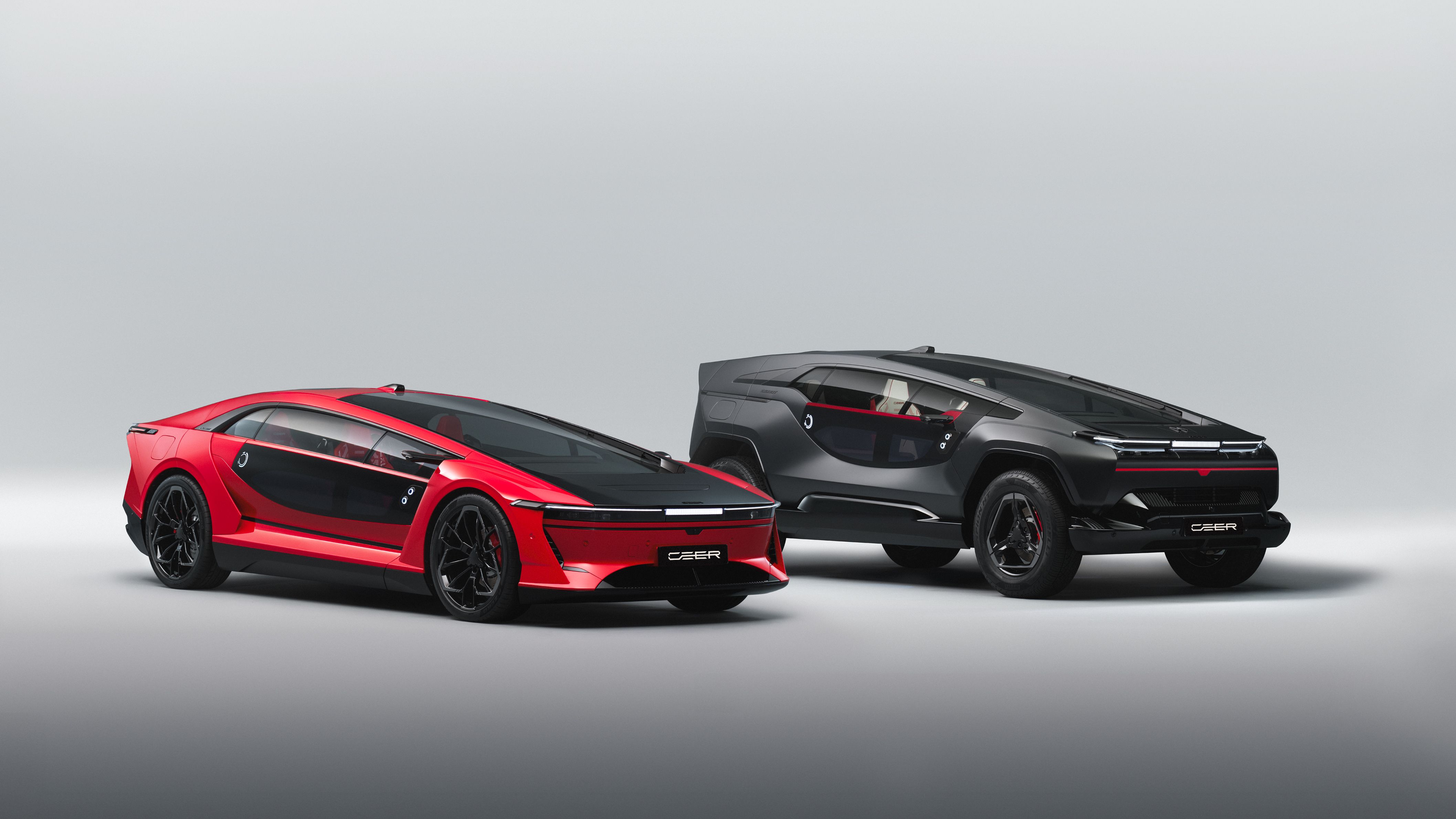
Saudi Arabia’s plan to build its own automotive industry has moved beyond factories, supplier contracts and long-term targets. CEER has unveiled Exobot, a premium electric vehicle platform that will launch with two models: a low-slung sedan and a sport utility vehicle. Both are being presented as vehicles designed, developed and manufactured in Saudi Arabia, making their arrival significant for buyers as well as the Kingdom’s industrial strategy.
The headline numbers are ambitious. The Exobot First Edition uses a three-motor all-wheel-drive system producing 850 horsepower and 1,000 Nm. CEER has also announced a higher platform specification with as much as 1,111 hp and 1,500 Nm, although its final price and availability have not been detailed. The First Edition sedan is claimed to accelerate from zero to 100 km/h in 2.6 seconds, while the SUV takes 2.9 seconds. Both use a 112 kWh NCM battery and an 800-volt electrical architecture.
This guide separates confirmed information from assumptions and explains what the published specifications could mean in everyday Saudi driving conditions.
CEER Exobot specifications at a glance
| Specification | Exobot Sedan | Exobot SUV |
|---|---|---|
| Powertrain | Three motors, all-wheel drive | Three motors, all-wheel drive |
| First Edition output | 850 hp | 850 hp |
| 0–100 km/h | 2.6 seconds | 2.9 seconds |
| Battery | 112 kWh NCM | 112 kWh NCM |
| Estimated range | 670 km NEDC | 560 km NEDC |
| 10–80% charging | Under 30 minutes | Under 30 minutes |
| Electrical architecture | 800 volts | 800 volts |
| Announced availability | First Edition during 2027 | First Edition during 2027 |
These are manufacturer figures and may vary by trim, wheel size and conditions. The range numbers use the NEDC test cycle. They should not be compared directly with WLTP or EPA figures without accounting for the different testing methods, and they should not be treated as a promise of identical range on every journey.
What is CEER, and what is Exobot?
CEER was established in 2022 by Saudi Arabia’s Public Investment Fund. It works with Foxconn and a network of domestic and international technology and component suppliers. Its stated objective is not merely to import a finished vehicle and apply a local badge, but to establish capabilities in design, engineering, manufacturing and supply-chain development.
Production is planned at the CEER Industrial Complex within the King Salman Automotive Cluster in King Abdullah Economic City. That location places the company inside a developing automotive ecosystem rather than at an isolated assembly site.
Exobot is the name of CEER’s performance-focused vehicle platform and the first family to emerge from the project. The sedan and SUV are the first two of seven releases that the company plans over five years. That wording does not necessarily mean seven completely unrelated nameplates, as releases may include additional body styles or versions. Exact future products will need to be confirmed individually.
Three motors and up to 850 horsepower
The Exobot First Edition uses three electric motors with all-wheel drive and produces 850 hp and 1,000 Nm. A multi-motor arrangement can distribute torque between axles rapidly, supporting acceleration, traction and cornering stability. CEER’s claimed zero-to-100 km/h times—2.6 seconds for the sedan and 2.9 seconds for the SUV—place the pair firmly in high-performance territory. CEER has separately announced a higher 1,111 hp, 1,500 Nm specification, capable of 2.1 seconds for the sedan and 2.4 seconds for the SUV; it should not be confused with the launch First Edition.
Acceleration, however, is only one part of the ownership experience. Saudi drivers will also want to know how consistently the powertrain performs in extreme heat, how much performance remains at a low state of charge, and how effectively the thermal management system handles repeated acceleration and fast charging. Those questions require independent testing of production cars.
The announced chassis equipment includes rear-wheel steering, dual-chamber air suspension and selectable driving modes. Rear steering can reduce the turning circle at low speeds and improve stability at higher speeds. Air suspension can provide a wider balance between comfort and body control. Hardware alone does not guarantee a polished drive, though; software tuning and calibration will determine whether those systems feel natural on real roads.
Battery and range: understanding the 670 km claim
The Exobot platform uses a 112 kWh nickel-cobalt-manganese battery. CEER estimates that the sedan will cover 670 km and the SUV 560 km under the NEDC cycle. The sedan’s lower body and likely aerodynamic advantage help explain its longer official figure despite the shared battery capacity.
Real range will depend on speed, outside temperature, air-conditioning load, elevation changes, passenger and luggage weight, tire pressure and wheel choice. Sustained motorway driving can use energy faster than a laboratory cycle, while hot conditions require the vehicle to cool both the cabin and its high-voltage components. The published figure is therefore most useful as a standardized reference within the same test system.
A practical driver rarely uses the full battery from 100% to zero. A long trip might begin at 90% and include a charging stop at 15%, leaving an intentional safety margin. Once deliveries start, local tests should reveal how many kilometres the sedan and SUV cover across that usable window on Saudi motorways and in urban traffic.
800-volt charging and the under-30-minute figure
CEER says the battery can charge from 10% to 80% in under 30 minutes. The 800-volt architecture is important because it can support high charging power while controlling current and heat, and it also benefits a performance-oriented drivetrain.
The result will not be identical at every public charger. Charging time depends on the station’s available output, battery temperature, the starting state of charge, site load and the vehicle’s charging curve. Fast-charging power normally falls as the battery approaches a high state of charge, so charging from 80% to 100% can take disproportionately longer.
Home charging is slower but often more convenient because the car can recover daily driving range overnight. CEER lists a wall charger and installation among the benefits of the limited First Edition. Buyers should check the installation conditions, electrical capacity, parking arrangement and warranty terms once final order information becomes available.
Distinctive design and upward-opening doors
CEER is giving Exobot a recognizable shape rather than relying on a badge to create an identity. The vehicles feature a broad glass area, clean surfacing and dramatic upward-opening doors. The pillarless visual treatment helps create a bright, open cabin and a striking entrance.
The design will also need to prove itself in ordinary situations. Owners will want to test access in narrow parking spaces, door operation under low ceilings, seal quality, wind noise and long-term mechanism durability. A large glazed area raises additional questions about solar heat gain and how quickly the climate-control system can cool the cabin after the vehicle has been parked outdoors.
Cargo capacity, rear-seat headroom and child-seat access have not received as much attention as performance figures. These details will be especially important for the SUV, whose target customer is more likely to treat it as a primary family vehicle.
A digital cabin with Arabic and English voice support
The interior is built around what CEER describes as a wide “digital horizon,” accompanied by three-dimensional navigation and camera-based mirrors. The company also lists a bilingual Arabic and English voice assistant. Strong Arabic recognition, including natural local phrasing, could make the system genuinely useful rather than a feature owners stop using after a few days.
A connected mobile application is expected to provide vehicle and battery monitoring, charging management, cabin preconditioning, remote parking, vehicle location, maintenance and service functions. Preconditioning is particularly relevant in Saudi Arabia because it allows the cabin to cool before passengers enter, ideally while the car remains connected to external power.
Long-term quality will depend on more than screen size. Buyers should look for a clear software-update policy, reliable account protection, rapid interface response, continued navigation support and access to essential controls if mobile data becomes unavailable.
Safety and driver assistance
CEER’s published equipment includes seven airbags and an advanced driver-assistance suite intended for city and motorway use. Listed functions cover lane keeping, lane centering, assisted lane changes, emergency intervention and collision avoidance, as well as an automatic emergency call.
These systems are driver aids, not permission to stop paying attention and not a declaration of unrestricted autonomous driving. Independent crash-test results and detailed system limitations have not yet been published. Testing in dust, intense sunlight and high temperatures will be important because cameras, sensors and cabin electronics must remain dependable in local conditions.
Good assistance is measured by calibration as much as feature count. Warnings should be understandable without becoming intrusive, and steering or braking interventions should be predictable. Owners also need a simple explanation of when each function works and when the driver must take full control.
First Edition versus Exobot Plus
| Item | First Edition | Exobot Plus |
|---|---|---|
| Availability | Limited numbers during 2027 | By the end of 2027 |
| Announced colors | Musk White or Harrat Grey | Wider choice including Silver Sky |
| Interior | Red and black Nappa leather | Partial leather with further options |
| Exterior details | Black package and red brakes | Optional color packs |
| Lower door glass | Switchable tint | Tinted lower glass |
| Ownership package | Wall charger with installation plus warranty/service package | Final package details to be confirmed |
The First Edition is designed for early buyers who value limited-production details and an inclusive ownership package. Exobot Plus appears to broaden customization and offer a more flexible specification. CEER also mentions wheel choices for the SUV, including 20- and 22-inch options. Larger wheels may strengthen the visual stance but can affect ride comfort, tire price and efficiency, so they should be chosen for more than appearance.
Final standard equipment, individual option prices and detailed warranty conditions remain necessary before a meaningful value comparison can be made.
Saudi release date: when will Exobot go on sale?
CEER’s official product page says the First Edition will be available in 2027 and that Exobot Plus will be available by the end of 2027. Reuters reported at the launch that Saudi sales were expected to begin in early 2027. Registration, ordering and physical deliveries can occur on different dates, so an unconfirmed month should not be presented as a guaranteed handover date.
Initial volume may be limited, especially for the First Edition. The company is also planning expansion to nearby markets from 2028 and then more widely across the Middle East and North Africa in subsequent years. The pace will depend on production, homologation, charging access and the development of sales and service coverage.
How much will CEER Exobot cost?
CEER has not published an official Saudi price for either the sedan or SUV as of this update. Any figure circulating without a company price list or live ordering page is speculation. The battery size, performance and cabin technology clearly position Exobot as a premium product, but they are not enough to calculate an accurate retail price.
Buyers should assess the total cost of ownership when official information arrives. That includes VAT, insurance, home-charger work, warranty coverage, maintenance, performance tires and expected resale value—not just the amount on the first invoice. A service plan or charger included with one trim can also change the effective comparison.
Why Exobot matters beyond a new car launch
The Public Investment Fund expects CEER to contribute more than SAR 30 billion to Saudi GDP, improve the trade balance by approximately SAR 80 billion and create direct and indirect employment through 2034. CEER has also announced substantial local supply agreements, signaling an effort to build value around components and services instead of limiting the project to final assembly.
Those targets are projections, not completed results. Success will be judged by production quality, the depth of local supplier participation, skills transfer, workforce development, export competitiveness and the ability to scale without sacrificing reliability. If those pieces come together, Exobot may become the visible front end of a much broader industrial ecosystem.
How might Exobot fit into the premium EV market?
On paper, the combination of 850 hp, rapid acceleration, air suspension, rear steering and a large battery puts Exobot in conversation with high-end electric products from established global manufacturers. That does not mean the vehicles are direct equivalents. Brand history, service reach, software maturity, charging performance, resale values and independent safety results all affect the ownership proposition.
CEER’s distinctive advantage is its Saudi identity and the opportunity to tune the product and support network for regional conditions. Its challenge is that a new manufacturer must earn trust through consistent build quality and responsive service. Early owners will effectively test not only the vehicle but the entire customer-care system.
Readers following Saudi technology and industrial developments can also see our guide to the Saudi unified industrial security platform and our coverage of the iPhone 18 Pro price in Saudi Arabia.
Who should consider a CEER Exobot?
Exobot may suit a buyer seeking strong performance, modern connected features and a vehicle associated with Saudi manufacturing. It will make the most sense for owners who can install a home charger or have dependable access to fast charging. The sedan prioritizes maximum stated range and sharper performance, while the SUV exchanges some range for a taller, more practical format.
Anyone who needs a car immediately or requires a precise ownership budget should wait for the final price, insurance quotations, warranty details, service locations and independent road tests. Supporting a local product and making a careful purchase decision are compatible: enthusiasm should still be matched by evidence.
Frequently asked questions
Is Exobot really a Saudi car?
CEER describes the sedan and SUV as designed, developed and manufactured in Saudi Arabia. The project uses international technology partners and suppliers alongside a growing local supply chain, with production planned in King Abdullah Economic City.
Has the official price been announced?
No. There was no official Saudi retail price for either Exobot model as of September 23, 2026. Unofficial numbers should not be treated as confirmed.
When will deliveries begin?
The limited First Edition is scheduled for 2027, with launch reporting pointing to sales beginning early in the year. Exobot Plus is due by the end of 2027. CEER must still confirm precise reservation and delivery dates.
What is the official range?
CEER quotes 670 km for the sedan and 560 km for the SUV under NEDC testing. Actual driving range will vary, and the figures are not directly interchangeable with WLTP or EPA ratings.
How quickly can it charge?
The company claims a 10% to 80% charge in under 30 minutes under suitable conditions. Charger output, battery temperature and the charging curve will affect the result.
Is Exobot a self-driving car?
CEER lists a broad suite of driver-assistance features, but these remain assistance systems. The driver retains responsibility and must follow the operating limits published with the production vehicle.
The bottom line
The Exobot sedan and SUV give CEER’s plans a tangible form. Their confirmed specifications are compelling: 850 hp in the First Edition and up to 1,111 hp in the higher announced specification, three-motor all-wheel drive, a 112 kWh battery, 800-volt architecture and an official NEDC range reaching 670 km. Planned Saudi production also gives the program economic relevance beyond the premium-car market.
Important questions remain unanswered. Price, real-world efficiency, full warranty terms, service reach and final production quality will determine whether Exobot delivers on its promise. For now, it is one of the most consequential Saudi automotive launches to watch in 2027—but the fairest verdict will come after customer deliveries and independent testing in the Kingdom.
Sources: CEER’s official Exobot information, the Public Investment Fund’s launch announcement and Reuters reporting. Details will be updated when CEER publishes final pricing and ordering dates.