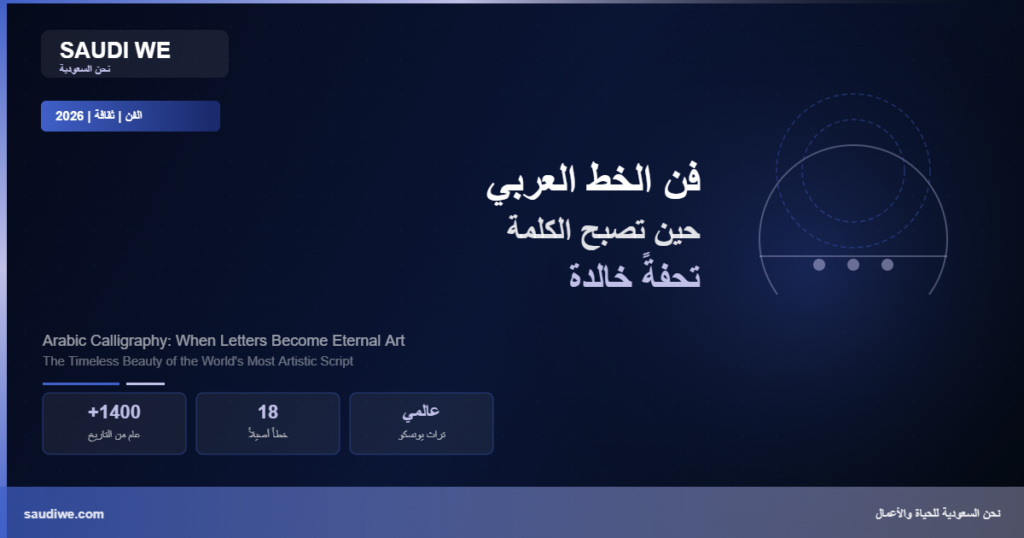
Since the dawn of Islamic civilization, Arabic calligraphy has occupied an unparalleled place among the visual arts of the world. It is not merely a tool for writing — it is a refined visual art that embodies beauty in its highest form and expresses the Islamic spirit in its deepest manifestations. In an era of digital speed and screen dominance, the value of Arabic calligraphy has risen remarkably. It is being rediscovered as a unique bridge between authenticity and modernity, between a rooted identity and openness to the world’s endless possibilities.
The History of Arabic Calligraphy: A Journey Through the Centuries
The roots of Arabic calligraphy extend to the seventh century CE, when the need to write the Holy Quran in the finest and most beautiful manner gave rise to refined and diverse calligraphic schools. Calligraphy began in its angular Kufic form before evolving over the centuries to encompass multiple styles including Naskh, Thuluth, Diwani, Ruq’a, Ijaza, Persian, and others. Each style carries its own history, philosophy, and unique aesthetic character. Great calligraphers such as Ibn Muqlah, Ibn al-Bawwab, and Yaqut al-Musta’simi established the foundations of this noble art and set its precise standards — standards that remain authoritative and revered to this day.
The Major Styles of Arabic Calligraphy
Arabic calligraphy encompasses a rich diversity of styles, each possessing its distinctive character and unique aesthetic. Thuluth script is considered the most refined and expressive, used for headings and the decoration of mosque niches. Naskh is the most widespread and commonly used in books and publications due to its clarity and readability. Diwani, with its beautiful geometric complexity, was historically used in official Ottoman state documents. Ruq’a serves as the everyday script of rapid daily writing, while Persian calligraphy is distinguished by its poetic fluidity and elegant incline. This rich diversity makes Arabic calligraphy an expansive creative field that never exhausts its possibilities.
Thuluth: The Crown of Arabic Scripts
Thuluth script is considered the crown of Arabic calligraphy and the most prestigious of all styles. It is characterized by its infinite variety in letter formation and its ability to combine geometric rigor with free-flowing movement simultaneously. Mastering it requires years of continuous practice, as each letter accepts multiple formations that vary according to context and compositional arrangement. The most beautiful Thuluth compositions adorn the entrances of great mosques, government buildings, and museums throughout the Islamic world, and are acquired at international art auctions for substantial sums.
Kufic Script: The Origin of All Arabic Scripts
Kufic script is the original ancestor of all Arabic scripts, having emerged in the Iraqi city of Kufa in the early period of Islam. It is characterized by its sharp angles and straight horizontal and vertical lines that give it a uniquely geometric character. Ornamental Kufic was later developed to include complex geometric interlacings forming astonishing visual patterns reminiscent of inexhaustible Islamic mosaics. Ornamental Kufic is used today in contemporary visual arts, logo design, and digital artworks, enjoying a remarkable renaissance among younger generations of designers and artists.
Arabic Calligraphy in Saudi Arabia: A Deep-Rooted Presence
The Kingdom of Saudi Arabia holds an exceptional calligraphic heritage, as it encompasses Mecca and Medina — the spiritual direction of Muslims around the world — where the name of God and verses of the Holy Quran are written in the most magnificent calligraphic forms by the most skilled calligraphers in existence. Associations and clubs specializing in teaching Arabic calligraphy and presenting it to new generations are active throughout the Kingdom. Competitions and exhibitions are organized annually, bringing together the foremost calligraphers from across the Arab and Islamic world. The contemporary Saudi calligraphic school is beginning to forge its own distinct identity, one that unites profound religious depth with genuine formal innovation.
Contemporary Calligraphy: When Heritage Meets Modernity
In recent decades, the art of Arabic calligraphy has undergone a radical transformation that has redefined its boundaries and possibilities. Young artists have moved toward merging traditional calligraphy with digital printing techniques, graffiti, installation art, and video art. What has come to be known as “contemporary calligraphy” or “calligraffiti” was born — a movement that has spread across major Arab cities including Dubai, Riyadh, Cairo, and Beirut. This movement transferred calligraphy from papers and formal walls to the public space, walls, and streets, making art accessible to all without exception and creating a genuine revolution in how this authentic and ancient art is experienced by contemporary audiences.
Learning Arabic Calligraphy: The Path of Patience and Mastery
Learning Arabic calligraphy is a journey that demands patience, perseverance, and consistent daily practice. Students typically begin by learning simpler scripts such as Ruq’a and Naskh before advancing to more complex styles like Thuluth and Diwani. The traditional Arabic reed pen remains the calligrapher’s preferred instrument, and the angle, pressure, and speed of movement create the subtle differences between ordinary work and exceptional creations. Today, online courses are available for anyone wishing to learn this noble art from anywhere in the world, significantly expanding the circle of those interested in and devoted to this ancient tradition.
Arabic Calligraphy in the Global Art Market
The Arabic calligraphy market is witnessing growing momentum at international auctions. In recent years, rare calligraphic works have been sold for hundreds of thousands of dollars at prestigious auction houses such as Sotheby’s and Christie’s. International collectors from Europe, Asia, and the Americas are now competing to acquire works by Arab calligraphers, particularly those combining artistic authenticity with spiritual depth. This growing international interest reinforces the recognition of Arabic calligraphy as a shared human heritage deserving preservation, care, and introduction to all future generations of humanity — a living testimony to civilization’s capacity for transcendent beauty.
💡 Enjoyed this content? Explore more cultural and artistic articles on Saudi We — your gateway to understanding Saudi culture in all its depth and richness.